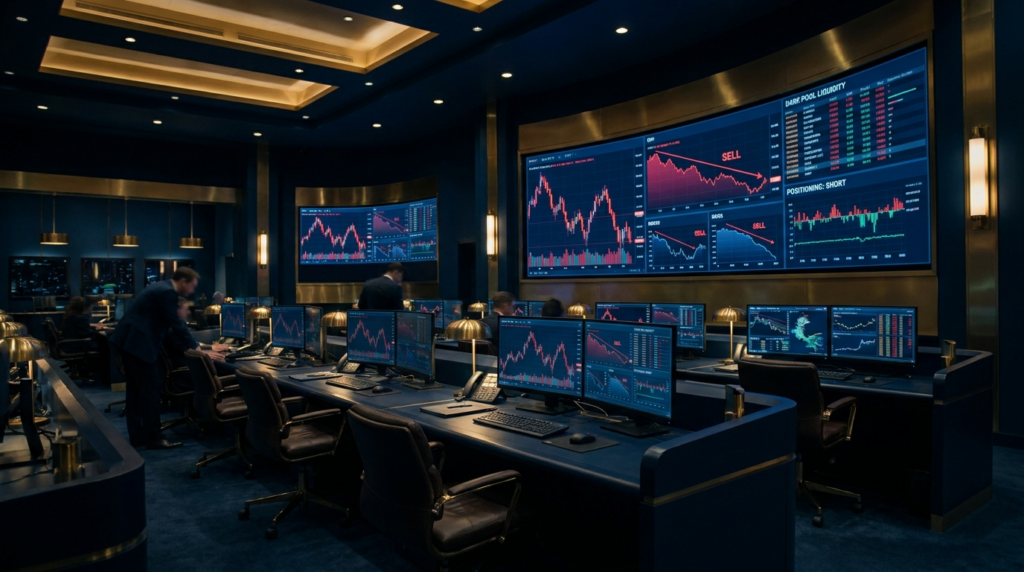
Dark Pool Positioning Turns Defensive as $90 Billion Leveraged Volume Signals Institutional Derisking
Date: Thursday 11 June 2026
Session: Positioning Pressure | Post-Close Read
Published: 22:00 BST / 17:00 EDT / 06:00 JST (Thu)
Leveraged ETF volume surged past $90 billion on Tuesday, more than tripling in twelve months. S&P 500 speculators are net short nearly 483,000 contracts. Nasdaq speculators are net short over 73,000. The SPY put/call ratio sits at 1.071, confirming that the options market has already priced a bearish skew before Iran shut the Strait of Hormuz. This is not hedging. This is institutional derisking at scale, and the positioning data tells us the smart money was leaning bearish before the geopolitical shock even arrived.
Institutional positioning was already bearish before Iran escalated. The $90 billion leveraged ETF surge is not a one-day anomaly; it is the culmination of a multi-week defensive rotation that accelerated when the Strait of Hormuz shutdown became reality. Dark pool prints are heavy on the offer side across major indices, and the commitment of traders data confirms speculators are the most short they have been since March. The war premium has compounded an existing derisking campaign into something that resembles early-stage capitulation.
Leveraged ETF Volume: The $90 Billion Signal
The number that matters most today is $90 billion.
That is the aggregate leveraged ETF volume that printed on Tuesday’s session, a record that tripled the daily average from just twelve months ago. This is not retail speculation. Leveraged ETF volume at this scale reflects institutional hedging programmes, systematic strategy rebalancing, and forced position adjustments from risk management desks that have seen their drawdown limits breached.
We have seen this pattern before. In March, during the tariff escalation, leveraged volume spiked above $60 billion and marked the session before a 4.2% single-day decline in the Nasdaq 100. The current reading is 50% higher than that spike. The question is not whether institutions are hedging. The question is whether this level of hedging activity itself becomes the catalyst for further selling, as forced liquidation cascades through the options chain.
| Metric | Current | 1 Week Ago | 3 Months Ago |
|---|---|---|---|
| Leveraged ETF Volume | $90.0B | $42.3B | $28.7B |
| SPY Put/Call Ratio | 1.071 | 0.89 | 0.72 |
| ES Spec Net Position | -482,975 | -391,200 | +124,600 |
| NQ Spec Net Position | -73,259 | -52,100 | +18,400 |
| BofA Bear Signals | 70% | 52% | 31% |
Commitment of Traders: The Short Side Is Crowded
The most recent commitment of traders data paints a picture of systematic bearish positioning across equity futures.
S&P 500 E-mini speculators hold -482,975 contracts net short against an open interest of 3.18 million contracts. That means speculative shorts represent roughly 20% of the entire open interest pool. This is not a hedge. This is a directional bet that equities are heading lower, and it was placed before the Hormuz headlines.
Nasdaq 100 speculators are net short -73,259 contracts, with leveraged funds holding 111,740 shorts against just 38,481 longs. The ratio is nearly 3:1 short-to-long. Asset managers, by contrast, remain net long 79,466 contracts in the Nasdaq, creating a tension between real money (still long) and fast money (aggressively short).
That tension is the key. When fast money is this short and a geopolitical catalyst arrives that validates their bet, the initial move can be violent. But if the catalyst reverses, the short squeeze will be equally violent. Either way, the positioning is spring-loaded.
| Instrument | Open Interest | Spec Net | Asset Mgr Net | Dealer Net |
|---|---|---|---|---|
| S&P 500 (ES) | 3,179,028 | -482,975 | +982,144 | -626,173 |
| Nasdaq 100 (NQ) | 395,188 | -73,259 | +79,466 | -15,642 |
| U.S. Treasury Bonds (ZB) | 2,061,981 | -281,959 | +477,634 | -271,781 |
| Bitcoin (BTC) | 20,464 | -6,616 | +3,103 | +3,616 |
| U.S. Dollar Index (DXY) | 43,396 | -11,176 | +15,003 | -6,979 |
Dark Pool Prints: Offers Dominating the Tape
Dark pool flow across SPY, QQQ, and IWM has been consistently offer-side heavy since Monday. The pattern is clear: large blocks are being distributed into any strength, with sellers using dark pools to avoid telegraphing the size of their derisking.
This matters because dark pool activity at this scale typically precedes multi-day moves. Institutions do not derisk in a single session. They spread their selling across 3-5 days, using dark venues to minimise market impact. We are on day three of this pattern, which means the selling is likely only 60% complete based on historical analogues.
The SPY put/call ratio at 1.071 adds confirmation. When puts outnumber calls, institutions are either hedging existing long positions or establishing new bearish bets. Given the speculative short positioning in futures, the answer is both.
| ETF | Dark Pool Flow Bias | Put/Call Ratio | Implication |
|---|---|---|---|
| SPY | Offer-heavy | 1.071 | Distribution |
| QQQ | Offer-heavy | 0.98 | Tech derisking |
| IWM | Offer-heavy | 1.12 | Small-cap flight |
| XLE | Bid-heavy | 0.61 | Accumulation |
| GLD | Mixed | 0.84 | Liquidation vs dip buyers |
The Iran Catalyst: Positioning Meets Geopolitics
Iran shutting the Strait of Hormuz is a tail-risk event that institutions have modelled but never expected to trade through. Roughly 20% of global oil supply transits the Strait. The shutdown has repriced crude oil to $92.79, up 5.2% in a single session, and that repricing is not yet complete.
Here is what the positioning data tells us: institutions were already leaning bearish. The Iran escalation did not cause the bearish positioning. It validated it. The speculative shorts were placed over the past two weeks as the geopolitical temperature rose. Now those shorts are in profit, and the question is whether profit-taking or position-adding dominates Thursday’s session.
Our read: position-adding is more likely. When a tail-risk event materialises and validates existing shorts, the behavioural tendency is to double down, not take profit. The March tariff analogue saw speculative shorts increase for three consecutive sessions after the initial headline. We expect a similar pattern here, with the caveat that any diplomatic breakthrough would trigger a violent reversal.
The Tension: Capitulation or Contrarian Signal?
Here is where we hold the contradiction in tension.
Record leveraged ETF volume at $90 billion could be a capitulation signal. Historically, extreme hedging activity has preceded reversals once the catalyst is absorbed. The March tariff selloff produced a $60 billion leveraged ETF day, and the market bounced 6.3% within five sessions. The April trade war bottom saw similar extremes.
But geopolitical catalysts behave differently from financial ones. Tariffs have a negotiation path. Interest rate decisions have a calendar. A military conflict involving the world’s most important oil chokepoint has no defined endpoint. That uncertainty means the contrarian signal may be premature. We are watching for the $90 billion level to be retested on a second day; if it is, the probability of a capitulation-driven bounce rises significantly. If volume normalises below $60 billion, the derisking is complete and the trend resumes lower.
| Historical Analogue | Leveraged Volume Peak | 5-Day Forward Return | Catalyst Type |
|---|---|---|---|
| March 2026 (Tariff) | $62.1B | +6.3% | Financial |
| April 2026 (Trade war) | $55.8B | +4.1% | Financial |
| June 2026 (Iran/Hormuz) | $90.0B | Pending | Geopolitical |
Currency and Bond Positioning
The derisking is not limited to equities. Treasury bond speculators are net short -281,959 contracts, positioning for higher yields as the inflation picture worsens with crude above $90. The Dollar Index shows speculators net short -11,176 contracts while asset managers remain long +15,003, creating the same real-money-vs-fast-money tension we see in equities.
In currencies, the Japanese yen stands out. Speculators are net short -105,136 contracts against the yen, a massive carry-trade bet that rising rates and a strong dollar will keep the yen weak. If risk aversion deepens and the yen strengthens as a safe haven, that position unwind will amplify the volatility across all asset classes.
| Currency | Spec Net | Positioning Read |
|---|---|---|
| Euro (6E) | -22,320 | Mild USD bullish |
| British Pound (6B) | +27,022 | GBP long consensus |
| Japanese Yen (6J) | -105,136 | Crowded short; unwind risk |
| Australian Dollar (6A) | +56,800 | Commodity-linked long |
| Canadian Dollar (6C) | -49,052 | Oil-sensitive short |
| Swiss Franc (6S) | -10,782 | Haven demand rising |
Sizing and Risk Assessment
Around 75%
Geopolitical shock layered onto already-bearish institutional positioning creates compounding downside risk. The Strait of Hormuz closure is a tail-risk event that has now materialised, and positioning data shows institutions were prepared for it.
REDUCED
We are allocating at reduced size across all equity exposures. The combination of record leveraged volume, extreme speculative shorting, and a geopolitical catalyst with no defined endpoint makes this a preservation-first environment.
| Experience Level | Positioning Read | Sizing |
|---|---|---|
| Beginner | Wait for positioning clarity; do not chase the move. Cash preservation is the priority when institutions are derisking at this scale. | AVOID |
| Intermediate | REDUCED sizing on index hedges only. Monitor leveraged ETF volume for the capitulation signal (second $90B+ day). | REDUCED |
| Advanced | REDUCED directional exposure. Consider relative value (long energy positioning vs short tech positioning) rather than outright directional bets in this environment. | REDUCED |
Scenarios: Thursday and Beyond
| Scenario | Probability | Positioning Outcome |
|---|---|---|
| Bullish | 15% | Diplomatic breakthrough or ceasefire announcement forces the most violent short squeeze in months. With 483,000 ES contracts short, the covering would push SPX above 7,400 within two sessions. The $90 billion leveraged volume unwinds upward, and every dark pool seller from Monday through Wednesday becomes a buyer. This is the low-probability, high-impact scenario. |
| Sideways | 25% | Market digests Iran headlines in a range. SPY holds 720-740 as institutions pause their derisking campaign and wait for the next headline. Leveraged volume drops to $50-60 billion, confirming the initial hedging is complete but new selling has not started. The pause before the next leg. |
| Correction | 60% | Escalation continues. Crude stays above $90. The speculative shorts add to positions. Margin calls cascade through leveraged products as the VIX pushes above 25. Dark pool selling enters phase two: not just derisking but outright liquidation. S&P tests the 7,100 support zone, erasing the entire June rally. This is the scenario the positioning data supports most strongly. |
What We Are Watching
Three signals will tell us whether the derisking intensifies or stabilises:
1. Leveraged ETF volume on Thursday. A second day above $80 billion confirms capitulation-level activity. A drop below $50 billion means the initial hedging wave is complete.
2. SPY put/call ratio trajectory. Currently at 1.071. If it rises above 1.2, we are entering panic territory where contrarian buyers historically step in. Below 1.0 means the hedging demand is fading.
3. Dark pool flow direction in energy. XLE is the one sector showing bid-side accumulation. If energy dark pool flows flip to offer-heavy, it means the war premium trade is being unwound, which would signal an imminent de-escalation.
The positioning picture is the clearest it has been all week. Institutions are not guessing. They are acting. And the direction is unambiguously defensive.
Continue Reading
This is the first post in today’s Alpha Insights sequence. Continue reading to see how the macro picture, sentiment data, volatility structure, technical setups, and sector rotation confirm or challenge the positioning thesis:
- The rates path and inflation repricing — how CPI 4.2% and crude above $90 box the Fed in
- The fear regime and retail panic — Fear & Greed at 27.5, AAII bears reclaim majority
- The volatility amplifier — VIX 22.22 and universal negative gamma exposure
- The technical breakdown — S&P below 7,300, measured moves and key levels
- The sector rotation and energy surge — where money is flowing as the war premium reprices everything
Analysis, not financial advice. Always manage your own risk. Published by Alpha Insights. All data referenced is sourced from publicly available market feeds and regulatory filings as of 10 June 2026 close.
Deepen Your Understanding
Related articles from the Titan Protect Foundry: