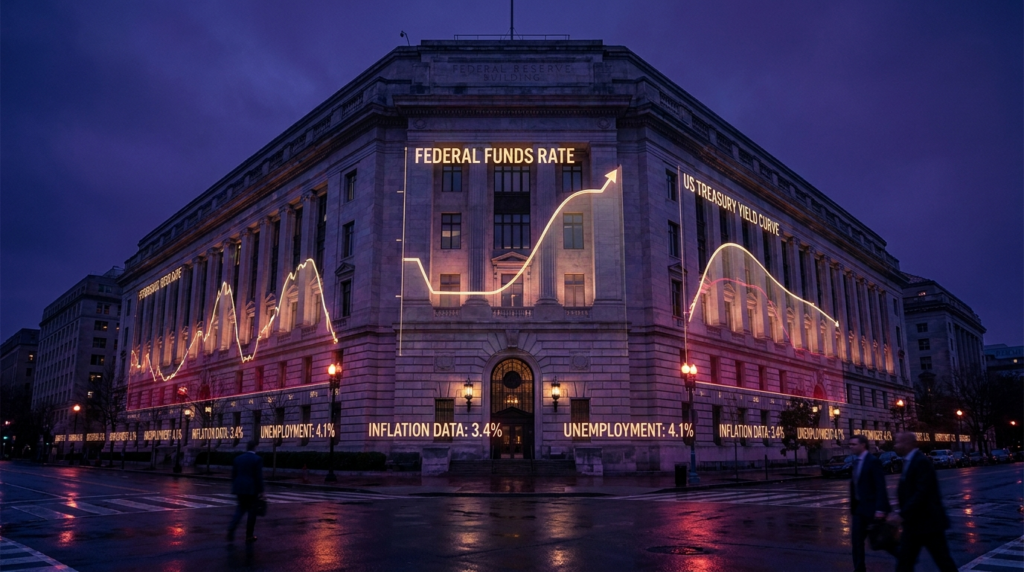
CPI Hits 4.2% as Iran War Premium Reprices Rates and Crude Oil Simultaneously
Date: Thursday 11 June 2026
Session: Macro Pulse | Post-Close Read
Published: 22:00 BST / 17:00 EDT / 06:00 JST (Thu)
CPI printed +4.2% headline with core at 2.9%. In isolation, that is sticky but manageable. With crude oil at $92.79 following Iran’s shutdown of the Strait of Hormuz, it is a macro catastrophe in the making. The energy pass-through into consumer prices has not even begun. The Fed is now boxed between fighting inflation that is about to accelerate and protecting an economy that is about to slow. Treasury bond speculators already hold -281,959 contracts net short, betting that yields are going higher. They are probably right.
The macro backdrop is the most hostile since the tariff escalation. CPI at 4.2% removes any near-term rate cut catalyst. Crude above $90 threatens second-round inflation effects through energy, transportation, and manufacturing cost pass-throughs. DXY is elevated as the safe-haven bid competes with an inflation-eroding-real-yields dynamic. The dark pool positioning campaigns we outlined in the institutional flow analysis were positioned for this exact macro deterioration. The Fed’s next move is not a cut. It is inaction, and inaction in this environment is itself bearish for risk assets.
CPI Breakdown: Sticky, Not Transitory
The headline CPI number of 4.2% is not a surprise. It is a confirmation.
Core CPI at 2.9% tells us that the non-energy, non-food components of inflation remain stubbornly above the Fed’s 2% target. Shelter costs, services inflation, and wage pressures are all contributing to a floor under core that the Fed cannot break without demand destruction. The disinflationary trend that began in late 2025 has stalled.
What makes this print dangerous is timing. Crude oil was at $78 when the CPI survey period closed. It is now at $92.79. The energy component of next month’s CPI will reflect this 19% surge, and that means headline CPI is heading toward 4.5-5.0% in July unless oil reverses sharply. The Iran factor transforms a manageable inflation print into a forward-looking crisis.
| CPI Component | Current Print | Prior Month | Direction |
|---|---|---|---|
| Headline CPI (YoY) | +4.2% | +3.8% | Accelerating |
| Core CPI (YoY) | +2.9% | +2.8% | Sticky |
| Energy (MoM) | +3.1% | +1.4% | Surging |
| Shelter (YoY) | +5.1% | +5.3% | Slowly easing |
| Services ex-Shelter | +3.4% | +3.2% | Reaccelerating |
Crude Oil: The Macro Transmission Channel
Crude oil at $92.79 is not just an energy story. It is a macro transmission channel that reprices the entire economy.
Every $10 increase in crude adds approximately 0.3-0.4 percentage points to headline CPI within 2-3 months through direct energy costs. But the secondary effects are larger and slower: transportation costs rise, manufacturing input prices increase, and services inflation accelerates as businesses pass through higher operating costs. The $15 move in crude over the past week will take 60-90 days to fully transmit into consumer prices.
Shell’s CEO warning that 1.2 billion barrels are effectively “in the hole” from the Hormuz shutdown puts the supply picture into perspective. Global strategic petroleum reserves can cover roughly 60-90 days of disrupted supply, but the market does not price in orderly drawdowns. It prices in panic. And $92.79 is not panic yet. If crude sustains above $90 for a week, the psychological anchor shifts and $95-100 becomes the next target zone.
| Crude Oil Metric | Current | 1 Week Ago | CPI Impact (Est.) |
|---|---|---|---|
| WTI Crude | $92.79 | $78.20 | +0.4-0.6pp |
| Gasoline (RBOB) | $3.24/gal | $2.87/gal | +0.2pp |
| Nat Gas | $3.41 | $3.22 | Marginal |
| Hormuz Supply Risk | 20% global supply | n/a | Tail risk realised |
The Fed Is Boxed
This is the worst possible macro combination for the Federal Reserve.
Inflation is sticky and about to accelerate from energy pass-through. Growth is decelerating as consumer confidence erodes and corporate margins face input cost pressure. BofA’s note that 70% of bear market signals have triggered is not hyperbole; it reflects a macro environment where leading indicators are deteriorating while lagging indicators (like CPI) are still rising.
The June meeting was already priced as a hold. The July meeting is now also a hold. The futures market has pushed the first rate cut expectation out to November at the earliest, and even that is conditional on crude falling back below $80. If crude stays above $90, the market will begin pricing rate hikes again, and that repricing will be violent for risk assets.
Trump’s comment that he “loves the inflation” adds political uncertainty. If the administration views higher energy prices as acceptable (or even desirable for domestic producers), the fiscal response may diverge from market expectations. The Fed cannot coordinate with an administration that is not aligned on inflation as a problem.
Consider what the institutional positioning data told us in the prior analysis. The $90 billion leveraged ETF volume surge and the -482,975 speculative short contracts were placed before CPI even printed. The dark pool campaigns selling into strength across SPY, QQQ, and IWM were not reacting to inflation. They were anticipating it. The smart money saw the CPI trajectory and the geopolitical risk simultaneously, and they acted. That is why the positioning was already bearish when the macro data confirmed it. The rates path does not just validate the institutional derisking; it explains why it started two weeks ago.
| Rate Expectation | Pre-CPI | Post-CPI | Post-Iran |
|---|---|---|---|
| June FOMC | Hold (98%) | Hold (99%) | Hold (99.5%) |
| July FOMC | Hold (82%) | Hold (91%) | Hold (96%) |
| September FOMC | Cut (35%) | Cut (22%) | Cut (14%) |
| First Cut Priced | September | November | November+ |
Yields and the Dollar: Safe Haven vs Inflation Erosion
The bond market is telling two stories simultaneously, and both are bearish for equities.
The 10-year yield is being pulled higher by inflation expectations (crude above $90 means higher CPI ahead) and pushed lower by safe-haven demand (geopolitical crisis drives flight to quality). The net effect so far is modestly higher yields, with the 10-year hovering around 4.55%. But Treasury bond speculators are positioned aggressively for higher yields, holding -281,959 contracts net short. That is the third-largest speculative short in Treasuries since 2022.
DXY is elevated but confused. EURUSD at 1.1539 and GBPUSD at 1.3364 suggest the dollar is receiving safe-haven flows, but the speculative positioning in the Dollar Index is actually net short -11,176 contracts. This means fast money was betting on dollar weakness before the Iran catalyst. That trade is now underwater, and the covering could push DXY toward 106 if the geopolitical premium sustains.
| Instrument | Level | Change | Macro Read |
|---|---|---|---|
| US 10Y Yield | 4.55% | +8bps | Inflation premium rising |
| US 2Y Yield | 4.82% | +5bps | Rate cut repricing |
| 2s10s Spread | -27bps | +3bps | Inversion deepening |
| DXY | 104.5 | +0.6% | Safe-haven bid |
| EURUSD | 1.1539 | -0.4% | Euro weakening |
| GBPUSD | 1.3364 | -0.3% | Sterling soft |
The Tension: Stagflation or Temporary Shock?
Our read is bearish. But we hold this tension honestly.
The stagflation scenario requires crude to stay above $90 for at least 4-6 weeks, long enough for energy costs to transmit into services and manufacturing. If Iran de-escalates within days, crude could collapse back to $78-82 and the CPI trajectory resets. The market would treat it as a temporary supply shock rather than a structural inflation regime change.
We do not have the information to predict Iranian military or diplomatic decisions. What we do have is the positioning data from the institutional flow analysis, which shows that the smart money is not waiting for clarity. They are acting as if the shock will persist. When institutions and speculators agree on direction with this much conviction, betting against them requires a specific catalyst. We do not see that catalyst tonight.
But here is the tension we must hold against this: the positioning analysis identified $90 billion in leveraged ETF volume as a potential capitulation signal. Historical analogues show that extreme hedging activity has preceded reversals after the catalyst is absorbed. If CPI at 4.2% was already priced into the positioning, and if crude stabilises rather than accelerating, the leveraged volume could mark a selling climax rather than the beginning of a prolonged selloff. The macro data says the environment is hostile. The positioning data says the most aggressive derisking may already be behind us. Both cannot be fully right. Our read favours the macro deterioration persisting, but the positioning contrarian signal is real and must be monitored.
Sizing and Risk Assessment
Around 80%
Dual shock of sticky CPI and energy price surge creates the most hostile macro backdrop since March. The Fed is boxed, with no rate cut path visible before November.
REDUCED
We are allocating at reduced size on all rate-sensitive positions. Duration exposure is particularly vulnerable with yields likely to test higher levels.
| Experience Level | Macro Read | Sizing |
|---|---|---|
| Beginner | This is not the environment for new positions. Understand that CPI above 4% with rising energy costs means the cost of borrowing stays high, and that compresses asset prices. | AVOID |
| Intermediate | REDUCED on all equity longs. Consider short-duration Treasury exposure as a hedge. Monitor the 10-year at 4.65% as the next resistance level. | REDUCED |
| Advanced | REDUCED directional. Inflation-linked instruments (TIPS, commodity producers) offer relative value. The yield curve steepener is the macro trade if you believe the Fed stays on hold while long-end reprices higher. | REDUCED |
Scenarios: Thursday and Beyond
| Scenario | Probability | Macro Outcome |
|---|---|---|
| Bullish | 10% | Iran de-escalation collapses crude back below $80. CPI fades as a one-off print. The Fed signals openness to cuts in September. This is the scenario that requires the geopolitical catalyst to fully reverse within 48-72 hours. Low probability but would produce a 200+ point SPX rally. |
| Sideways | 30% | Market prices in elevated CPI but crude stabilises in the $88-95 range. Yields range-trade 4.45-4.65% as the Fed stays on hold. The macro damage is contained but not resolved. A slow grind that preserves the bearish bias without triggering cascading liquidation. |
| Correction | 60% | Iran escalation drives crude above $95. Second-round inflation fears force a hawkish pivot in Fed communication. Yields break above 4.65%, and the equity risk premium expands. The institutional dark pool selling accelerates, and the S&P retests the 7,100 support zone. This is the scenario where the macro backdrop becomes the primary driver of the selloff, replacing geopolitics. |
Continue Reading
This is the second post in today’s Alpha Insights sequence. Read the institutional positioning analysis first, then continue with the sentiment, volatility, and sector rotation data:
- The dark pool derisking campaigns — $90 billion leveraged ETF volume and speculative short positioning
- The fear regime and retail sentiment collapse — Fear & Greed at 27.5, AAII bears reclaim majority
- The volatility amplifier and gamma exposure — VIX 22.22 with universal negative gamma
- The technical breakdown across indices — S&P below 7,300, key support levels
- The energy surge and sector rotation — where money is flowing in a war-premium environment
Analysis, not financial advice. Always manage your own risk. Published by Alpha Insights. All data referenced is sourced from publicly available market feeds and regulatory filings as of 10 June 2026 close.
Deepen Your Understanding
Related articles from the Titan Protect Foundry: