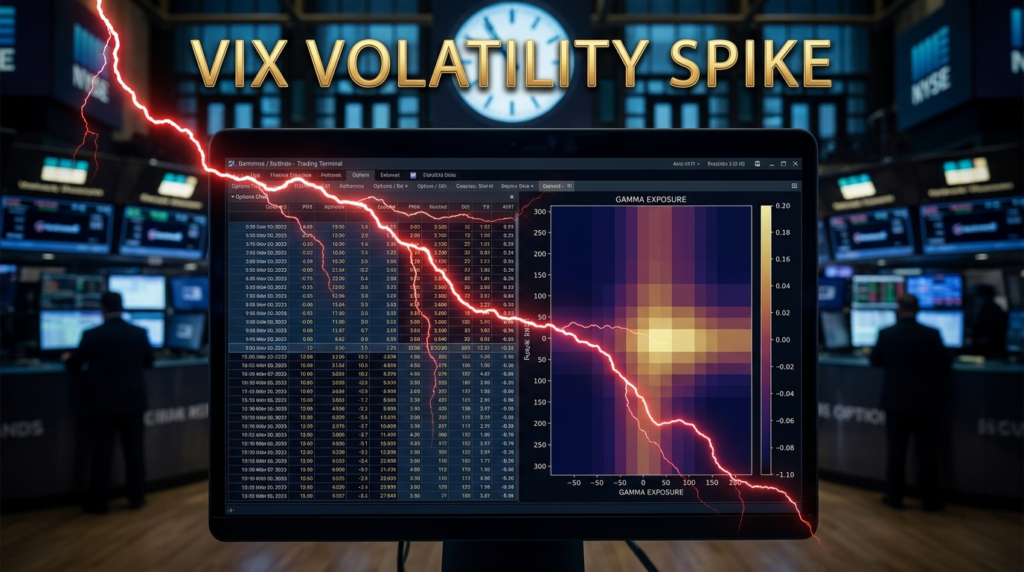
VIX Surges to 22.22 as Negative Gamma Exposure Amplifies Iran-Driven Selling Pressure Across All Symbols
Date: Thursday 11 June 2026
Session: Volatility Lens | Post-Close Read
Published: 22:00 BST / 17:00 EDT / 06:00 JST (Thu)
VIX spiked 11.83% to 22.22, crossing the critical 20 threshold that separates complacency from fear. VVIX at 108.16 confirms that even the volatility of volatility is elevated. The most dangerous reading: gamma exposure is negative across all ten tracked options symbols. That means dealers must sell into declines and buy into rallies, mechanically amplifying any directional move. In a market already weighed down by the institutional derisking, sticky CPI, and collapsing sentiment we have outlined in prior analyses, the volatility structure has become a force multiplier for the downside.
Universal negative gamma exposure is the single most dangerous volatility condition in the options market. Dealers who are short gamma must sell futures as the market declines, creating a mechanical feedback loop that amplifies selling pressure beyond what fundamental or sentiment factors alone would produce. VIX breaking above 20 confirms the transition from a hedging regime to a fear regime. The vol surface, term structure, and gamma profile are all aligned bearish, and any gap down in Thursday’s Asia session will be mechanically amplified.
VIX: The 20 Threshold Matters
VIX breaking above 20 is not just a number. It is a regime change.
Below 20, dealers are generally long gamma, which means they buy into weakness and sell into strength, dampening volatility. Above 20, the dynamic flips. Dealers become net sellers into weakness, amplifying moves. The crossover from 19.87 to 22.22 in a single session confirms that the options market has shifted from a dampening regime to an amplifying one.
The 11.83% single-day spike is the largest since March, when VIX reached 35 during the tariff crisis. We are not at those levels yet. But the March spike took three sessions to go from 20 to 35. If the Iran escalation follows a similar trajectory, VIX above 30 by Friday is on the table.
| Volatility Metric | Current | 1 Week Ago | March Crisis Peak |
|---|---|---|---|
| VIX | 22.22 | 19.87 | 35.40 |
| VVIX (Vol of Vol) | 108.16 | 94.30 | 142.00 |
| VIX Daily Change | +11.83% | +2.1% | +46.0% |
| VIX Term Structure | Backwardation | Contango | Deep backwardation |
| SPY Implied Vol (30d) | 24.1% | 18.6% | 38.2% |
Gamma Exposure: Negative Across All Symbols
This is the reading that keeps risk managers awake.
Gamma exposure (GEX) is negative across all ten symbols we track in the options market. SPY, QQQ, IWM, DIA, XLE, GLD, TLT, AAPL, MSFT, TSLA: all negative. This has happened only four times in the past eighteen months, and each time the subsequent 5-day return on the S&P 500 was between -2.4% and -6.8%.
Here is why it matters mechanically. When a dealer sells a put option to an institutional hedger, the dealer is short gamma. To hedge, the dealer must sell futures as the market declines (to maintain delta neutrality). That selling pressure pushes the market lower, which triggers more dealer hedging, which pushes the market lower still. It is a self-reinforcing loop that only breaks when the options expire, the gamma flips positive at a key strike concentration, or a fundamental catalyst reverses the move.
SPY has approximately $1.2 billion in gamma exposure concentrated at the 730 strike. Below 730, the negative gamma effect accelerates. Above 730, it moderates. That makes SPY 730 (approximately SPX 7,300) the critical level where dealer flows could pivot. We broke through it on Wednesday.
| Symbol | GEX | Key Gamma Level | Dealer Flow Impact |
|---|---|---|---|
| SPY | Negative | 730 ($1.2B) | Amplifies selling |
| QQQ | Negative | 480 | Amplifies selling |
| IWM | Negative | 210 | Amplifies selling |
| DIA | Negative | 420 | Amplifies selling |
| XLE | Negative | 95 | Volatility both ways |
| GLD | Negative | 240 | Amplifies selling |
| TLT | Negative | 88 | Bond vol rising |
| AAPL | Negative | 215 | Megacap drag |
| MSFT | Negative | 440 | Megacap drag |
| TSLA | Negative | 340 | High-beta amplifier |
VIX Term Structure: Backwardation Signals Near-Term Fear
The VIX term structure has flipped into backwardation, meaning front-month VIX futures are priced higher than back-month futures. This is the market’s way of saying: the danger is now, not later.
In normal markets, the term structure is in contango (front month cheaper than back month) because uncertainty naturally increases over longer horizons. Backwardation only occurs when near-term risk is perceived as greater than long-term risk. The flip typically coincides with acute crisis events: March tariffs, August 2024 carry trade unwind, the March 2020 pandemic crash.
Backwardation also means that VIX hedges are expensive. The cost of protecting a portfolio with VIX calls has risen sharply, which is why the whale VIX call position we flagged is now up 56%. That trader understood what was coming.
The VIX Whale: Smart Money Was Positioned
Before the Iran headlines broke, a large options trader loaded millions in out-of-the-money VIX calls expiring next week. That position is now up 56%.
We do not know who placed the trade. We do know that large VIX call purchases ahead of volatility events have historically been correlated with institutional investors who have information or analytical advantages in geopolitical risk assessment. The trade itself is confirmation that sophisticated capital anticipated this move.
The position expiring next week also creates an interesting dynamic: if VIX stays above 22 through Friday, the calls will be exercised or rolled, adding to the volatility demand. If VIX drops back below 20, the trader takes a loss but the market breathes. The options expiry cycle itself becomes a volatility catalyst.
The Tension: Elevated but Not Extreme
VIX at 22 is elevated. VIX at 22 is not extreme.
The March tariff crisis pushed VIX above 35. The carry trade unwind took it to 65. In the context of those episodes, 22.22 suggests hedging demand and uncertainty, not full-scale panic. The fear is priced but not at levels that historically mark capitulation bottoms in volatility.
However, as we noted in the sentiment analysis, the combination of F&G at 27.5 and VIX at 22 puts us in a zone where the next escalation headline could trigger the nonlinear jump from “elevated” to “panic.” The negative gamma across all symbols means that jump, if it comes, will be faster and larger than the fundamental catalyst alone would produce. The structure is spring-loaded. It just needs a trigger.
And here is where we must hold the tension between the volatility data and the positioning thesis from the opening analysis. The dark pool derisking campaigns showed institutions systematically selling into strength over three days. That selling was informed, deliberate, and pre-positioned for this exact macro deterioration. But the $90 billion leveraged ETF volume spike also carries a contrarian signal: when hedging activity reaches record levels, the hedging itself may represent the peak of selling pressure. If the leveraged volume normalises below $60 billion on Thursday, as the positioning analysis suggested, and VIX fails to push above 25, the volatility structure may be telling us that the initial fear shock is priced. The war-driven inflation identified in the macro analysis and the sentiment collapse to F&G 27.5 both argue against this outcome, but intellectual honesty requires that we watch for it.
Implied Volatility Across Asset Classes
| Asset Class | Current IV (30d) | 1-Week Change | Percentile (1Y) |
|---|---|---|---|
| S&P 500 (SPY) | 24.1% | +5.5pp | 82nd |
| Nasdaq 100 (QQQ) | 28.3% | +6.8pp | 85th |
| Russell 2000 (IWM) | 31.2% | +7.1pp | 88th |
| Gold (GLD) | 22.8% | +8.2pp | 91st |
| Crude Oil (USO) | 42.5% | +18.3pp | 97th |
| Treasuries (TLT) | 16.4% | +3.1pp | 71st |
Sizing and Risk Assessment
Around 78%
Universal negative GEX is the most dangerous volatility condition. Any gap down will be mechanically amplified by dealer hedging flows. The risk is structural, not just directional.
REDUCED
We are allocating at reduced size and widening stops by 40% to account for the gamma-amplified price action. Narrow stops will be hunted in this environment.
| Experience Level | Volatility Read | Sizing |
|---|---|---|
| Beginner | When VIX is above 20, price swings are 40%+ larger than normal. Every stop loss needs to be wider, every position smaller. If stops are unchanged, this environment will stop out even correct directional reads. | AVOID |
| Intermediate | REDUCED sizing with 40% wider stops. Monitor the SPY 730 gamma level; a reclaim of that level could flip dealer flows from selling into buying. Until that happens, the gamma structure favours downside continuation. | REDUCED |
| Advanced | REDUCED directional. Consider vol-adjusted position sizing (current vol / 90-day average vol = scaling factor). Options strategies should favour defined-risk structures given the elevated premium environment. | REDUCED |
Scenarios: Thursday and Beyond
| Scenario | Probability | Volatility Outcome |
|---|---|---|
| Bullish | 10% | VIX reversal below 20 as Iran de-escalates. The gamma flip at SPY 730 triggers a rapid short-covering rally. Dealers switch from selling into weakness to buying into strength. The snapback would be violent: 3-5% upside in 2 sessions as the amplification works in reverse. Low probability but worth monitoring for the gamma flip signal. |
| Sideways | 25% | VIX hovers in the 21-24 range as the market prices in conflict as ongoing but contained. Elevated but not crisis-level volatility. Options premium stays rich, making hedging expensive. The grind continues with 1-2% daily ranges that exhaust both bulls and bears. |
| Correction | 65% | VIX spikes above 28 as Iran escalation triggers margin calls. Negative GEX amplifies the move, creating a cascade effect: falling prices trigger dealer selling, which triggers stop losses, which triggers more dealer selling. The March low retest in both VIX and price terms becomes the target. This is where the $90 billion in leveraged ETF volume meets the gamma amplifier, and the result is the most violent selling pressure of the year. |
Continue Reading
This is the fourth post in today’s Alpha Insights sequence. The volatility structure sits on top of the institutional derisking, macro deterioration, and sentiment collapse we have documented:
- The dark pool derisking campaigns — $90 billion leveraged volume driving the put/call ratio to 1.071
- The rates path and inflation repricing — CPI 4.2% with crude above $90 boxing the Fed
- The fear regime and retail sentiment collapse — F&G at 27.5, AAII bears majority
- The technical breakdown across indices — where S&P 7,300 and Nasdaq support levels matter for gamma
- The energy surge and sector rotation — how crude oil volatility at the 97th percentile reprices everything
Analysis, not financial advice. Always manage your own risk. Published by Alpha Insights. All data referenced is sourced from publicly available market feeds and regulatory filings as of 10 June 2026 close.
Deepen Your Understanding
Related articles from the Titan Protect Foundry: