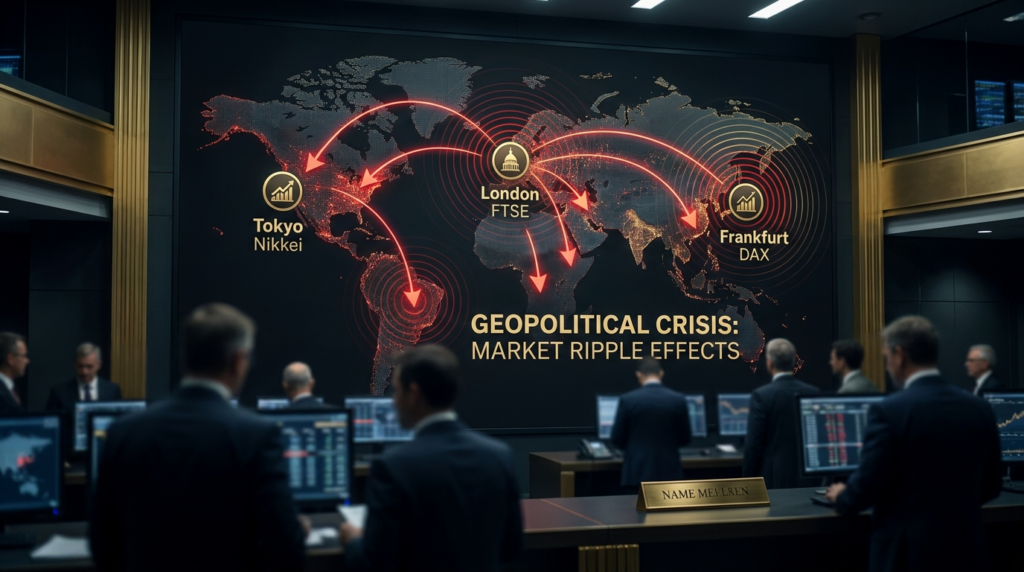
Nikkei Faces Worst Energy Shock in Decades as Hormuz Closure Reprices Every Oil-Importing Index
Date: Thursday 11 June 2026
Session: Global Grid | Post-Close Sequence
Indices: Nikkei 225, Hang Seng, DAX 40, FTSE 100, STOXX 600, Russell 2000
Iran shut the Strait of Hormuz. Twenty per cent of global oil supply transits that chokepoint. Japan imports roughly 90% of its crude through Middle Eastern shipping lanes, and the Nikkei 225 is about to open into the most acute energy supply shock since the 1970s. European indices face a double bind of energy cost inflation and proximity to another conflict zone. The FTSE 100 stands alone as the one major index where the energy shock might actually help more than it hurts. We are watching a global repricing event unfold in real time, and the war premium has not finished being absorbed.
THESIS
The Hormuz closure is a global supply shock that disproportionately punishes energy-importing economies. Japan, South Korea and India face the sharpest repricing. Europe re-learns the energy security lesson it thought Russia had already taught. The FTSE 100’s heavy energy and commodity weighting makes it the relative outperformer in an ugly field. Our read is bearish on oil-importing indices, with conviction highest on the Nikkei and lowest on the FTSE. Sizing is REDUCED across all international exposure until the war premium stabilises.
The Hormuz Chokepoint: What 20% of Global Oil Means
The Strait of Hormuz handles approximately 20 million barrels per day. That is roughly one-fifth of the world’s total oil consumption flowing through a passage narrower than the English Channel at its tightest point. Iran’s shutdown announcement is not a threat or a partial blockade. It is a full closure.
Crude oil responded immediately, surging 5.20% to $92.79. But crude is just the transmission mechanism. The real damage flows through to every economy that cannot produce its own energy. Japan imports 90% of its crude. South Korea imports 98%. Germany, despite its renewable energy push, still imports over 60% of its primary energy. Each percentage point higher in crude costs translates directly into wider trade deficits, weaker currencies and compressed corporate margins.
The inflation implications were mapped in the macro analysis, where CPI at 4.2% with crude above $90 boxed the Fed into inaction. The institutional dark pool derisking campaigns identified in the positioning analysis showed that the smart money anticipated this macro deterioration before it arrived. The sentiment collapse to F&G 27.5 reflects the fear that is now spreading globally. The universal negative gamma exposure documented in the volatility analysis means any gap-down in Asian trading will be mechanically amplified by dealer hedging flows. And the technical breakdown below S&P 7,300 confirmed the domestic index damage, while the sector rotation into energy and away from technology showed where the domestic capital is fleeing. Now we see how all of those forces distribute unevenly across the globe.
Asia: The Epicentre of Energy Vulnerability
| Index | Oil Import % | Energy Cost Exposure | Expected Impact | Gap Risk |
|---|---|---|---|---|
| Nikkei 225 | ~90% | Extreme | -2.5% to -4.0% | Very High |
| Hang Seng | ~75% | High | -1.5% to -3.0% | High |
| KOSPI | ~98% | Extreme | -2.0% to -3.5% | Very High |
| Nifty 50 | ~85% | High | -1.5% to -2.5% | High |
The Nikkei 225 is the most exposed major index on the planet right now. Japan sources roughly 90% of its crude oil from Middle Eastern producers, and the vast majority of that oil passes through the Strait of Hormuz. A full closure does not just raise prices. It threatens physical supply.
Japan’s strategic petroleum reserves cover approximately 140 days of imports. That sounds comfortable until you realise that markets do not wait 140 days to reprice. They reprice immediately, and the Nikkei’s manufacturing-heavy composition means energy costs flow straight into corporate earnings. Toyota, Sony, Panasonic, every major exporter faces margin compression from input costs they cannot pass through quickly enough.
The Bank of Japan may need to intervene in the yen. The currency dynamics from this energy shock, explored in detail in our foreign exchange analysis, create a secondary pressure channel. A weaker yen raises the local cost of dollar-denominated crude even further, creating a vicious feedback loop.
The Hang Seng faces a different version of the same problem. China imports roughly 75% of its oil, with significant volumes transiting Hormuz. But China has diversified its supply chains more aggressively than Japan, with pipelines from Russia and Central Asia providing partial offset. The Hang Seng’s expected decline is material but less severe than the Nikkei’s.
Europe: The Second Energy Crisis in Four Years
European markets thought the energy crisis was over. Russia taught Germany a painful lesson about pipeline dependency. Now Iran is teaching the same lesson about maritime chokepoints. Different geography, identical vulnerability.
| Index | Last Close | Energy Sector Weight | Defensive Tilt | Expected Range |
|---|---|---|---|---|
| DAX 40 | ~19,500 | ~3% | Low | 18,800 – 19,500 |
| FTSE 100 | ~8,700 | ~13% | High | 8,500 – 8,800 |
| STOXX 600 | ~540 | ~6% | Medium | 525 – 540 |
The DAX 40 is the most vulnerable European index. Germany’s manufacturing base is an energy vacuum. Automotive, chemicals, heavy industry — all require cheap energy to remain competitive. With crude above $92 and natural gas prices rising in sympathy, German industrial margins face the same compression that hammered them in 2022.
The FTSE 100 tells a different story. And this is where the tension in the read becomes important.
BP and Shell together account for roughly 13% of the FTSE 100 by market capitalisation. Add mining companies like Rio Tinto, Glencore and Anglo American, and nearly a quarter of the index benefits directly from commodity price spikes. While the broader UK economy suffers from higher energy costs, the index composition creates a natural hedge that no other major European benchmark possesses.
Our read is that the FTSE outperforms the DAX and STOXX 600 over the next two weeks. Not because the UK economy is in better shape, but because the FTSE 100 is a commodity index dressed up as a stock market index.
Russell 2000: Small Caps in the Blast Zone
The Russell 2000 dropped to 2,823, and small caps face a problem that large caps do not. They cannot hedge.
| Factor | Russell 2000 | S&P 500 |
|---|---|---|
| Floating Rate Debt % | ~38% | ~12% |
| Energy Hedging Capability | Minimal | Extensive |
| Domestic Revenue % | ~80% | ~60% |
| Profitable Companies % | ~58% | ~95% |
| Crisis Resilience | Low | Moderate |
Nearly 38% of Russell 2000 debt is floating rate. When energy-driven inflation keeps rates elevated or pushes them higher, small cap interest costs spike immediately. Large caps locked in fixed-rate debt during 2020-2021; small caps did not have that luxury.
The sentiment reading showed fear at 27.5 on the greed index. Small caps amplify fear. They always have. And with BofA reporting that 70% of bear market signals have now triggered, the Russell 2000 sits in the blast zone of any broader de-risking.
Defence Spending: The Counter-Narrative
Every geopolitical crisis accelerates defence spending. This one is no different.
European defence budgets were already rising before Hormuz. NATO’s 2% GDP target became a floor, not a ceiling. The DAX’s Rheinmetall has quadrupled since 2022. BAE Systems on the FTSE continues to hit all-time highs. This is not a new trend, but the Hormuz closure adds acceleration.
The partial offset matters. For the DAX specifically, defence names like Rheinmetall and Hensoldt provide some cushion against the broader energy-driven sell-off. It is not enough to flip the index positive, but it narrows the expected decline.
Central Bank Response Matrix
| Central Bank | Current Rate | Energy Inflation Risk | Likely Response | FX Pressure |
|---|---|---|---|---|
| Bank of Japan | 0.50% | Extreme | FX intervention, hold rates | JPY weakness |
| ECB | 3.65% | High | Pause cuts, hawkish tilt | EUR vulnerable |
| Bank of England | 4.50% | Moderate | Hold, watch energy pass-through | GBP stable |
| PBoC | 3.45% | High | Targeted stimulus, FX management | CNY managed |
The Bank of Japan is in the worst position of any major central bank. Rates at 0.50% give almost no room for manoeuvre. Energy-driven inflation cannot be fought with rate hikes when your economy is barely growing. The BoJ’s most likely response is direct FX intervention to prevent the yen from collapsing, which would make dollar-denominated crude even more expensive in local terms.
The ECB faces a familiar dilemma: cut rates to support growth, or hold rates to fight energy-driven inflation. In 2022, they chose to fight inflation. Our read is they choose the same again this time. That means no relief for European equity markets from monetary policy.
The Tension: FTSE as the Odd One Out
Here is where we hold two contradictory ideas simultaneously.
The FTSE 100 should decline on a global risk-off event. Every major index did yesterday. The S&P fell 1.70%, the Nasdaq dropped 2.22%. Risk-off means risk-off.
But the FTSE 100 is not like other indices. Its heavy weighting towards energy majors, mining companies and defensive names like Unilever, Diageo and AstraZeneca means it has a built-in shock absorber. BP and Shell’s combined gains from crude above $92 could offset half the index-level decline from broader risk aversion.
We are not calling the FTSE positive. We are calling it the least negative major index during this crisis. That distinction matters for allocation.
Here is where the global picture holds a tension against the domestic data. The positioning analysis showed -482,975 speculative short contracts in S&P 500 futures. That positioning is US-centric. But the Hormuz shutdown does not punish the US proportionally. America is a net energy producer. Japan imports 90%. That means the speculative shorts positioned against the S&P may be short the wrong index. The highest-conviction short, based on energy vulnerability, is the Nikkei, not the S&P. Meanwhile, the energy sector surge documented in the hot zones analysis translates directly into FTSE outperformance through BP and Shell weightings. The domestic fear at F&G 27.5 may be partially misplaced; the true pain from this crisis falls on Tokyo and Frankfurt, not New York.
Global Index Conviction Matrix
| Index | Direction | Conviction | Sizing | Key Driver |
|---|---|---|---|---|
| Nikkei 225 | Bearish | High | REDUCED | Oil import dependency |
| Hang Seng | Bearish | Medium | REDUCED | Supply diversification partial |
| DAX 40 | Bearish | High | REDUCED | Manufacturing energy cost |
| FTSE 100 | Cautious | Medium | REDUCED | Energy weighting hedge |
| STOXX 600 | Bearish | Medium | REDUCED | Blended European exposure |
| Russell 2000 | Bearish | High | AVOID | Floating rate debt, no hedging |
Scenarios
Hormuz reopens within 48 hours on diplomatic breakthrough. Global relief rally led by Asian energy importers. Nikkei recovers 2-3% from gap-down open. FTSE underperforms on the reversal as energy longs unwind. This is the tail risk scenario. We assign it just 10% because Iran has no incentive to back down before extracting concessions.
Markets price in prolonged closure but strategic petroleum reserves get deployed by US, Japan and IEA members. Crude stabilises between $88-95. Asian indices decline 1-2% but avoid panic. European defence names continue to outperform. Range-bound trading for one to two weeks.
Hormuz remains shut for weeks. Crude pushes above $100. EM currencies collapse under energy-driven current account deterioration. Asian central banks burn reserves defending currencies. Global recession fears become consensus. The Nikkei enters a bear market. European indices follow with a lag. The Russell 2000 leads US small caps to new lows.
Risk Assessment
Risk: Around 73%
The Hormuz shutdown threatens 20% of global oil supply. Energy-dependent Asian economies face the most acute repricing risk. Japan’s 90% oil import dependency makes the Nikkei the highest-conviction short among global indices. European defence spending provides a partial offset for the DAX and FTSE, but not enough to flip the direction. The Russell 2000’s floating-rate debt exposure and lack of hedging capability make it the worst-positioned US index. Sizing is REDUCED across all international equities. The Russell is AVOID.
Continue Reading
Previously in the sequence:
- The strategic positioning read — where the war premium sits in the broader market structure
- The macro pulse — CPI at 4.2% and the inflation transmission from crude
- The sentiment landscape — fear at 27.5 and what capitulation looks like from here
- The volatility lens — VIX at 22.22 and dealer hedging cascades
- The market radar — cross-asset confirmation of the risk-off regime
- The hot zones — where the selling concentrated and where it did not
Coming next:
- The institutional flow — dark pool campaigns and speculative positioning
- The options architecture — negative gamma across all symbols
- The currency landscape — how Hormuz reprices every energy-importing currency
Analysis, not financial advice. Always manage your own risk.
Deepen Your Understanding
Related articles from the Titan Protect Foundry: