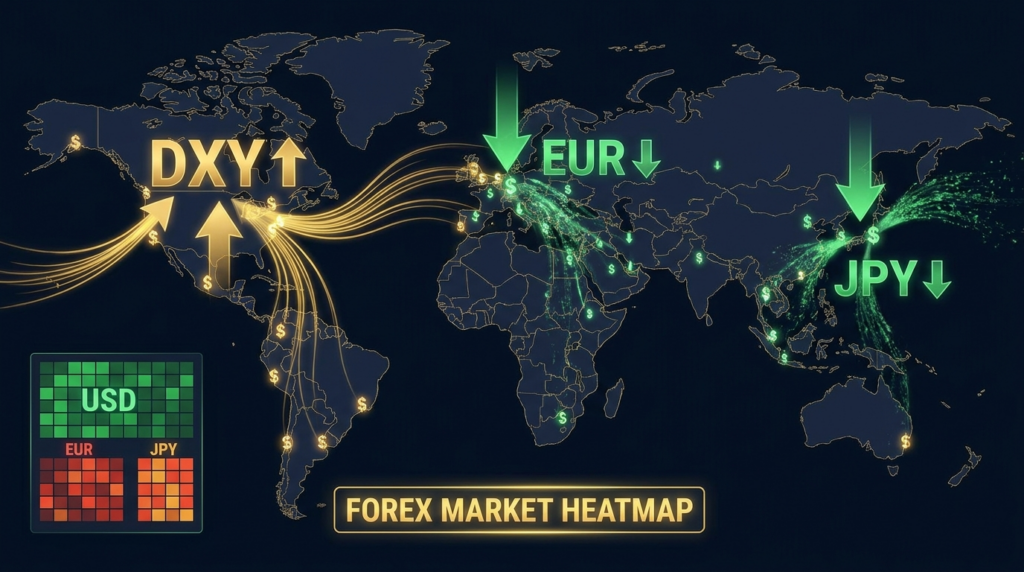
Dollar Strengthens on Safe Haven Demand as Yen Short Squeeze Risk Reaches Critical Levels
Date: Thursday 11 June 2026
Session: FX Focus | Post-Close Sequence
Coverage: DXY, EURUSD, GBPUSD, USDJPY, AUDUSD, USDCAD, USDCHF, NZDUSD
The foreign exchange market is running the classic geopolitical risk-off playbook, but with a twist that makes it more dangerous than usual. The dollar is strengthening on safe-haven demand while simultaneously benefiting from rising inflation expectations. The yen is in the crosshairs of two opposing forces: safe-haven demand pulling it stronger and energy import costs pulling it weaker. Leveraged funds are sitting on -105,136 net short yen contracts. If risk-off deepens and the yen rallies, that is the most violent short squeeze in G10 FX right now. The Australian dollar is the hidden victim, with +56,800 net long contracts vulnerable to a commodity-linked currency unwind. Every energy-importing currency is repricing. The Hormuz closure is a currency event as much as it is an oil event.
THESIS
The yen short squeeze is the highest-conviction FX trade setup on the board. 105K net short contracts face a geopolitical catalyst that historically strengthens the yen. DXY benefits from dual safe-haven and inflation-premium bids. Euro weakness reflects European energy vulnerability documented in the global grid analysis. Sterling is the oddity: net long +27K with FTSE energy weighting providing support. Our read is short USDJPY as the primary expression, neutral DXY (competing forces cancel), and cautious on the AUD long unwind. Sizing is STANDARD on USDJPY, REDUCED elsewhere.
G10 FX Positioning Matrix
| Currency | Spot Rate | Leveraged Net | Asset Mgr Net | Squeeze Risk |
|---|---|---|---|---|
| DXY | ~104.5 | -11,176 | +14,968 | Moderate (short covering) |
| EURUSD | 1.1539 | -22,320 | +314,385 | Low (small leveraged short) |
| GBPUSD | 1.3364 | +27,022 | -101,728 | Low (longs may unwind) |
| USDJPY | ~148.0 | -105,136 | -62,814 | EXTREME (yen short squeeze) |
| AUDUSD | ~0.6550 | +56,800 | +1,441 | High (long unwind risk) |
| USDCAD | ~1.3650 | -49,052 | -50,566 | CAD benefits from energy |
| USDCHF | ~0.8850 | -10,782 | -32,517 | CHF safe haven bid |
USDJPY: The Highest-Conviction Trade
USDJPY is the trade. Here is why.
Leveraged funds hold -105,136 net short yen contracts. That means they are long USDJPY, betting the yen weakens further. In normal market conditions, that is a carry trade that works beautifully because the interest rate differential between the Fed and the Bank of Japan is enormous.
But Hormuz changes the calculus. The yen is a traditional safe-haven currency. When global risk spikes, capital repatriates to Japan. Japanese institutions sell foreign assets and convert back to yen. The yen strengthens. USDJPY falls.
Now layer in two additional forces from today’s data.
| Factor | Direction for USDJPY | Magnitude | Timeframe |
|---|---|---|---|
| Safe-haven yen repatriation | USDJPY lower (yen stronger) | Large | Immediate |
| Energy import cost (crude $92+) | USDJPY higher (yen weaker) | Medium | Lagged (weeks) |
| BoJ intervention risk | USDJPY lower (yen stronger) | Large if triggered | Any time |
| Short squeeze (105K contracts) | USDJPY lower (yen stronger) | Very Large | Sudden |
Three of four factors point to USDJPY lower. The one factor pointing higher (energy import costs weakening the yen) is a lagged effect that takes weeks to materialise in the trade balance data. The three bullish-yen factors are immediate. The dark pool positioning analysis documented leveraged ETF volume at $90 billion, confirming the scale of hedging activity across all asset classes. That hedging demand is the same force driving yen repatriation: when risk is being repriced everywhere, capital returns home.
The global grid analysis documented Japan’s extreme energy vulnerability: 90% crude import dependency, manufacturing-heavy economy, Bank of Japan with only 0.50% in rates to work with. All of that is yen-bearish on a 3-month horizon. But on a 3-day horizon, the safe-haven bid and short squeeze potential dominate.
Our read: short USDJPY with a target of 144.0, stop at 150.0. STANDARD sizing because the risk-reward is the best in the FX book right now.
DXY: The Competing Narratives
The dollar is caught between two bullish forces that normally do not coexist.
Safe-haven demand. When the world is on fire, capital flows to the dollar. That is not changing. The Hormuz closure reinforces dollar strength through the classic risk-off channel.
Inflation premium. CPI at 4.2% and crude surging above $92 means the Fed stays restrictive for longer. Higher-for-longer rates support the dollar through the interest rate differential channel. The macro pulse documented this dynamic in detail.
The leveraged position is -11,176 net short DXY. That is a small short that can be covered easily, adding marginal upside pressure. Asset managers are +14,968 net long, confirming the directional bias.
We are neutral on the DXY as a standalone trade because the competing forces roughly cancel in terms of magnitude. But as a cross-rate, the dollar’s strength is expressed most cleanly against energy-importing currencies: the euro, the yen (though we are playing the yen via the squeeze), and the Australian dollar.
EURUSD: Europe’s Energy Bill
EURUSD at 1.1539 reflects the European energy vulnerability documented in the global grid. Germany imports over 60% of its primary energy. The DAX is expected to underperform. The ECB faces a familiar inflation-growth trade-off. All bearish for the euro.
| EURUSD Factor | Direction | Weight |
|---|---|---|
| Energy dependency | EUR weaker | High |
| ECB likely to pause cuts | EUR neutral | Medium |
| Leveraged net short -22,320 | Small squeeze risk | Low |
| Asset managers +314,385 net long | Structural support | Medium |
Asset managers hold +314,385 net long euro contracts. That is structural support that prevents a freefall. But the energy headwind is a gravity well that pulls EURUSD lower on each crude price uptick. Our target is 1.1350, with a stop at 1.1650. REDUCED sizing because the asset manager support complicates the short.
The Tension: Sterling’s Odd Resilience
GBP is the curiosity in this FX landscape.
Leveraged funds are +27,022 net long sterling. That is a meaningful bullish position in a risk-off environment where most currencies are being sold. The FTSE 100’s energy weighting provides a unique cushion for the UK economy’s market valuation, even as the real economy suffers from higher energy costs.
Asset managers are -101,728 net short. That is a significant structural headwind. The divergence between leveraged longs and asset manager shorts creates a tug-of-war that keeps GBPUSD range-bound between 1.3200 and 1.3500.
We are not taking a directional view on sterling. The positioning is too mixed, and the BoE sits in a comfortable middle ground between the BoJ’s impotence and the Fed’s hawkishness. Sterling is a sideshow while the yen, euro and Australian dollar dominate the FX volatility.
AUDUSD: The Hidden Vulnerability
Nobody is talking about the Australian dollar. They should be.
Leveraged funds hold +56,800 net long AUD contracts. That is the largest speculative long position in any G10 currency we track. The Aussie is typically seen as a commodity currency, but Australia is also a net energy importer despite being a major LNG exporter. The nuance matters.
In a global risk-off driven by an energy supply shock, the Australian dollar faces a triple threat: risk-off weakens all risk currencies, energy import costs hit the trade balance, and the +56,800 long position becomes a source of selling if sentiment deteriorates further.
| Commodity Currency | Net Energy Position | Leveraged Positioning | Hormuz Impact |
|---|---|---|---|
| AUD | Mixed (LNG export, oil import) | +56,800 long | Vulnerable |
| CAD | Net energy exporter | -49,052 short | Benefits |
| NOK | Major oil exporter | — | Strong benefit |
The CAD-AUD divergence is the clearest pair trade. Canada is a net energy exporter that benefits from $92 crude. Australia’s position is more ambiguous. The leveraged long in AUD combined with risk-off creates a crowded-trade unwind risk that could push AUDUSD below 0.6400.
Carry Trade Unwind: The Systemic Risk
The carry trade unwind is the FX event that has systemic implications.
The yen carry trade funds billions in global risk assets. Investors borrow cheap yen (at 0.50%), convert to dollars, and invest in higher-yielding assets. When the yen strengthens, the carry trade losses force liquidation of those higher-yielding assets, which is how a currency event becomes an equity event.
The institutional flow showed asset managers holding +982K net long S&P 500 futures. A portion of that long position is funded by yen carry. If the yen squeezes and USDJPY drops from 148 to 144, the carry trade losses trigger forced selling in the very equity positions that asset managers are holding.
This is the transmission mechanism the market is not pricing: a yen short squeeze does not just affect FX. It affects equity futures, Treasury futures and every risk asset funded by cheap yen borrowing. The basis analysis showed equity futures already trading at a discount. A carry trade unwind would widen that discount materially.
The tension with the options architecture is worth stating explicitly. The options analysis found negative gamma exposure across all ten tracked symbols, with SPY max pain at $709. That universal negative gamma means dealers must sell into declines. Now consider: if a yen short squeeze triggers equity selling via carry trade liquidation, those equity losses hit markets already in negative gamma territory. The dealer hedging flows amplify the selling. And that amplified selling deepens the equity losses that triggered the carry trade unwind in the first place. This is a reflexive loop, and the sentiment reading at Fear and Greed 27.5 suggests the market is not yet at the capitulation point where it exhausts itself. The $90 billion in leveraged ETF volume documented in the positioning analysis is the kindling. A yen squeeze could be the match.
FX Conviction Matrix
| Pair | Direction | Conviction | Sizing | Target | Stop |
|---|---|---|---|---|---|
| USDJPY | Short | High | STANDARD | 144.0 | 150.0 |
| EURUSD | Short | Medium | REDUCED | 1.1350 | 1.1650 |
| GBPUSD | Neutral | Low | AVOID | — | — |
| AUDUSD | Short | Medium | REDUCED | 0.6400 | 0.6650 |
| USDCAD | Short (CAD strength) | Medium | REDUCED | 1.3450 | 1.3800 |
| USDCHF | Short (CHF safe haven) | Medium | REDUCED | 0.8700 | 0.8950 |
Scenarios
DXY pushes above 106 on combined safe-haven and inflation premium. USDJPY falls below 145 as yen safe-haven demand overwhelms the dollar bid. EURUSD drops below 1.14. The dollar rally is broad-based against risk currencies but loses against safe-haven peers (JPY, CHF). AUD breaks below 0.6400 on long unwind.
FX pairs consolidate as the market digests competing safe-haven vs inflation narratives. DXY holds 104-105. USDJPY ranges between 146-149. EURUSD holds 1.14-1.16. No clear directional break. Central bank jawboning keeps moves contained. The market waits for the next Hormuz headline before committing.
Energy-importing EM currencies collapse under current account deterioration. INR, TRY, ZAR and THB face the worst of it. G10 carry trade unwinds as yen and CHF strengthen. AUD long unwind triggers secondary selling across APAC currencies. The FX volatility spills into equity markets through the carry trade transmission mechanism.
Risk Assessment
Risk: Around 60%
FX markets are running the classic geopolitical risk-off playbook with an energy-driven twist. The yen short squeeze at -105K contracts is the highest-conviction single trade. The AUD long at +56,800 is the most vulnerable to unwinding. DXY benefits from dual tailwinds but is neutral as a standalone trade. Sterling’s odd resilience from FTSE energy weighting creates a no-trade zone. The carry trade unwind risk is systemic: a yen squeeze does not just affect FX but transmits to equities and rates through leveraged position liquidation. Sizing is STANDARD on USDJPY, REDUCED on all other pairs, AVOID on GBPUSD.
Continue Reading
Previously in the sequence:
- The strategic positioning read — dark pool landscape and opening war premium thesis
- The macro pulse — CPI 4.2%, inflation path, rate implications
- The sentiment landscape — fear at 27.5, BofA 70% bear signals
- The volatility lens — VIX 22.22, dealer hedging cascade
- The market radar — cross-asset risk-off confirmation
- The hot zones — selling concentration map
- The global grid — Nikkei, DAX, FTSE face the energy shock
- The institutional flow — +982K asset manager longs vs -482K leveraged shorts
- The options architecture — universal negative gamma, max pain $709
- The sector rotation — energy only positive sector, tech under distribution
- The futures basis — crude contango, equity discount, Treasury paradox
Coming next:
- The digital asset landscape — Bitcoin, Ethereum and crypto’s correlation to risk
- The commodities pulse — crude, gold, copper, natural gas
Analysis, not financial advice. Always manage your own risk.
Deepen Your Understanding
Related articles from the Titan Protect Foundry: