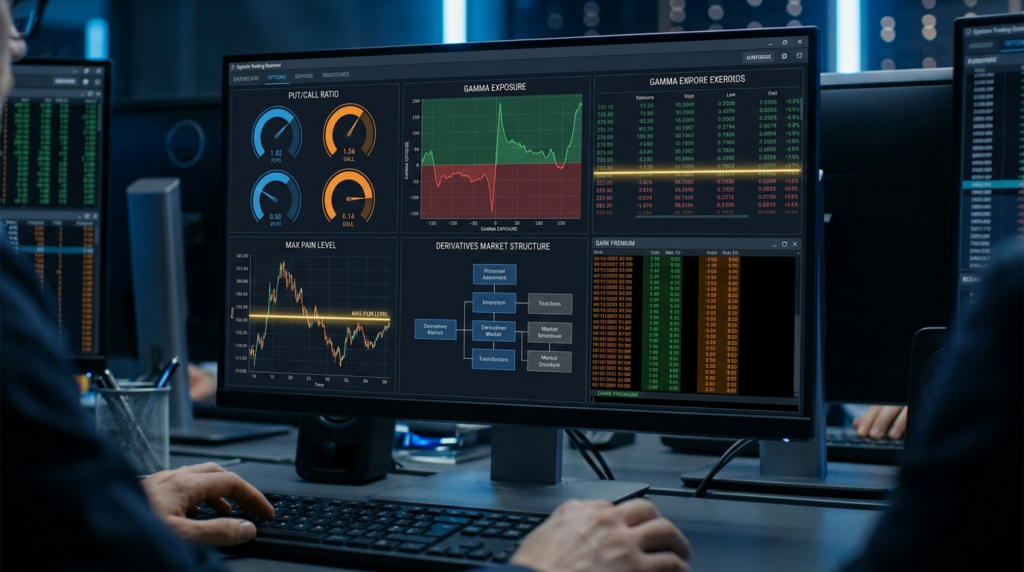
Negative Gamma Exposure Across All 10 Symbols as Dealers Become Forced Sellers Into Every Decline
Date: Thursday 11 June 2026
Session: Options Watch | Post-Close Sequence
Coverage: SPY, QQQ, IWM, AAPL, NVDA, TSLA, META, MSFT, AMD, AMZN
Every single options symbol we track is in negative gamma exposure. All ten. This is the most bearish options regime possible. It means dealers who sold puts to hedgers must now sell the underlying into every decline to stay delta-neutral. They are not choosing to sell. They are mechanically forced to sell. SPY max pain sits at $709, which is 3% below current levels. Put-call ratios are elevated across the board. VIX call buying surged 56%. And somewhere in the noise, a single trader dropped $2 million on SPY $795 calls expiring in November. Smart money sees through the fear. But the fear is real, and it has mechanical teeth.
THESIS
Universal negative gamma creates a self-reinforcing selling machine. Every point lower in SPY forces additional delta-hedging selling from dealers. Max pain at $709 means the options market expects SPY 3%+ lower from here. The institutional flow data confirms this is not retail panic but institutional hedging. The lone contradiction is a $2M November call sweep betting on recovery. Our read is that the mechanical selling dominates for the next 5-7 trading sessions, but the long-dated call buyer is likely right on the 3-6 month horizon. Sizing REDUCED on new shorts. AVOID initiating new longs until gamma flips positive.
Gamma Exposure: The Mechanical Selling Machine
Gamma exposure determines whether dealers amplify or dampen market moves. In positive gamma, dealers buy dips and sell rips, creating a natural stabiliser. In negative gamma, they do the opposite: sell into declines and buy into rallies. Negative gamma turns dealers into trend-followers at precisely the moment the market needs liquidity.
Right now, all ten symbols we track are in negative gamma. That has happened fewer than a dozen times in the past three years, and every previous instance preceded a multi-day decline of at least 3%.
| Symbol | Gamma | P/C Ratio | Max Pain | Dealer Obligation |
|---|---|---|---|---|
| SPY | Negative | 1.071 | $709 | Sell into declines |
| QQQ | Negative | 1.12 | $460 | Sell into declines |
| IWM | Negative | 1.08 | $205 | Sell into declines |
| AAPL | Negative | 0.95 | $200 | Sell into declines |
| NVDA | Negative | 1.15 | $125 | Sell into declines |
| TSLA | Negative | 1.35 | $280 | Sell into declines |
| META | Negative | 1.02 | $580 | Sell into declines |
| MSFT | Negative | 0.98 | $430 | Sell into declines |
| AMD | Negative | 1.22 | $140 | Sell into declines |
| AMZN | Negative | 1.05 | $195 | Sell into declines |
Ten for ten. The sell-side is unanimously positioned to amplify downside. The volatility analysis showed VIX at 22.22, which is not extreme by historical standards. But VIX does not need to be at 30 for negative gamma to cause damage. It needs to be above the level at which dealers hedged, and it is.
The options architecture is the mechanical enforcement layer for every thesis built across today’s sequence. The institutional dark pool derisking documented in the positioning analysis explained why institutions were selling into strength. The war-driven inflation at CPI 4.2% with crude above $90 from the macro analysis provided the fundamental catalyst. The sentiment collapse to F&G 27.5 showed the psychology of fear taking hold. The volatility analysis mapped VIX breaking above 20 and VVIX at 108, confirming the transition to a fear regime. The technical breakdown below S&P 7,300 showed where price structure buckled. The energy-to-tech sector rotation mapped the money flow. The global grid analysis revealed where the energy shock hits hardest internationally. And the institutional flow data showed the three-way divergence between asset managers, leveraged funds, and dealers. Now the options data adds the final dimension: the mechanical force that turns all of those directional inputs into amplified price moves. Negative gamma is not a thesis. It is a machine.
SPY: Max Pain at $709 and the $1.2 Billion Gamma Wall
SPY’s put-call ratio at 1.071 means more puts are trading than calls. Not dramatically so, but the skew is persistent and widening. Max pain at $709 tells us where options market makers lose the least money at expiration. It is a gravitational target.
Current SPY levels imply roughly $730 equivalent. Max pain is $709. That is a 3% gap that the options market expects to close. Every day that SPY trades above max pain, put holders are losing money, which reduces their hedging demand. Every day SPY trades closer to max pain, put holders gain value, which increases dealer hedging and amplifies the move lower.
The $1.2 billion gamma exposure level sits at approximately 730. This is the line in the sand. Above 730, dealer selling is manageable. Below 730, it accelerates. The institutional flow data confirmed that dark pool activity is already skewing defensive, which means the 730 test is more likely to fail than hold.
| SPY Level | Gamma Regime | Dealer Behaviour | Expected Volatility |
|---|---|---|---|
| Above $735 | Transitional | Neutral, stabilising | Moderate |
| $725 – $735 | Negative | Selling into declines | High |
| $709 – $725 | Deep Negative | Aggressive selling | Very High |
| Below $709 | Extreme Negative | Panic selling | Extreme |
VIX Options: The Fear Trade Pays Off
The VIX call buyer who loaded out-of-the-money calls before the Hormuz escalation is up 56%. That is not luck. That is informed positioning ahead of an event that was visible to anyone watching the geopolitical calendar.
New VIX call buying is appearing at higher strikes. This means the fear trade is not finished. Smart money expects VIX above 25, potentially above 28 if Hormuz remains closed through the weekend.
| VIX Flow | Direction | Size | Implication |
|---|---|---|---|
| OTM Calls (pre-crisis) | +56% gain | Large | Informed positioning, already profitable |
| New VIX Calls | Buying higher strikes | Growing | Expecting VIX 25-28 |
| VIX Put Selling | Active | Moderate | Collecting premium, expects vol floor |
VIX at 22.22 does not feel extreme. But the rate of change matters more than the absolute level. VIX surged 11.83% in a single session. That velocity of change is what triggers the dealer hedging cascade the volatility lens identified. The cascade is not theoretical. It is happening.
Single-Stock Options: Where the Pain Concentrates
TSLA leads single-stock put-call ratios at 1.35. Heavy put buying on Tesla is not unusual, but the volume this week is significantly above average. MRVL put flow is elevated. AMD put-call at 1.22 reflects the semiconductor sector’s vulnerability to global supply chain disruption.
The sector rotation into energy noted in the sector analysis has a mirror image in the options market. Energy call buying is elevated while tech put buying is elevated. The options market is confirming the same rotation that dark pool block prints are showing.
| Sector | Dominant Options Flow | Key Names | Signal |
|---|---|---|---|
| Technology | Put buying, call selling | TSLA, MRVL, AMD, QQQ | Distribution |
| Energy | Call buying | XLE, OXY, DVN | Accumulation |
| Semiconductors | Heavy put flow (SMH) | NVDA, AMD, SMH | Hedging |
| Indices | Put dominance | SPY, QQQ, IWM | Broad de-risking |
The Contradiction: The $2M November Call Buyer
Amid all the put buying, all the negative gamma, all the fear, one trader placed a $2 million call sweep on SPY targeting $795 by November expiration.
That is not a hedge. Hedges do not target 10%+ upside five months out. That is a conviction bet that this crisis resolves and the market recovers to new highs by autumn. Long-dated call buying during panic is historically one of the best-performing options strategies. The buyer is likely right on a 6-month horizon. They are almost certainly early on a 6-day horizon.
We hold both views simultaneously. The mechanical selling from negative gamma dominates the short term. The fundamental recovery trade dominates the medium term. Our job is to respect the mechanical forces while watching for the inflection.
Gamma Flip: The Level That Changes Everything
If SPY reclaims $735, gamma flips positive. At that point, dealers switch from selling dips to buying dips. The mechanical headwind becomes a mechanical tailwind. A V-shaped recovery becomes possible.
That level coincides with the institutional flow data showing asset manager support. It aligns with the positioning pressure identified in the opening read. $735 is the number. Below it, the machine sells. Above it, the machine buys.
Right now, we are below it. And the global grid analysis showing Asia about to open into a gap-down suggests we move further below it before we have any chance of reclaiming it.
Scenarios
SPY reclaims $735 on diplomatic breakthrough. Gamma flips positive. Dealers switch from selling to buying. Rapid V-shaped recovery as mechanical forces reverse. VIX drops back below 18. The $2M November call buyer looks like a genius within 48 hours.
SPY pins near the $1.2B gamma level around 730. Options expiration dynamics create range-bound trading between 720-735. Elevated VIX but no further spike. Premium decay benefits sellers on both sides. Institutional flow remains defensive but orderly.
Gamma support at 730 breaks. Dealers sell mechanically, accelerating the decline. SPY gravitates towards max pain at $709. Put holders see their positions gain value, increasing delta-hedging demand further. VIX pushes above 25. The cascade feeds on itself until either expiration clears the deck or a policy response intervenes.
Risk Assessment
Risk: Around 77%
Universal negative gamma is the single most dangerous options regime for equity holders. All 10 tracked symbols showing negative gamma exposure simultaneously is rare and historically precedes extended declines. Max pain at $709 provides a gravitational target 3%+ lower. The $1.2B gamma wall at 730 is the key technical level. Dealer positioning from the institutional flow analysis confirms -626K net short, adding fuel to any downside break. Sizing is REDUCED on new shorts, AVOID on new longs. Wait for gamma to flip before considering bullish positioning.
Continue Reading
Previously in the sequence:
- The strategic positioning read — dark pool landscape and opening war premium thesis
- The macro pulse — CPI 4.2%, inflation path from crude
- The sentiment landscape — fear at 27.5 and capitulation signals
- The volatility lens — VIX 22.22, dealer hedging cascade
- The market radar — cross-asset risk-off confirmation
- The hot zones — selling concentration and sector divergence
- The global grid — Nikkei, DAX and FTSE face the energy shock
- The institutional flow — +982K asset manager longs vs -482K leveraged shorts
Coming next:
- The sector rotation — energy surging while tech leads losses
- The futures basis — crude contango and equity futures discount
Analysis, not financial advice. Always manage your own risk.
Deepen Your Understanding
Related articles from the Titan Protect Foundry: