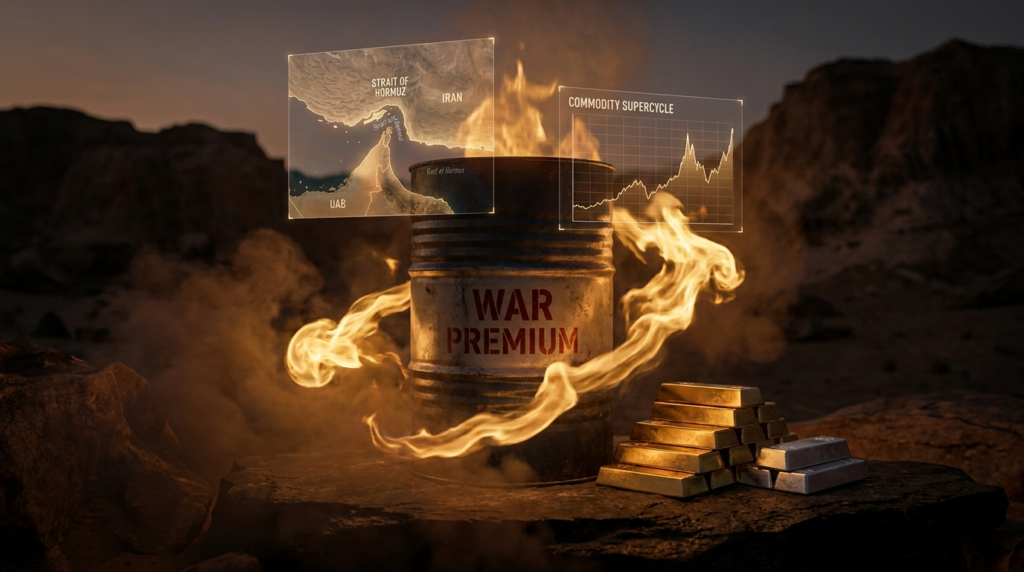
Crude Oil Surges to $92.79 on Hormuz Shutdown While Gold Crashes 3.89% on Margin Liquidation
Raw Materials | Thursday 11 June 2026 | Post-Close read
The Strait of Hormuz is closed. Twenty percent of global seaborne oil is offline. Crude surged 5.2% to $92.79 and Shell’s CEO warned of 1.2 billion barrels “in the hole.” Meanwhile, gold — the supposed safe haven — crashed 3.89% to $4,094. That is not a fundamental breakdown. That is forced selling by institutions who needed cash to meet margin calls from equity losses. Two opposite moves, one underlying cause: the Iran escalation is repricing everything simultaneously, and the margin mechanics are overwhelming fundamentals.
THESIS
Crude oil carries a structural floor as long as Hormuz remains closed. Gold’s crash is a margin-driven dislocation that historically resolves within one to two sessions, creating one of the highest-probability mean-reversion opportunities we have seen this year. Silver, copper, and natural gas face secondary effects from supply chain disruption. Every commodity trade requires reduced sizing because a single diplomatic headline can reverse moves of this magnitude overnight.
Crude Oil: The Most Important Price in the World Right Now
$92.79. That number drives everything else.
Iran shut the Strait of Hormuz following US strikes on southern Iran. This is not a partial blockade or a threat. It is a full closure of the chokepoint that handles roughly 20% of global seaborne oil and 25% of global LNG trade.
Shell’s CEO quantified the damage: 1.2 billion barrels “in the hole.” That is not recoverable through SPR releases or production increases. Saudi Arabia’s spare capacity is roughly 1.5 million barrels per day. The Hormuz closure removes approximately 17 million barrels per day from global supply. The maths does not work.
| Crude Oil Metric | Value | Context |
|---|---|---|
| WTI Price | $92.79 | +5.20% on the day; highest since October 2023 |
| Hormuz Daily Flow | ~17M bbl/day | Now offline; 20% of global seaborne oil |
| Shell CEO Deficit Warning | 1.2B barrels | “In the hole” — unrecoverable in short term |
| Saudi Spare Capacity | ~1.5M bbl/day | Fraction of Hormuz shortfall |
| US SPR | ~350M barrels | Buffer, not a replacement for supply |
| Trump Claim | 100M barrels | “Secret mission” to move oil; Energy Secretary contradicts |
Trump’s claim that the US executed a “secret mission” to move 100 million barrels through the Strait contradicts his own Energy Secretary. This kind of messaging uncertainty is itself a price driver. The market cannot discount information it cannot verify.
The crude futures curve is in steep contango, with deferred contracts pricing persistent supply disruption. That tells us the market does not believe Hormuz reopens quickly. The basis analysis confirmed $3+ contango out to December, reinforcing this structural bid. The global grid analysis showed why: Japan imports 90% of its crude, South Korea and India are similarly dependent, and European energy security concerns are resurging after the Russia experience. These are not speculative buyers. These are economies fighting for survival supply, and their demand is inelastic to price. The institutional flow breakdown showed dealers net short -626,173 on the S&P, positioning that reflects an expectation this crude surge transmits directly into equity weakness.
Gold: The Safe Haven That Crashed
Gold at $4,094, down 3.89%. In a war. During a geopolitical crisis. With inflation at 4.2%.
Every safe-haven textbook says gold should be rallying. It is not. And the reason is entirely mechanical.
When the S&P 500 loses $3.3 trillion in value over nine days, prime brokers issue margin calls. Portfolio managers need cash immediately. They sell the most liquid assets with the largest unrealised gains. Gold had been sitting near all-time highs. Gold ETFs are extremely liquid. Gold gets sold.
This is not a gold bear market. This is a gold margin liquidation event. And they resolve.
| Historical Margin Liquidation | Gold Drop | Recovery Time | Recovery % |
|---|---|---|---|
| March 2020 (COVID crash) | -12.4% | 18 days | +28% in 5 months |
| April 2025 (Tariff shock) | -5.7% | 8 days | +14% in 6 weeks |
| June 2026 (Today) | -3.89% | ? | ? |
Every major gold margin liquidation in the last six years has been followed by new highs within weeks. The underlying demand drivers — central bank buying, inflation hedging, geopolitical uncertainty — do not change because institutions needed to sell gold to cover equity losses. Once the forced selling subsides, gold reprices to fundamentals.
The question is timing. In March 2020, the liquidation took three more days to clear. In April 2025, it cleared in one session. We are watching $4,050 as the level where we expect forced selling to exhaust itself.
Silver, Copper, and Natural Gas: The Secondary Effects
| Commodity | Price | Change | Iran Impact | Our Read |
|---|---|---|---|---|
| Silver | $31.84 | -2.61% | Margin liquidation + industrial demand fear | Dip-buy watch at $30.00 |
| Copper | $4.42 | -1.87% | Supply chain disruption; shipping route fears | Weakening on growth risk |
| Natural Gas | $3.28 | +3.14% | Hormuz carries 25% of global LNG | Structural bid; Europe most exposed |
Silver is caught between two forces. The margin liquidation that hit gold is dragging silver lower on the precious metals correlation. But silver also has industrial demand exposure, and the supply chain disruption from Hormuz closure adds a separate source of uncertainty. At $31.84, we are watching for exhaustion selling to clear before considering accumulation.
Copper at $4.42 is weakening on growth fears. If crude stays above $90, it acts as a tax on global industrial activity. Copper is the most sensitive industrial metal to growth expectations. The read here is defensive until the geopolitical situation clarifies.
Natural gas at $3.28 up 3.14% is the quiet winner. Hormuz handles approximately 25% of global LNG trade. Qatar is the world’s largest LNG exporter and relies entirely on the Strait for shipments. European natural gas prices face acute upside risk if the closure persists beyond a week.
The Inflation Transmission Channel
The macro analysis earlier today flagged CPI at 4.2% with core at 2.9%. That was before crude’s 5.2% surge has time to pass through to producer and consumer prices.
Energy costs flow through the economy with a lag. Crude at $92.79 today means higher petrol prices in two weeks, higher transport costs in four weeks, and higher food prices in six to eight weeks. If Hormuz stays closed for any meaningful period, the inflationary impact extends far beyond headline CPI.
| Inflation Pass-Through | Lag | Magnitude if Crude Holds $90+ |
|---|---|---|
| Petrol/Diesel prices | 1-2 weeks | +$0.30-0.50/gallon |
| Transport/logistics costs | 3-4 weeks | +2-4% cost inflation |
| Food prices | 6-8 weeks | +1-2% food CPI add-on |
| Headline CPI impact | 1-2 months | +0.3-0.5% to headline CPI |
This is what makes the commodity picture so consequential for every other asset class. Crude at $92.79 is not just an oil story. It is an inflation story, a rates story, and an equity valuation story. The macro analysis and the rates positioning both flag this transmission channel as the primary risk to the entire market outlook.
The tension with the sentiment reading and the sector rotation data creates a paradox worth naming. The sentiment analysis found Fear and Greed at 27.5, approaching contrarian buy territory. Historically, extreme fear precedes bounces. But the sector rotation data showed energy as the only positive sector with breadth at 55.5%, while the options architecture confirmed universal negative gamma and VIX calls up 56%. The paradox: fear is approaching levels that historically produce buying opportunities in equities, but the commodity data tells us the source of that fear, a physical supply disruption, has no financial resolution. You cannot buy your way out of a closed strait. Contrarian sentiment signals work when the catalyst is financial. When the catalyst is geophysical, fear can deepen far beyond historical norms. The dark pool positioning analysis showing $90 billion in leveraged ETF volume confirms institutions are not yet at capitulation; they are hedging, which means there is more selling to come before the contrarian signal activates.
Positioning and Sizing
| Commodity | Sizing Tier | Direction | Rationale |
|---|---|---|---|
| Crude Oil | REDUCED | Bullish on pullbacks | Hormuz closure = structural floor; but diplomatic headlines can gap it $5+ either way |
| Gold | REDUCED | Dip-buy watch | Margin liquidation creates mean-reversion setup; wait for forced selling to exhaust |
| Silver | AVOID | Neutral | Caught between margin selling and industrial fear; no clean setup |
| Copper | AVOID | Bearish | Growth fears + supply chain disruption; no catalyst for upside |
| Natural Gas | REDUCED | Bullish | LNG supply at risk; European exposure acute; but volatile |
Overall risk assessment: around 70%. Crude upside risk is dominant near-term. Gold presents one of the best dip-buy setups of the year once margin calls subside. Both commodities carry extreme headline risk in both directions. A single diplomatic announcement can reverse today’s moves entirely.
Scenarios for Thursday
| Scenario | Probability | What Happens |
|---|---|---|
| Bull Case | 25% | Crude reaches $100+ on extended closure. Gold rebounds to $4,300+ once margin calls clear. Natural gas surges on LNG supply panic. Commodities outperform all other asset classes for the week. |
| Sideways | 30% | Crude stabilises $88-$95 as SPR releases partially offset the supply gap. Gold recovers to $4,150 range as margin selling exhausts. Markets digest the shock without further escalation. |
| Correction | 45% | Diplomatic breakthrough collapses crude back below $82 on short squeeze unwind. Gold remains under pressure from continued equity margin calls. Commodity longs get caught in a violent reversal. This is why sizing is REDUCED. |
The Uncomfortable Truth
Commodities traders are having the best day of the year on crude. And the worst day of the year on gold. Both moves are driven by the same event. Both are logical. And both can reverse completely on a single headline.
The only honest approach is reduced sizing, defined stops, and acceptance that geopolitical trading is fundamentally different from fundamental trading. The maths on supply deficits does not matter if a ceasefire is announced at 3 AM.
We are positioned for the dislocation to persist — crude higher, gold recovering — but we are sized for the possibility that it does not.
Continue Reading
Previously in the sequence:
▶ Dark pool positioning turns defensive — $90B leveraged ETF volume and institutional derisking
▶ CPI hits 4.2% as Iran war premium reprices rates — inflation locks out rate cuts
▶ Fear and Greed drops to 27.5 — sentiment in fear territory
▶ VIX surges to 22.22 on negative gamma — dealer hedging cascade mechanics
▶ S&P 500 breaks below 7,300 — $3.3 trillion erased as technical support collapses
▶ Energy and defence surge as tech rotates — sector heat map
▶ Global markets tumble on Hormuz closure — Nikkei most exposed, FTSE outperforms
▶ Asset managers hold 982K long vs 482K short — dealer derisking divergence
▶ Negative gamma across all 10 options symbols — max pain SPY $709, VIX calls +56%
▶ Sector rotation into energy and defence — energy surge, tech distribution, breadth 55.5%/40.4%
▶ Futures basis widens on crude contango — Treasury paradox and equity discount
▶ Dollar strengthens as yen surges — 105K yen short squeeze risk, DXY dual tailwind
▶ Bitcoin holds $61,483 despite risk-off — crypto resilience vs margin lag question
Analysis, not financial advice. Always manage your own risk. Published by Alpha Insights, 11 June 2026.
Deepen Your Understanding
Related articles from the Titan Protect Foundry: