Titan Macro Desk | Earnings Reaction
Nike Insiders Were Right: $3.7M Cluster Called the Beat Before Wall Street
30 June 2026 | After-Hours Reaction | Consumer Discretionary
Nike just delivered its strongest earnings surprise of FY2026, and the signal was hiding in plain sight. The $3.7 million insider buying cluster we flagged weeks ago has been emphatically validated. Reported EPS of $0.35 crushed the $0.28 consensus by 24.3%, and obliterated the original estimate of $0.13 that had anchored bearish positioning for months.
This is not a marginal beat. This is a structural repricing event for consumer discretionary, arriving at the precise moment the broader market has broken through its own resistance ceiling.
Q4 FY2026 Key Metrics
| EPS | $0.35 actual vs $0.28 expected | +24.3% beat |
| Revenue | $11.28B vs $11.23B expected | +0.4% beat |
| vs Original Consensus | $0.35 vs $0.13 original | +169% beat |
| Insider Signal | $3.7M cluster buying | VALIDATED |
The Insider Signal That Called It
When multiple insiders buy simultaneously with their own capital, it tells you something no analyst report can. The $3.7 million cluster we identified was not a single director exercising options or a routine compliance purchase. It was coordinated conviction, and it landed at a time when consensus had Nike dead to rights.
Consider the gap: the original consensus for this quarter was $0.13 per share. That number reflected a market that had priced in tariff headwinds, inventory overhang, and consumer fatigue. The insiders saw something different. They saw a company about to deliver $0.35, nearly three times what the Street originally expected.
This is precisely why insider flow analysis sits at the core of our research framework. Earnings estimates are backward-looking consensus. Insider behaviour is forward-looking conviction.
Breaking Down the Beat
The headline number is $0.35 against $0.28 expected. That 24.3% surprise is significant on its own, but the composition matters more than the magnitude.
Revenue Quality
Top-line revenue came in at $11.28 billion, edging past the $11.23 billion estimate. A modest beat in isolation, but meaningful because it demonstrates that the earnings surprise was not purely driven by cost-cutting. Nike is moving product. The consumer is spending.
Tariff Refund Contribution
A tariff refund contributed to the upside, which some analysts will flag as a one-off tailwind. That framing misses the point. Nike navigated the tariff environment well enough to extract a refund. Operational competence in adverse conditions is not a one-off; it is management quality.
The Consensus Journey
The original consensus of $0.13 was revised upward to $0.28 over the quarter. That revision alone tells a story of gradually improving sentiment. The fact that even the revised number was beaten by 24% suggests the market was still too cautious. Positioning was wrong, and it was wrong because it anchored to fear rather than fundamentals.
After-Hours Reaction and Positioning
The after-hours move will set the tone for consumer discretionary into the shortened holiday week. What matters is not just Nike’s price action, but the read-across to the entire sector.
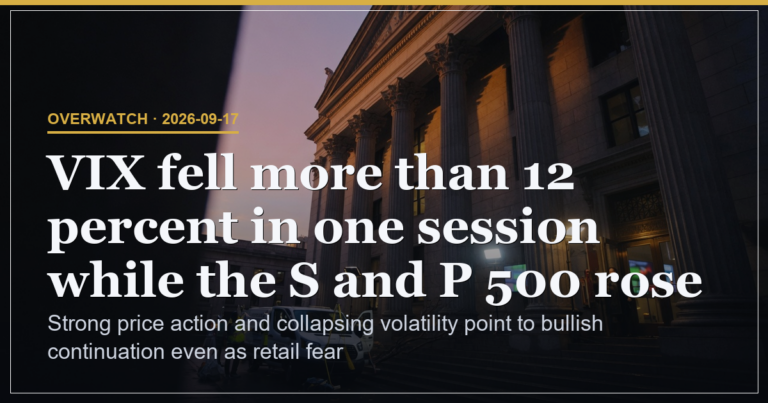
Today’s regular session already told the story. NAS100 broke 30,000 for the first time, closing at 30,269, up 1.7% on the day and 3.9% over two sessions. VIX collapsed to 16.59, the lowest level in weeks. The put/call ratio dropped to 0.70, firmly bullish territory. Fear and Greed climbed to 30.6, accelerating from the 24.8 extreme fear reading just four days ago.
Nike’s beat arrives into this backdrop as an accelerant, not an anomaly. The market was already telling you fear was overdone. Nike’s insiders were telling you the same thing weeks earlier.
Market Context at the Close
| NAS100 | 30,269 (+1.7%) |
| SPY | $746.60 (+0.76%) |
| VIX | 16.59 (-0.99) |
| Fear & Greed | 30.6 (+3.7) |
| Put/Call Ratio | 0.70 (bullish) |
What This Means for Consumer Discretionary
Nike is a bellwether. When Nike beats on both lines with insiders already positioned, it reframes the entire consumer discretionary narrative. The tariff-driven recession trade that dominated positioning through June now has a significant counterpoint.
The fear was real but the damage was priced in too aggressively. Fear and Greed at 24.8 extreme fear four days ago was the market pricing in a scenario that the actual earnings data does not support. Nike’s quarter shows that premium consumer brands can navigate tariff uncertainty, maintain revenue growth, and deliver upside surprises.
For Q3 positioning, the question becomes whether this beat catalyses a broader re-rating of consumer names that were punished on tariff fears. The put/call ratio at 0.70 and VIX below 17 suggest the market is already leaning that way. Nike’s result gives it fundamental permission to continue.
The “Manufactured Fear” Thesis Gains Evidence
We have tracked the disconnect between fear-driven positioning and actual earnings delivery throughout this cycle. The pattern is consistent: macro anxiety drives positioning to extremes, insiders accumulate, and then actual results reveal that the fear was overdone.
Nike is the latest and most emphatic example. F&G moving from 24.8 to 30.6 in four days, with NAS100 breaking a major psychological level, and now a bellwether consumer name beating by 24% on EPS. These are not disconnected data points. They are a single narrative: the fear cycle is turning.
That does not mean the all-clear has sounded. But it means that those who positioned for the worst-case scenario are now offside, and the unwind of that positioning becomes its own catalyst.
Forward Scenario Framework
Bullish: Sector Re-Rating Accelerates (45%)
Nike’s beat triggers upgrades across consumer discretionary. Short covering amplifies the move. NAS100 extends above 30,000 through the holiday-shortened week. VIX stays below 17.
Base: Digestion and Selective Rotation (40%)
Nike gaps higher but the broader market consolidates near 30,000. Holiday-week thin liquidity limits follow-through. Consumer names outperform but gains are measured, not euphoric.
Bearish: Tariff Refund Discount and Fade (15%)
Market discounts the tariff refund contribution as non-recurring. Nike fades the after-hours gap. Macro bears use the holiday week to reset shorts at higher levels.
The Takeaway
The insiders were right. $3.7 million of conviction buying ahead of a 24% EPS beat is not luck. It is information asymmetry, and it is exactly the kind of signal our research framework is built to capture.
Nike’s quarter validates three things simultaneously: the consumer is more resilient than bearish positioning suggested, tariff headwinds are navigable for premium brands, and insider behaviour remains one of the most reliable forward indicators available.
As always, depth over noise.
Titan Macro Desk | titanprotect.co.uk
This content is for informational purposes only and does not constitute financial advice. Past insider activity does not guarantee future results.