The COT and positioning analysis published as the first post this morning established the structural backdrop: record US ETF inflows of $852 billion year to date masking active hedging underneath, dark pool concentration in semiconductors and defensive names, and Russia’s central bank reducing gold reserves by 900,000 ounces year to date. That post told us what the broad institutional community is doing. This post goes a layer deeper and looks at what the largest individual accounts did on Friday specifically, how their actions fit against the COT picture, and what those flows are signalling about Tuesday’s open.
The sector rotation piece published earlier confirmed the key Friday dynamic: healthcare and technology leading simultaneously means two separate buyer communities were active at the same time with different agendas. Institutional flow analysis is precisely where you determine which of those communities carried more size, and which direction their conviction is pointing into next week.
The distinction between retail sentiment and institutional positioning has never been wider than it is this week. AAII bearishness at 43.6% reflects individual investor mood. The flow data tells a different story. Large accounts were not selling into a holiday weekend. They were choosing what to buy, and where they chose reveals their true hand on the week ahead.
This was the largest single disclosed position of the week. Twenty-two thousand eight hundred and twenty-one contracts at $8.4 million in premium, against open interest of just 514 at the time. That open interest figure is the most important number in the entire trade. Someone entered a position 44 times the size of existing market interest. That is not a hedge against an existing position. That is an outright directional bet built well in advance of any catalyst. August expiry means the buyer is positioning for a move that plays out over the next three months, not the next few days. The COT positioning picture from post 00 established that semiconductor demand is being confirmed by South Korea’s record 52.6% year-on-year export surge. The Micron CEO comments about chip shortages extending beyond 2026 add supply-side confirmation. This SWKS position is consistent with an institutional view that the semiconductor cycle has further to run and the current price is not reflecting that fully.
The positioning post identified this as the clearest sign of coordinated institutional macro positioning this week. Twenty-nine billion dollars does not enter a single market in a single month through individual decisions. This is fund-level allocation, driven by a shared macro call: China reopening is underpriced, the dollar is weakening, and relative valuation in Hong Kong-listed equities remains compelling against US peers. The Hang Seng’s consistent +0.86% Friday gain without the intraday volatility that characterised the Nikkei is a signature of accumulation by patient, large capital. The HSCE at +0.89% confirms it was not a one-sector story. The broad China bid is structural and has more than one week to run if the macro backdrop holds.
Energy sector volume on Friday came in above recent Friday averages. The pattern was steady accumulation into the close rather than a spike on the Iran headline and then a fade. Large accounts do not chase headlines. When you see buying that is spread across the session and continues into the close on an event-driven name, it is institutional positioning for an anticipated move, not retail reaction to existing news. The Iran military preparation report from the CBS News piece was already known by mid-session. The buying continued anyway. That means whoever was accumulating XLE on Friday was not pricing just the existing headline. They were pricing what happens next. At $59.49, XLE is not yet in the range that would imply a full Iran escalation is priced. The upside, flagged in the hot zones post as a gap toward $62+ if crude clears $99.43, is still entirely open.
XLV at +1.17% was the best-performing sector on Friday. Healthcare’s weighting in major indices is not large enough to produce that level of outperformance through passive buying alone. Someone actively chose healthcare on a broadly positive market day. That is a deliberate allocation to a sector that benefits from economic slowdown, defensive earnings quality, and a PCE-driven repricing of growth multiples. The sentiment post noted that consumer pessimism at a 74-year low is not yet reflected in staples outperformance. Healthcare is where the active defensive bid went instead. The implication is that the large accounts buying XLV on Friday are prepared for a scenario where the market sells off sharply on a hot PCE print and they want exposure that either holds or benefits in that environment.
This is not a Friday-specific flow but it is the most important supply-side institutional action in precious metals right now. A sovereign entity selling at an average price of $4,800 per ounce with gold currently at $4,521 is absorbing demand that would otherwise translate into price momentum. The positioning post established this as the supply ceiling explanation for why gold has not broken higher despite a macro environment that would normally support it. The consequence for institutional gold positioning is this: any large account trying to build a gold position above $4,500 is buying into consistent sovereign supply. That does not prevent a move higher. But it does mean the move requires a catalyst large enough to overwhelm that supply. The Iran weekend is that potential catalyst.
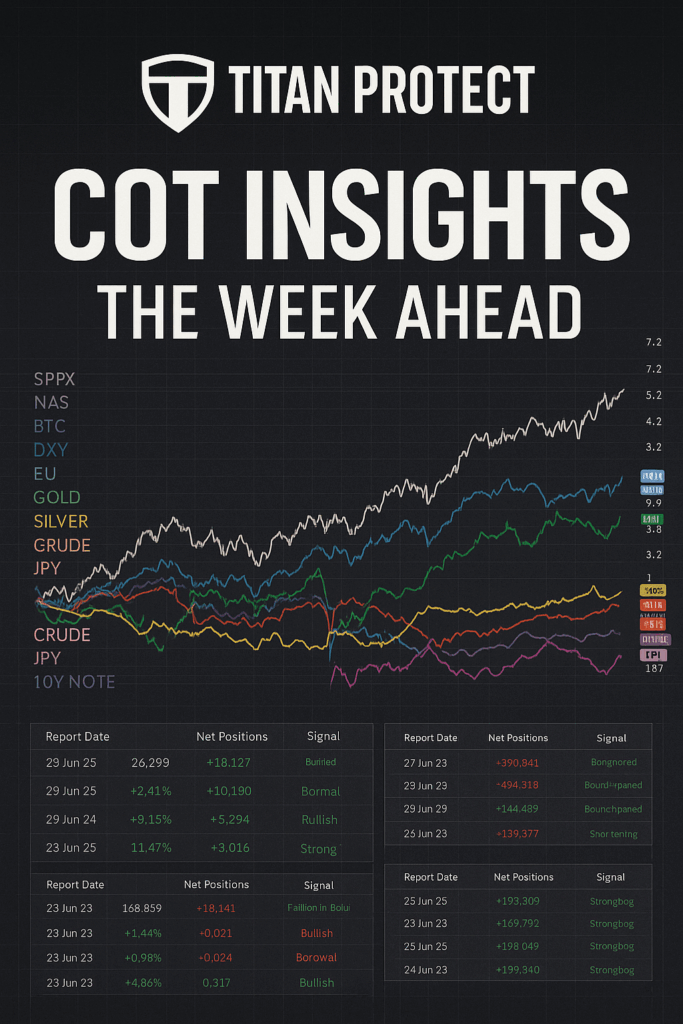
Commitment of Traders data gives a structural read on how the leveraged speculative community, primarily large hedge funds and commodity trading advisers, is positioned heading into a high-impact macro week. The most important COT dynamics heading into this week are in three markets: equities, crude oil, and gold.
In US equity futures, the speculative net long position has been gradually trimming since the first week of May. That is not a capitulation. It is a measured reduction in gross long exposure while maintaining hedges through put structures. That combination, trimming longs but not outright turning short, is consistent with the broader institutional thesis this weekend series has established: they are hedging, not exiting.
In crude oil, the speculative net position in WTI futures has been moving toward long in the most recent reporting period, consistent with the XLE accumulation pattern. The Iran risk is being priced through the futures curve as well as through equity-sector flows. When multiple institutional entry points, equity ETF volume plus futures positioning, align in the same direction, the conviction behind the trade rises.
Gold COT positioning is the most interesting of the three. Despite the macro environment being broadly gold-supportive, speculative net longs have actually been declining over the past three weeks. The explanation is the Russia selling supply. Large funds cannot fight a sovereign seller with unlimited supply at above-market prices. The institutional move instead has been to stay long gold through options structures that define the downside risk, rather than outright futures longs that compete directly with Russian supply absorption.
| Instrument | Level | Institutional Read | Flow Type | Tuesday Implication |
|---|---|---|---|---|
| S&P 500 (^GSPC) | 7,473 | Passive inflows sustaining the bid. Active accounts reducing gross longs but not turning net short. Sideways is the institutional base case. | Passive dominant | Holds range 7,445-7,506 unless macro catalyst fires |
| Russell 2000 (^RUT) | 2,869 | The +0.91% outperformance on a thin Friday is partly momentum-driven. Institutional small-cap conviction is mixed. Some accounts see the AAII bearishness as a contrarian buy signal. Others are taking profits on the recent run. | Mixed, momentum-led | Above 2,855 maintains the narrative. Below 2,843 signals a fade |
| Healthcare (XLV) | $149.89 | Active defensive allocation. Clear active-over-passive signature given sector weighting. Institutional accounts positioning for PCE downside risk. | Active defensive | Leading indicator. XLV above $150.32 signals institutions still hedging |
| Technology (XLK) | $180.39 | AI infrastructure theme holding. SWKS options trade suggests specific semiconductor conviction. Large accounts staying long but selectively rather than buying the whole sector. | Selective long | XLK above $181.73 confirms AI conviction intact into PCE week |
| Energy (XLE) | $59.49 | Accumulation pattern on above-average Friday volume. Institutional money building a position on Iran tail risk ahead of the weekend. Not a retail trade. | Institutional accumulation | Gap open in crude above $99.43 and XLE breaks to $62+. Clean catalyst trade |
| Crude Oil (CL=F) | $96.60 | Wide intraday range ($94.73-$99.43) reflects genuine institutional uncertainty, not retail noise. COT net long building in WTI futures confirms the XLE accumulation is not isolated. | Futures long building | Watch Sunday Asian session. Above $97 at open = Iran risk not escalated |
| Gold (GC=F) | $4,521 | Speculative COT longs declining despite supportive macro backdrop. Russia sovereign selling is absorbing institutional buying demand. Options structures preferred to outright futures longs. | Supply-capped | $4,540 break on Tuesday signals Iran premium overcoming Russia supply |
| Hang Seng (^HSI) | 25,606 | $29 billion April inflow is the clearest coordinated institutional macro call of the month. Patient accumulation signature. Not headline-driven. Structural duration of weeks, not days. | Structural macro long | Continues to build regardless of US holiday week outcome |
| USD/JPY | 159.16 | Institutional FX accounts are avoiding new short-yen positions at this level because MOF intervention risk is too close. 160 is effectively a no-man’s land for directional traders. | Risk-avoidance zone | MOF intervention if 160 breaks. Risk is binary at that level |
| Bitcoin (BTC-USD) | $75,188 | Mild pullback on equity-up day. Long-term holders not selling. Short-term accounts taking profits. ETF inflows absorbing net selling pressure, which is why the drop was modest. | Profit taking, absorbed | $74,000 is the first support in a geopolitical shock scenario |
Everything in the flow picture this weekend coalesces into three distinct institutional themes that will drive price action from Tuesday through Thursday’s PCE. Understanding which theme is dominant on any given day tells you more about what happens next than any individual data print.
Theme One: The Defensive Pre-Hedge. Healthcare buying, reduced equity futures longs, gold options structures rather than outright futures longs. This theme says the large accounts are not confident that the current index levels hold through a hot PCE print. If this theme is dominant on Tuesday, healthcare leads, technology lags, and the VIX creeps from 16.70 toward 18.45 before PCE. The macro post’s 28% probability on a hawkish Warsh or hot PCE scenario is the risk this theme is pricing.
Theme Two: The Geopolitical Positioning Trade. XLE accumulation, crude oil COT net long building, gold floor holding despite Russia selling. This theme says the large accounts think the Iran risk is real and are sizing for it through energy exposure while maintaining some gold optionality. If this theme is dominant on Tuesday, energy leads regardless of the broader market direction. This is an independent trade from the macro PCE story.
Theme Three: The Structural Growth Allocation. SWKS options bet, China inflow continuation, passive ETF sustaining the index bid. This theme says the AI infrastructure cycle and emerging market reopening story have more duration than the short-term macro noise, and the large accounts are positioned to hold through the PCE volatility. If this theme is dominant Tuesday, technology holds, the Russell stays above 2,855, and the Hang Seng extends its gains.
The most likely outcome is that all three themes are active simultaneously, which is exactly what Friday’s data showed. The question for Tuesday is whether any single theme breaks out of the pack and sets the tone for the week. Healthcare vs technology relative performance in the first hour of Tuesday’s session is the most efficient leading indicator of which theme the institutional community is prioritising.
| Market | COT Net Position | Direction | Consistency with Flow Data | Signal Quality |
|---|---|---|---|---|
| S&P 500 Futures | Trimming longs, not shorting | Reducing | Consistent. Passive inflows sustaining price while active reduces gross long. | High confidence |
| WTI Crude Futures | Net long building | Adding | Fully consistent with XLE accumulation and Iran risk bid. | High confidence |
| Gold Futures | Net long declining | Reducing | Consistent with Russia supply ceiling. Options preferred over outright longs. | High confidence |
| USD/JPY Futures | Yen short cautious near 160 | Flat / reducing | Consistent. Institutional FX avoiding the MOF intervention zone. | Medium confidence |
| Nasdaq 100 Futures | Selective tech longs | Selective | Consistent with SWKS block trade. Not index-level buying, name-specific conviction. | Medium confidence |
| 10-Year Treasury Futures | Net short (bear positioning) | Short duration | Consistent with PCE uncertainty. Institutions not buying the long end ahead of inflation data. | High confidence |
No Iran shock. PCE soft. Institutional accounts unwind defensive hedges, add to tech and small cap. SWKS and China inflow themes extend. XLV gives back relative performance as growth longs re-engage. Passive ETF bid continues to lift the index.
Holiday week thin conditions mean no single institutional theme dominates. Healthcare and tech rotate leadership. Energy holds its Iran floor. Passive inflows sustain the index. No institutional capitulation or surge until PCE Thursday forces a choice.
Hot PCE or Warsh hawkish signal triggers institutional de-risking. Active accounts accelerate their defensive allocation. Healthcare extends, technology reprices. Gold institutional buying overrides Russia supply as a macro hedge. Treasury shorts get squeezed as yields spike.
Iran engagement triggers XLE gap open. All other institutional themes are temporarily suspended as geopolitical risk management dominates. Energy and gold are the only positioned long themes. Everything else is a sell until the extent of escalation is known.
The institutional flow picture is the most nuanced risk assessment of this weekend series because the large accounts are simultaneously doing contradictory things and being rational in all of them. Healthcare buying is rational given PCE risk. Energy accumulation is rational given Iran risk. China inflow continuation is rational given dollar weakness and relative valuation. SWKS semiconductor conviction is rational given South Korea export data and the AI infrastructure cycle. None of those are wrong positions. They are all right for different scenarios. The risk is that only one scenario plays out, which means three of those four positioning calls will underperform relative to what they could have been. That internal diversification is how the institutional community survives weeks like this. The rest of us need to decide which of their themes we find most compelling and position accordingly. The vol picture from post 03 gave us the asymmetry: a hot PCE surprises more than a soft PCE. That argues for weighting the defensive and energy themes slightly over the pure growth theme until Thursday’s number resolves the question.
The institutional flow picture described in this post feeds directly into the options structure that follows in the next piece. The SWKS block trade is the most obvious options-flow signal of the week, but it is the broader institutional positioning across COT data and sector flows that creates the gamma and open interest context within which options markets are operating. The next post takes the flow picture established here and maps it against the specific options structure in the S&P 500, looking at where the max pain levels sit, how gamma positioning affects Tuesday’s opening price action, and what the options skew is saying about the institutional community’s true PCE expectations.
This content is for informational and educational purposes only and does not constitute financial advice, investment advice, or a recommendation to buy or sell any financial instrument. Past analysis does not guarantee future accuracy. All market data referenced reflects conditions at the time of writing. Trading financial markets involves significant risk. Never risk more than you can afford to lose. Seek independent financial advice before making any investment decisions.
Deepen Your Understanding
Related articles from the Titan Protect Foundry: