Monday 18 May 2026 | Technical Frameworks Series | Post 15 of 19 | Members Only
Tactics gave you the levels. This post gives you the language underneath the levels — what the framework is reading about market structure, the current phase of the trend, where momentum sits relative to price, and how the regime has been classified. None of this is decoration. Every reading here has a consequence for how you size, when you wait, and what kind of market you are trading into tomorrow.
The short version: this is a market in a consolidation phase on the intermediate timeframe, with the longer-term structure intact but under genuine pressure. The framework has not turned bearish. What it has done is issued a caution — a flag that says the conditions for trend continuation are not yet in place. Until that flag clears, the framework is asking you to wait for confirmation before committing size.
As you’ll find in our Tactics brief, the two confluence zones identified for Tuesday — Gold at 3,220-3,235 and NAS100 at 28,717 — are not arbitrary levels. They are the points where the framework’s structural read, the macro context, and the entry discipline all converge simultaneously. This post explains why those levels carry the weight they do: the confluence zone table in Tactics is only meaningful if you understand the regime and momentum reads that sit beneath it, and that is precisely what the sections below provide.
Market Structure Phase: The Intermediate Timeframe Has Turned
The most useful thing a framework can tell you is where you are in a market cycle. Not the daily noise — the actual structural position. Right now, on the intermediate timeframe, the framework has rotated from the bullish trend phase that defined March and April into a correction phase. That is not a signal to sell everything. It is a signal that the easy money on the long side has already been made, and the next long entry needs to be earned rather than assumed.
What a correction phase looks like in practice: price is pulling back toward levels where the prior trend found buyers, volume on up-moves is lighter than volume on down-moves, and momentum has outrun price on the recovery from the April lows. That last point matters. When momentum moves faster than price, it typically means the early buyers are already positioned and the new money coming in is thinner. The correction phase is the market’s way of resetting that imbalance.
The longer-term structure tells a different story. The macro direction on the longer timeframe remains locked in the bullish camp. The April trade-deal relief rally created a structural shift that is still intact, and nothing on Monday’s tape challenged that structure directly. The correction phase on the intermediate timeframe sits inside a longer-term trend that is still pointing up. That is important because it means the framework is reading a pullback within an uptrend, not a trend reversal. The bias is to look for the long re-entry, not to get short and stay short.
| Timeframe Layer | Phase | Implication for Trading |
|---|---|---|
| Longer-term (macro) | Bullish trend intact | Structural bias to the long side. Do not fight the bigger picture. |
| Intermediate | Correction phase active | Raised the bar for long entries. Need confirmation, not assumption. |
| Short-term (intraday) | Ranging. Catalyst-dependent. | Negative gamma environment amplifies both directions. No edge in the middle. |
Directional Lean: Neutral With a Cautious Flag. Not the Same Thing as Bearish.
There is a version of this that gets misread, so it is worth being precise. The framework’s directional lean right now is neutral and cautious. That is not the same as bearish. Bearish means the framework is reading institutional distribution, structural breakdown, and momentum deterioration. None of those three things are fully in place. What is in place is a warning flag — a reading that says the conditions for trending long are not yet present, and entering as if they are will cost you.
The equities segment of the framework carries its own signal, and today that signal leans toward caution at the instrument level. As noted in Post 02 (Sentiment), the Fear and Greed Index is in greed territory at 61.8, but the individual investor survey shows bears almost matching bulls — 36.6% bears versus 39.3% bulls. The analysis reads this contradiction and flags it as a warning, not a direction. It is telling you the crowd is divided, which means there is no clear wind at anyone’s back right now.
The commodities segment is different. The framework is reading a bullish signal on commodities, which lines up exactly with what the positioning data showed in Post 01 and what the tactical analysis in Post 14 (Tactics) confirmed. Gold is the clearest expression of that signal. The framework’s lean on Gold is constructive without qualification.
Momentum State: Has Outrun Price on Equities. Gold Is the Exception.
The momentum state is one of the most actionable readings the framework produces, because it tells you whether price is leading or lagging its own internal energy. Right now, on the equity indices, momentum has outrun price. The recovery from the April trade-deal lows pushed momentum higher faster than price could follow. That imbalance is now resolving through the correction phase — price is pulling back to where momentum can catch up.
This is normal behaviour in a healthy pullback within an uptrend. The problem is the timing. The momentum overshoot happened right before a binary geopolitical catalyst — the Tuesday Situation Room meeting. An overstretched momentum reading going into a binary event creates asymmetric risk. If the event is benign, momentum cools and price consolidates, which is the most boring outcome. If the event is negative, momentum reverses sharply from an already-stretched position, and the move is larger than a normal pullback would be.
Gold’s momentum state is different. The analysis reads Gold’s momentum as supportive — not stretched, not exhausted, but constructively building. That is why the gravity zone on Gold behaves differently to the gravity zone on NAS100. On NAS100, the gravity zone is where a stretched momentum is correcting to. On Gold, the gravity zone is where fresh momentum is gathering before the next leg. The framework distinguishes between these two very clearly, and you should trade them differently as a result.
| Instrument | Momentum State | What It Means |
|---|---|---|
| NAS100 | Outrun price. Cooling. | Correction phase is momentum catching up. Do not fight it. |
| SPX | Flat to slightly soft. | Options pinning suppressing directional momentum. Catalyst needed. |
| Gold | Building. Constructive. | Gathering energy. Pullbacks to level are buying opportunities, not warnings. |
| Crude Oil | Spike and reject. | Momentum led price to $107, failed to sustain. Reset needed before next move. |
| Russell 2000 | Weakest of all indices. | Credit-sensitive, most bearish P/C structure. Momentum deteriorating. |
Regime Classification: Normalising. Not Risk-Off. Not Risk-On. In Between.
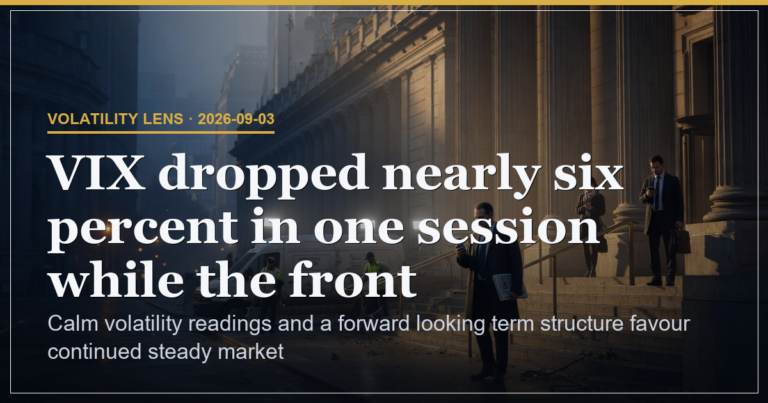
The regime reader has classified the current environment as normalising. In the weeks following the April panic, the regime shifted sharply into risk-on as the trade deal headline sparked a relief rally and volatility collapsed. That risk-on regime has now begun to stabilise rather than extend. The VIX closed at 17.82 after an intraday high of 19.44, which is the signature of a regime that is not panicking but is not complacent either — it is sitting with its hands on its knees, watching the door.
As noted in Post 03 (Volatility), the VIX path through Monday’s session is the signal that matters more than the close. The fall from 19.44 to 17.70 in a single session was not a conviction drop — it was position squaring ahead of a binary event. A regime that is genuinely normalising would see the VIX gradually compress over multiple sessions, not spike and retreat inside one day. The analysis reads the intraday VIX behaviour as consistent with a market that is holding its breath, not one that has resolved its uncertainty.
The VVIX at 91 reinforces this. Elevated VVIX tells you that the options market is pricing uncertainty about the VIX itself — not just about the equity market. That is what you see ahead of events with genuinely binary outcomes. The regime can resolve to risk-on very quickly if Tuesday de-escalates. It can also resolve to risk-off just as quickly if it does not. The framework’s classification of “normalising” is doing the honest thing: it is not calling a direction it does not have evidence for.
| Measure | Reading | Regime Implication |
|---|---|---|
| VIX close | 17.82 | Mid-range. Neither complacent nor fearful. |
| VIX intraday high | 19.44 | Key level. Break here signals regime flipping risk-off. |
| VVIX | 91 | Elevated. Options market uncertain about the VIX itself. Binary event live. |
| Negative gamma breadth | All major indices | Dealer hedging will amplify the next directional move. Not dampen it. |
| Regime classification | Normalising | Pullback within uptrend. Warning flag active. Not a trend reversal signal. |
Swing State: Cautious. The Warning Flag Is Real. Here Is What It Means.
The swing state reading right now is cautious, with an active warning flag. It is worth being precise about what a warning flag means in the context of the framework. It is not a sell signal. It is a risk adjustment signal. The framework has identified that the conditions required for a high-probability trend entry are not all in place. One or more of the inputs that normally align to confirm a continuation trade are currently misaligned or insufficient. As a result, the framework is telling you to reduce position size, require stronger trigger conditions before entering, and hold less overnight risk than you normally would.
The warning flag emerged because the intermediate timeframe turned while the longer-term timeframe remained bullish. That divergence between timeframes is exactly the condition that creates false starts — setups that look good on one timeframe but fail because they are running against the current on another. Trading into a timeframe divergence without a catalyst to resolve it is one of the most common ways experienced traders give back gains on what looks like a valid setup.
The flag clears when the intermediate timeframe re-aligns with the longer-term direction. That can happen quickly if Tuesday’s catalyst is benign and risk sentiment re-engages. Or it can take longer if the geopolitical uncertainty extends. The framework does not try to predict which — it reads what has happened, flags what is misaligned, and adjusts the read when the evidence changes. That is the discipline.
Pulling It All Together: What Every Post in This Group Is Saying
This is the synthesis moment. Every post in today’s group — from institutional positioning through to the framework signals you have just read — is pointing at the same underlying truth from a different angle. Here is what that truth is.
The market is not broken. The structural trend from April is intact and the longer-term daily read confirms it. But the market is not running freely either. Institutional participants are hedged, sentiment is split, the regime is in between states, and a binary catalyst is 24 hours away. The framework has responded by raising the bar — asking for confirmation before acting, flagging the warning, and identifying the one instrument that does not need Tuesday to resolve before it is tradeable.
That instrument is Gold. As noted in Post 14 (Tactics), the framework’s strongest directional read of the session is on Gold. As confirmed in Post 02 (Sentiment), the commodities signal is bullish while equities carries a warning. As confirmed in Post 03 (Volatility), the VIX path indicates the market is holding its breath ahead of Tuesday — and Gold is the trade that works whether Tuesday resolves bullishly or bearishly. It is a safe-haven instrument when fear rises. It is a commodity instrument when macro inflation pressure continues. Both of those conditions are present right now.
| Signal Source | Reading | What It Adds |
|---|---|---|
| Post 01: Positioning | Hedged but long. COT yen safe-haven. | Institutions not fully committed. Gold and yen are their hedge instruments. |
| Post 02: Sentiment | Equities bearish signal. Commodities bullish. | Framework sentiment divergence confirms Gold over equities as primary trade. |
| Post 03: Volatility | VIX 17.82. VVIX 91. Negative gamma. | Amplified moves ahead. Regime normalising, not resolved. Catalyst live. |
| Post 04: Radar | Levels mapped. Range defined. | 7,400 max pain gravity on SPX. 28,717 the NAS100 line. |
| Post 14: Tactics | Gold highest conviction. NAS100 conditional. | Specific entry/stop/target levels. Sizing by experience level. |
| Post 15: Signals (this post) | Correction phase. Cautious flag. Normalising regime. | The why behind the levels. Confirms Gold is the primary read. Equities need trigger. |
The Overwatch post closes tonight’s session with a full synthesis across all instruments and all posts. Everything you have read today — positioning, sentiment, volatility, levels, and signals — comes together in a single view of what the market is likely to do from here.
This content is for informational and educational purposes only. It does not constitute financial advice. Framework readings interpret market data and do not guarantee future results. Always apply your own risk management before placing any trade.
Deepen Your Understanding
Related articles from the Titan Protect Foundry: