Monday 18 May 2026 | Macro Foundations Series | Post 4 of 4
The three posts before this one built a specific picture: institutions are hedged but long, macro is stressed at 15-month yield highs, and sentiment is divided despite a greed reading. This final post in the Macro Foundations group looks at what the volatility structure itself is telling you — the VIX path through the day, the VVIX reading at 91, the options skew, and what negative gamma means for how the next move is likely to behave.
VIX at 17.82: Reading the Path, Not Just the Close
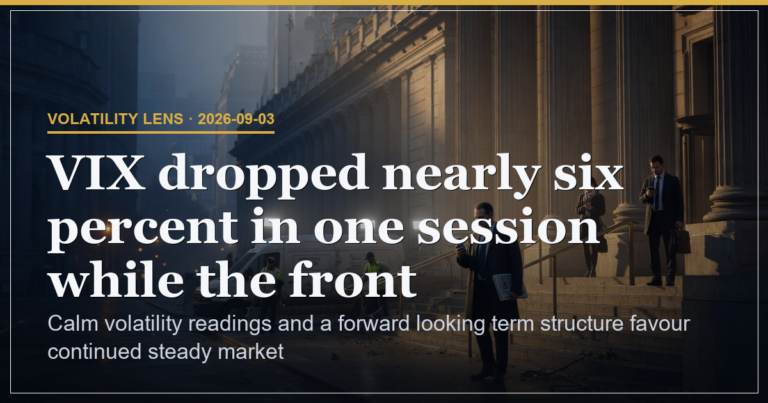
The VIX closed at 17.82, which is 3.31% below Friday’s close of 18.43. On the surface, volatility fell on Monday. But the path to that close tells you everything the number hides. The VIX opened at 19.25 as London carried the risk-off tone from overnight into European markets. It then spiked to an intraday high of 19.44 as the DAX and FTSE sold off on rising bund yields. The low of the day was 17.70, reached during the US afternoon as buyers stepped in to fade the fear.
What this path means in practice: the market’s fear response was genuine during the European and early US session. Then it reversed. The question is whether that reversal was a change of view or simply position squaring ahead of Tuesday’s Situation Room meeting on Iran. A VIX that falls from 19.44 to 17.70 in a single session and then finds a catalyst the following day often spikes back above where it started. Watch the 19.44 intraday high as the key level. If Tuesday’s news is negative, that level is likely to be tested and exceeded.
| Level | Price | Implication |
|---|---|---|
| Previous Close (Friday) | 18.43 | Starting fear level for the week |
| Monday Open | 19.25 | Fear elevated at the open — overnight risk priced in |
| Intraday High | 19.44 | Key resistance level — break here signals escalation |
| Intraday Low | 17.70 | Support — where dip buyers stepped in |
| Monday Close | 17.82 | Relief, not resolution. Tuesday will confirm which. |
VVIX at 91: The Volatility of Volatility Is Elevated
The VVIX — the volatility of the VIX itself — sits at 91. This measures how quickly and aggressively the market expects the VIX to move, not simply where it is. A VVIX of 91 tells you that the options market is pricing significant uncertainty about the VIX’s own direction. In practical terms: participants are not just buying protection for where the VIX is now. They are buying protection for sudden jumps in the VIX itself.
Historically, a VVIX above 90 while the VIX is below 20 is one of the more interesting setups in volatility markets. The VIX is “calm” at 17.82, but the market is pricing the possibility of a rapid VIX expansion. This typically happens in two scenarios: when a known binary catalyst is approaching (Iran Situation Room on Tuesday), or when market participants have become aware of a systemic vulnerability that has not yet triggered (rising yields, student loan defaults, freight cost spikes).
Both conditions apply here. This combination — relatively calm VIX but elevated VVIX — is the volatility market’s way of saying “we do not know exactly when, but we know something can happen quickly.” If you are trading without hedges this week, the VVIX at 91 is telling you that the cost of being wrong is higher than the VIX alone suggests.
Negative Gamma and the Skew: Why This Week’s Moves Will Be Amplified
Negative gamma is the single most important structural factor in this week’s market. It means that market makers who have sold options are in a position where they have to buy when prices rise and sell when prices fall. They are forced to trade in the same direction as price. This amplifies moves — both up and down — rather than dampening them.
Every major index product is in negative gamma territory right now: SPY, QQQ, and IWM. That is not a marginal situation. It means that for any catalyst — positive or negative — the first move will be exaggerated. If Iran de-escalates on Tuesday and equities jump, dealers will buy into the rally, pushing it further than the fundamental news warrants. If Iran escalates and equities sell, dealers will sell into the decline, pushing it further than fundamentals would suggest.
The skew tells the same story from a different angle. QQQ gex-max-pain-and-putcall-ratios/” style=”color:#D8AF44;text-decoration:underline” title=”What is Options Intelligence?”>put/call ratio is 1.40. IWM is 1.49. Participants are paying a premium for downside protection on the indices. The fact that they are willing to pay that premium at a VIX of only 17.82 suggests they believe the current VIX is underpricing the risk of a sharp downward move. They are right to question it — the VVIX at 91 agrees with them.
| Product | Max Pain | P/C Ratio | GEX | Skew Read |
|---|---|---|---|---|
| SPY | $740.00 | 0.58 | Negative | Dealers amplify moves both ways |
| QQQ | N/A | 1.40 | Negative | Active protection buying, bearish skew |
| IWM | $283 | 1.49 | Negative | Most bearish skew of any major index |
| MSFT | $407.50 | 0.24 | Negative | Strong call bias — institutional demand |
What the Volatility Structure Means for Your Trades This Week
The combination of negative gamma, VVIX at 91, and a binary Tuesday catalyst creates a specific set of rules for sensible risk management this week.
First: move sizes will be larger than usual on catalyst events. Do not anchor your stop levels to “normal” intraday ranges. A move of 1-1.5% on a VIX day like today is normal. If Tuesday’s news is sharp, moves of 2-3% on the index in a short window are realistic. Size your positions so that a 2% adverse move is tolerable, not catastrophic.
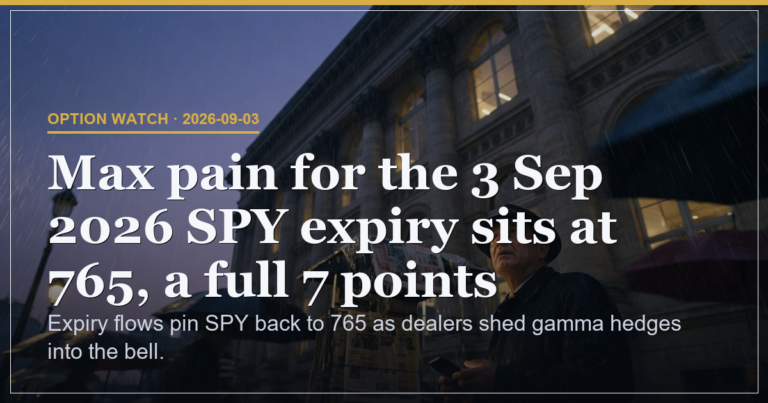
Second: the market gravitates toward max pain on options expiry. SPY’s max pain for today’s expiry was at $740.00 — very close to the SPX level of 7,403. This is not coincidence. The gravitational pull of max pain in negative gamma environments is stronger because dealers are actively managing their books around these levels. For Tuesday, watch where the new max pain levels sit after today’s expiry rolls off.
Third: gold and yen are the cleanest hedges in this environment. Gold at $4,570 is rising alongside yields — a sign that the market is pricing genuine uncertainty rather than simple rate repricing. The yen at USD/JPY 158.90 is strengthening on safe-haven demand. Both instruments perform best in the “Iran escalates” scenario. If de-escalation happens, they give back some gains but with far less speed than equities would rally.
Volatility Scenarios for Tuesday and Beyond
Sizing Around the Volatility Structure
In a negative gamma environment, your stop levels need to be further from entry than usual. A move that would normally be noise becomes a forced dealer cascade. Either widen stops and reduce size proportionally, or sit out Tuesday’s catalyst entirely and enter on Wednesday when the picture is clear.
The VVIX at 91 with VIX at 17.82 creates a specific opportunity: buying options protection is cheaper than the VVIX suggests it should be. If you want to hold long equity positions through Tuesday, defined-risk structures — where the maximum loss is fixed — are the appropriate vehicle, not naked longs with stops.
Negative gamma with elevated VVIX and a known binary catalyst is a volatility trader’s setup. Long straddles on SPX around Tuesday’s session open, or long VIX calls with the VIX at 17.82, both offer defined-risk ways to profit from whichever direction the move goes. The move will be larger than the current VIX implies.
Positioning (Post 1): Institutions are hedged but long. Mega-cap call buying with broad index put protection. Negative gamma environment confirmed.
Macro (Post 2): 10Y yields at 4.63%, highest since Feb 2025. Dollar falling despite yield rise — fiscal concern, not growth signal. Student loans, freight, electricity all pointing to stagflation pressure.
Sentiment (Post 3): Fear and Greed at 61.8 greed while AAII is almost evenly split. VIX fell from 19.44 to 17.82 in one session. The relief may be premature.
Volatility (Post 4): VVIX at 91 says the next move will be fast. Negative gamma says it will be amplified. Tuesday’s Iran Situation Room is the catalyst. Gold and yen are the cleanest hedges into it.
This content is for informational and educational purposes only. It does not constitute financial advice. Options data and volatility measures are backward-looking and do not guarantee future outcomes. Always apply your own risk management and trade within your means.
Deepen Your Understanding
Related articles from the Titan Protect Foundry: