Titan Tactics | Sunday 3 May 2026 | Monday open read
SPY printed a record close at 720.65 on Friday. NDX closed at a record too. PCE came in at 2.5 percent in-line, VIX compressed to 16.99, and the week’s macro binary resolved cleanly bullish. Every box that was supposed to tick, ticked. And that is precisely the moment to slow down. When the story is this clean going into a Monday open, the dangerous trade is the one that chases it. The continuation read is high-probability — 50 percent weight — but the continuation trade is already 65 percent priced into Friday’s close. What follows is not a case against being long. It is a case for being long intelligently: at the right levels, with the right size, with defined exits on every scenario, and with cross-asset hedges in place for the 50 percent of outcomes that are not textbook continuation.
The Monday thesis. Risk tier is 50% — moderate, not aggressive. Position management beats new entry at the open. SPY 714-720 is where longs are acceptable; 725+ is where existing positions are trimmed, not added. NDX 27,400-27,600 is the reload band; 27,950+ is the fade zone. Gold longs hedge equity longs — they are not separate bets. BTC needs 80,000 to confirm continuation; below that it is a wait-and-watch, not a chase. Crude shorts are live on any rally toward 64.00-64.20 — Friday’s breakdown is structural, not noise. Three scenarios sum to 100%: continuation 50%, range 35%, mean reversion 15%. Use each section below to match your entry to the scenario that unfolds at the open, not the scenario you are hoping for.
1. What Monday Inherits — The Five-Point Setup Card
Every Monday trade plan starts with the inheritance. The institutional flow read from Friday — the dark pool campaigns and the options positioning that closed the week long — confirmed that the buy side entered the weekend fully loaded after PCE resolved. That positioning is now the ceiling, not the floor. It is priced.
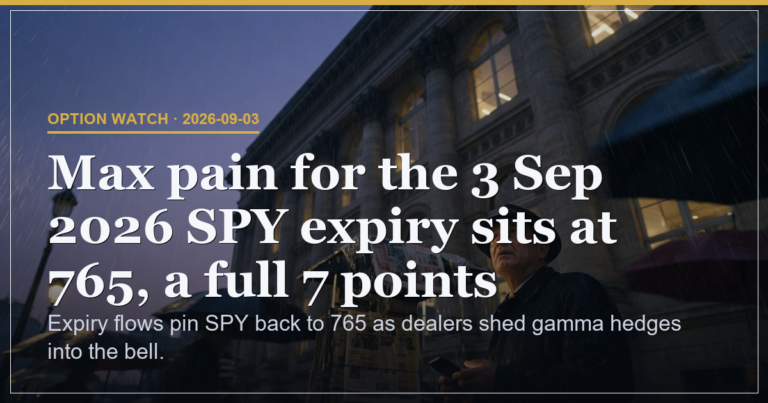
The macro picture cleared the big overhang: PCE at 2.5 percent, third consecutive softer read, no re-acceleration. The week ahead is light on data — ISM Services on Tuesday is the only print of significance, with no Fed speakers on Monday and earnings tail reduced to second-tier names. Light data weeks amplify price action. Friday’s setup was bullish. Monday inherits that momentum, but momentum without a catalyst to extend it runs on fumes. The gamma exposure at 725 — $2 billion confirmed in the flow read, with QQQ calls hammered throughout Friday’s session — creates a magnetic pull toward that level. But maximum pain for this week’s SPY expiry sits at $714. Current price of 720.65 is trading $6.65 above max pain, which tells you the options market’s pain gradient is below current price. That means the path of least resistance for options-market pinning pressure is slightly downward, not upward, into Monday’s close.
The sentiment picture is equally nuanced. The greed reading at 66.6 is elevated without being extreme. AAII individual-investor sentiment fell 7.9 percentage points to 38.1% bullish week-ending 4/29 — the retail crowd cooled while the tape was ripping. That divergence — retail selling into institutional buying — is typically a healthy sign. But it means the institutional cohort is holding a concentrated position, and the breadth of that position is narrow. Tech led by 0.96% on Friday; the Dow faded 0.33%. When the headline index hits a record but the average stock is lagging, the quality of the leg matters as much as its direction.
2. The Read vs The Trade — Why Continuation Is High-Prob But Easy Money Is Priced
Here is the tension that every sound Monday trade plan has to hold at once. The directional read is bullish. Record closes on both SPY and NDX, PCE resolved, vol curve in contango, cross-asset picture aligned — risk-on regime, week three. The institutional options flow on Friday confirmed it: QQQ calls hammered the entire day, GOOGL calls from a flow flag on April 23rd ran to max return by May 1st, and the total bullish flow volume through the session was the highest concentration of the week. The read says higher.
But the trade that read suggests — “buy the open Monday, ride the record-close momentum” — is the one that loses money most often in this specific setup. Friday’s high was 724.85. The close was 720.65. Four points and fifteen minutes was the gap between the target and the reality. The market told you something at 3:45 PM Friday: it could not hold its session high into the close on a record-breaking day. That is not a catastrophic signal. It is a subtle one. It means the marginal buyer had already bought. There is no one left on the sideline who looks at “record close” and decides to add. The audience that would chase this has already chased it.
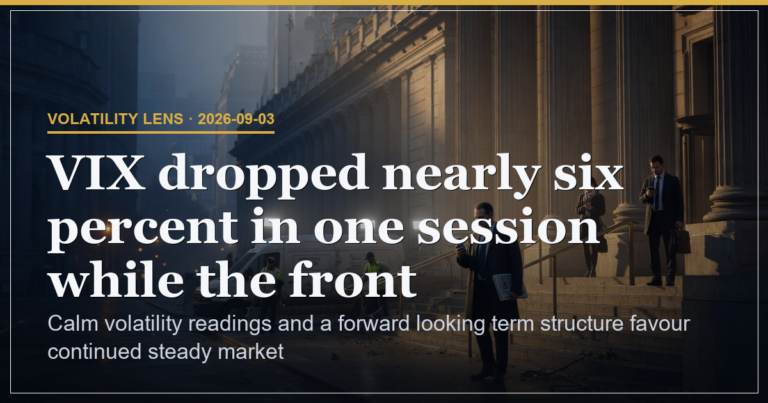
The vol structure read — detailed in the volatility lens that mapped the VIX term structure — adds another layer. VVIX at 95.17, rising from 93.69 the prior session even as spot VIX compressed further, says the professionals are paying more to hedge their vol exposure, not less. When the cost of hedging vol goes up at the same time that spot vol goes down, it typically means the smart money is buying insurance on the insurance. That is not a panic signal. It is a precision signal: they believe in the direction but they are not betting the house on it uncovered. You should think the same way.
The sector divergence is the final piece. The hot-zones read — which mapped tech’s dominance and energy’s structural weakness — showed a Friday session where QQQ led by nearly a full percent while the Dow finished red. The breadth picture is a warning label on an otherwise bullish bottle: the product inside is good, but the distribution is uneven. Five to six names are carrying the weight. If one of those names cracks Monday — earnings revision, analyst downgrade, fund rebalancing — the index effect is outsized in both directions. Position management is not pessimism. It is the responsible version of bullish.
3. The Levels That Matter — Monday’s Operating Map
Every setup below derives from Friday’s structure and the options market positioning entering the week. The reload zones are where longs make structural sense. The fade targets are where existing positions are trimmed. The invalidation lines are where the trade plan is abandoned — not debated, abandoned. The extension targets are where profits are taken on continuation acceleration. These are not wish-list levels. They are the zones where the market itself has already stacked the majority of open interest, options activity, and prior price action.
A note on the gold-equity relationship: gold at 4,613 holding its 3-session breakout above 4,590 while equities also hold record highs is an unusual but not unprecedented configuration. It typically signals one of two things: either institutional money is hedging equity longs with gold exposure (the smart-money protection trade), or the market is simultaneously pricing risk-on (equities up) and uncertainty (gold up). Both interpretations land in the same place tactically — gold longs paired with equity longs is a net-positive portfolio construction for Monday, not a contradiction.
4. Monday Position Sizing — Four Conditions, Four Tiers
Risk tier for this setup is 50% — moderate. The record close validates the direction but the priced-in nature of the continuation reduces the reward-to-risk on new entries at the open. The sizing matrix below applies to any instrument in the playbook. Read the open, match the condition, stick to the tier. The most common mistake on a clean Monday open is confusing a favorable setup with permission to size up. The setup is favorable because the risk is defined, not because the reward is unlimited.
Note on the aggressive gap-up REDUCED tier: this is the most counterintuitive tier for traders who see a green open and want to load immediately. The argument for patience is simple. SPY’s max pain for Monday is $714. Current price is $720.65. A gap to $725 on the open puts price $11 above max pain with no new catalyst since Friday’s close. The options market’s gravity pulls toward $714 over the course of Monday’s session. That does not mean $714 is inevitable — but it does mean the risk-reward on a 725 open chase is far worse than the chart alone suggests. Let the structure show you where it wants to go before committing size.
5. Three Monday Scenarios — 100% of the Probability Accounted For
The scenarios below are not predictions. They are conditional trade plans — each one tells you what to do if the market hands you a specific opening structure. Read the open, identify which scenario is live within the first 15 minutes, and execute the plan for that scenario. Do not switch between them intraday without a structural reason. The one trap that destroys discipline on Mondays is starting in Scenario A and migrating to Scenario C logic halfway through the session because the first 30 minutes were choppy.
Probability check: 50% + 35% + 15% = 100%. The 50% weight on continuation reflects a genuinely constructive setup — PCE cleared, vol compressed, regime intact. The 35% range scenario reflects the max pain gravity and VVIX tension. The 15% mean reversion reflects the narrow-leadership risk and the fact that the easy money is priced. Do not let the 50% weight on continuation tempt you into treating it as 80%. It is not. There is meaningful probability in B and C. Build your plan accordingly.
6. Instrument-by-Instrument Trade Plans — The Specific Work
The table above gave you the matrix. This section gives you the reasoning behind each setup — the why beneath the entry, stop, and target. Read this section before Monday’s open. It will help you hold your conviction when the tape is noisy in the first thirty minutes.
SPY — The Central Position. SPY’s max pain for Monday’s expiry is $714. Current price 720.65 is $6.65 above that. The gamma exposure flagged by flow voices at the 725 strike — $2 billion — creates a ceiling that is real but not impenetrable. The 714-720 band is the most structurally sound long zone entering Monday. A dip to 716-718 that holds on a 15-minute bar is the highest-probability entry in the entire playbook. The stop at 710 gives the setup room to breathe below max pain without permitting catastrophic loss. The target at 728-730 captures the gamma wall break if continuation extends. The fade setup at 727.50-730 exists for the scenario where price tags the gamma wall and fails to close above it — that failure is a quick reversal candidate with defined risk to 732.
NDX — The Leadership Instrument. NDX’s 1-day expected move prices Monday’s range at 27,471-27,928. This is the market’s stated expectation of where NDX moves with 68% probability. Trading within this range is statistically aligned. The long at 27,471-27,600 represents the lower bound of the expected move — where the options market says the risk-reward flips back to the long side after a decline. The fade at 27,950+ is the mirror — above the upper bound of the expected move, the statistical alignment flips short. NDX carrying the index on narrow leadership means this instrument amplifies both scenarios: it runs hardest in Scenario A and drops sharpest in Scenario C. Size NDX positions at 80% of SPY sizing to account for this amplification effect.
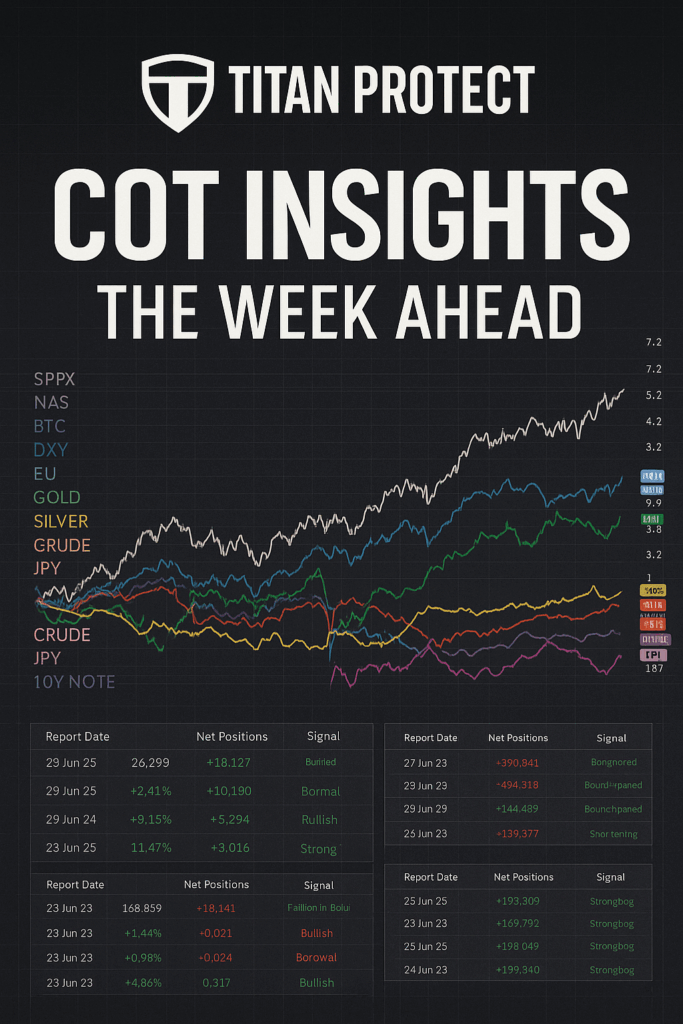
Gold — The Hedge That Also Pays. Gold at 4,613 is holding a multi-session breakout above 4,590. The cross-asset read from the macro picture is clear: dollar capped below 99 on DXY, inflation hedge bid persisting despite PCE clearing, and institutional non-commercial long positioning in gold futures trending upward week over week per the latest commitments report. The 4,590-4,620 long entry zone uses the breakout level as support. The stop at 4,565 is below the prior session’s structure. The target at 4,680 uses Friday’s intraday resistance as the exit point. The reason gold is described as a hedge here is structural: in Scenario A (continuation), gold likely holds and grinds higher as the dollar stays capped. In Scenario C (mean reversion), gold typically bids more aggressively as a flight-to-quality play — the long is protected in both scenarios. In Scenario B (range), gold may drift sideways, which is the only scenario where the gold long has modest opportunity cost.
BTC — The Patience Play. BTC at 78,630 (Friday close) has been consolidating below 80,000 for multiple sessions. This is not a broken setup — it is an unresolved one. The 76,800-77,200 long on a pullback represents the zone where accumulation is happening below the resistance. The stop at 76,000 is the line below which the consolidation argument breaks down and the tape is showing distribution. The target at 80,000 is the confirmation level — not an exit target in itself, but the trigger for the continuation thesis. If BTC breaks 80,000 on meaningful volume Monday, the target extends to 83,000-85,000 and the position size increases. If BTC fails to reclaim 80,000 by Tuesday’s close, the consolidation is stretching into fatigue and the position is reduced. ETH at 2,324, lagging BTC significantly, is a signal that retail crypto appetite is moderate — confirm via BTC before extending into alt positions.
Crude — The Structural Short. WTI crude’s -2.45% decline on Friday was the standout weakness in the entire cross-asset picture. The energy sector reading from the sector analysis confirms this is not noise: energy was hit hard, XLE declined, and the global growth softening narrative has a real driver behind it. A rally in crude to 64.00-64.20 on Monday is the entry trigger for the short — that zone represents a technical retest of where the breakdown occurred. The stop at 64.50 is above the breakdown zone. The target at 62.50 is the next structural support. This is a 3:1 setup with a 50-cent risk and a 1.50 reward. The position does not require Scenario A or C to work — it works in all three scenarios, because even in Scenario A (equity continuation), crude’s driver is global growth softening, not domestic equity sentiment.
VIX — The Continuation Confirmation. The vol structure read — VIX9D at 14.37 far below spot VIX at 16.99, which is far below 3M VIX at 21.37 — is a textbook bullish steepness. The front end is priced for calm. The back end is still carrying uncertainty premium from the prior weeks. As the front end compresses further, UVXY (the leveraged vol product) depreciates. Buying puts on UVXY or using VIX call spreads (selling higher-strike calls against a lower-strike call position) captures that compression. The risk is defined: if VIX spikes above 19.50, the spread position is closed. The target is VIX drifting toward 14-15, which is the logical destination if Scenario A plays out through the week.
7. Risk Score Breakdown — Why This Week Is Not a Max-Size Week
The risk tier of 50% for this setup is not pessimism. It is the appropriate calibration for a week that has several simultaneously elevated factors. The table below shows exactly how the risk score is calculated and which factors are driving it toward the moderate tier rather than the aggressive tier.
The 50% risk tier translates directly to position construction: STANDARD sizing (70% of maximum) on longs entered at tested support zones (716-720 SPY, 27,471-27,600 NDX, 4,590-4,620 gold). REDUCED sizing (40% of maximum) on aggressive new longs above Friday’s high or on the BTC consolidation play. AVOID on any instrument that requires chasing above the prior week’s range without a confirmed new catalyst. This is not caution for caution’s sake — it is matching the size to the quality of the setup, and the quality of the setup this week is good but not exceptional.
8. Cross-Asset Hedges — How the Portfolio Breathes in All Three Scenarios
A well-constructed Monday portfolio for this setup is not just a directional bet — it is a cross-asset architecture that captures the primary scenario while limiting the damage from the secondary and tertiary ones. The three hedge relationships below are the load-bearing structure of that architecture.
Gold longs hedge equity longs. If Scenario A plays out — equity continuation — gold holds its breakout and grinds modestly higher as the dollar stays capped. The gold long participates in the risk-on environment without the same sensitivity to the narrow-leadership risk that plagues equity longs. If Scenario C unfolds — mean reversion — gold is the one asset that benefits most immediately. A flight from equities goes somewhere. With dollar capped and rates stable, gold is the natural destination. The gold long position actually gains in the scenario where equity longs are stopped out. This is not a hedge in the conventional options sense — it is a structural offsetting position across asset classes.
Crude shorts hedge macro optimism. The energy weakness noted in the sector analysis — crude down 2.45% Friday, global growth softening narrative intact — provides a natural counter-trend position to equity bulls. If equity longs are working, the macro backdrop is “strong enough for equities but not for energy demand,” which is a specific regime. The crude short captures the energy-specific weakness without requiring the equity thesis to be wrong. If equities correct, crude typically follows — the short benefits in both directions.
VIX spread positions hedge gamma concentration. The $2 billion gamma exposure at 725 in SPY creates a binary: either the market breaks through it (Scenario A continuation) or it rejects and the gamma unwind adds selling pressure (Scenario C trigger). A VIX spread — short higher-strike calls against a small long position — costs almost nothing if VIX stays compressed (Scenario A) and pays materially if VIX spikes above 19.50 (Scenario C). It is the lowest-cost hedge in the playbook for this specific setup.
9. Experience-Level Guidance — The Right Version of This Trade for Each Tier
The same setup means different things depending on where you are in your development. This section translates the Monday playbook into the version appropriate for each tier. Reading the wrong tier’s guidance is the fastest way to be technically right but practically wrong on execution.
Beginner — One Trade, One Instrument, One Session
Your Monday trade is SPY only. Watch the first 30 minutes. If SPY opens in the 716-720 zone and holds after the initial chop, you have a clean long to 724. Stop at 712. That is 4-8 points of profit potential against 4-8 points of risk — 1:1 minimum. Do not add, do not trade NDX or crude or BTC until this framework is second nature. The reason beginners lose money on Mondays is they trade three instruments at the open before they have even established what the tape is doing. One trade. Wait for the 30-minute structure. Then enter.
Intermediate — Two Instruments, Cross-Asset Awareness
Your Monday plan uses SPY as the primary position and gold as the hedge. Enter SPY at 716-720 on the dip structure with a 70% book. Simultaneously hold or add gold at 4,590-4,620 with a 40% book. The two positions offset each other’s risk: if SPY goes to Scenario C, the gold position gains. If SPY goes to Scenario A, gold holds and adds modestly. Do not trade crude until you have confirmed which scenario is live. Add crude short at 64.00-64.20 only after the first hour has established direction. Watch the QQQ/IWM ratio — if IWM lags QQQ by more than 0.5% in the first hour, reduce SPY sizing to REDUCED and hold gold at STANDARD.
Advanced — Full Portfolio Construction With Active Hedges
You are running the full architecture: SPY long at 716-720 (STANDARD), NDX long at 27,471-27,600 (REDUCED, sized at 80% of SPY equivalent), gold long at 4,590-4,620 (STANDARD), crude short trigger at 64.00-64.20 (REDUCED), VIX spread via UVXY puts for structural insurance, and BTC as a speculative add only if 80,000 breaks on volume. Your active hedges are the gold long, the VIX spread, and the crude short. Your core directional book is the SPY and NDX longs. You are managing the portfolio as a system, not as individual trades. The AAII retail bearish at 39.7% is a contrarian tailwind — you are positioned long against the crowd. The VVIX at 95 is your early warning system: if VVIX spikes above 100 intraday on Monday, reduce equity exposure by 30% regardless of price action, as it signals institutional hedging is accelerating.
10. Three-Timeframe Verdict — Monday, This Week, This Month
11. The First-Hour Decision Matrix — What to Do at Each Price Point
The first hour of Monday trading is when the scenario is identified, not when the position is built. The matrix below maps each price zone SPY could open at, the corresponding scenario, the appropriate action, and the time gate. Do not deviate from this matrix in real time — write it on paper before the open and execute accordingly.
12. What the Smart Money Flow Said on Friday — And Why It Matters Monday
The institutional options flow from Friday confirmed the directional bias without confirming the magnitude. The top flow by premium across the session showed MU leading with $132.28M across 26,106 contracts, GOOGL at $82.44M, NVDA at $73.25M, and QQQ at $69.57M. The QQQ calls that hammered the tape all session — referenced in the flow commentary — were not hedges, they were directional bets. The GOOGL calls that ran from 8.12 to max return by May 1st, first flagged on April 23rd, illustrate the compounding nature of the institutional positioning that drove the record close.
SPY total premium through the day: $62.32M on 115,929 contracts in the primary flow, and another $46.08M on 92,823 contracts in secondary flow. Combined, SPY drew roughly $108M in options activity Friday. That is not a Friday of passive hedging — that is a Friday of active directional positioning. The week’s aggregate flow commentary noted: “the entire week has had an insane amount of bullish flow” and “bulls have been in complete control all week.” That characterisation is accurate as a description of the week that just ended. The question for Monday is whether the same flow resumes, or whether the positions taken Friday are the high-water mark of the week’s activity.
The $259M dark pool print in UNH that appeared in the flow read on Friday is the outlier worth watching — it does not directly affect the equity index read, but it signals that institutional money is actively repositioning within the healthcare sector. Healthcare was noted as drifting in the sector picture. A $259M print is not drifting — it is a deliberate positioning move. If healthcare rotates into the leadership alongside tech next week, the breadth concern partially resolves. Watch XLV Monday morning alongside XLK to see if this flow signal is the beginning of a rotation.
Continue Reading — The Full Composite
This tactics read is the fifth layer in the weekend composite. Every trade plan above rests on four prior layers of analysis. Reading them in order gives you the full context — not just the entries and stops, but why those levels exist and what the underlying read is behind each one.
- The dark pool campaigns and institutional flow that built Friday’s record — how the buy side loaded into PCE, what they’re set up for on Monday’s open, and why VVIX at 95 tells a different story than spot VIX at 17.
- PCE cleared — what’s left: the macro map for the week ahead — what the in-line print resolved, what the bond market and yield curve are saying, and why ISM Services Tuesday is the only data event that can materially change the direction this week.
- Fear & Greed at 66, VVIX at 95: the retail-institutional divergence in the sentiment picture — why the crowd cooled to 38.1% bullish while institutions were loading QQQ calls all session, and what that gap typically means for the next 5 trading days.
- VIX term structure, bullish steepness, and the signal VVIX is sending — the vol curve breakdown: VIX9D 14.37, spot 16.99, 3M 21.37, and why that steepness at the front end is the single most bullish structural signal in this week’s data — plus what breaks it.
- Tech led, energy broken, Dow faded: the hot zones and what rotates next — the sector picture that produced the narrow leadership, why crude’s -2.45% is structural and not noise, and where the rotation money goes if Monday’s breadth finally broadens.
This content is for educational and informational purposes only and does not constitute financial advice. Trading involves significant risk of loss. Past performance does not guarantee future results. All levels and scenarios are analytical frameworks, not guarantees of outcome.
Deepen Your Understanding
Related articles from the Titan Protect Foundry: