Monday 18 May 2026 | Macro Structure Series | Post 8 of 10
The volatility post (Post 04) told you the VIX closed at 17.82, down on the day but with an intraday spike to 19.44 that revealed genuine fear during the European session. The institutional flow post (Post 07) showed you the block tape: institutions long selected mega-caps, hedged broadly on the indices. This post goes one layer deeper — into the actual options structure driving that behaviour. Max pain levels, gamma exposure, skew readings, and the unusual activity that stood out from 125 lines of options flow captured on Monday.
Our Institutional Flow analysis detailed how Monday’s dark pool activity produced a specific accumulation pattern in mega-cap tech — 143 block-level order lines concentrated in five names while the rest of the market saw little institutional commitment. That structure is the direct cause of the options skew you are about to read: the call bias in MSFT and the put hedges on QQQ and IWM are not independent decisions, they are the two sides of the same institutional trade the block tape already revealed.
Negative Gamma: Why Monday’s Moves Felt Bigger Than They Should Have
Every major index product — SPY, QQQ, IWM — is sitting in negative gamma territory. Gamma is the rate at which an option’s delta changes as price moves. When dealers are short gamma (negative gamma from the market’s perspective), they are forced to buy when price rises and sell when price falls. This is the opposite of the stabilising behaviour you see in positive gamma environments, where dealers sell into rallies and buy dips, acting as a natural shock absorber.
In a negative gamma environment, dealers become procyclical. The market moves, they respond in the same direction, which causes the market to move further, which forces more dealer hedging, which amplifies the move again. This is why Monday’s session felt more volatile than the flat close suggested: the intraday range from high to low was meaningful, and dealer hedging was exaggerating every push in either direction.
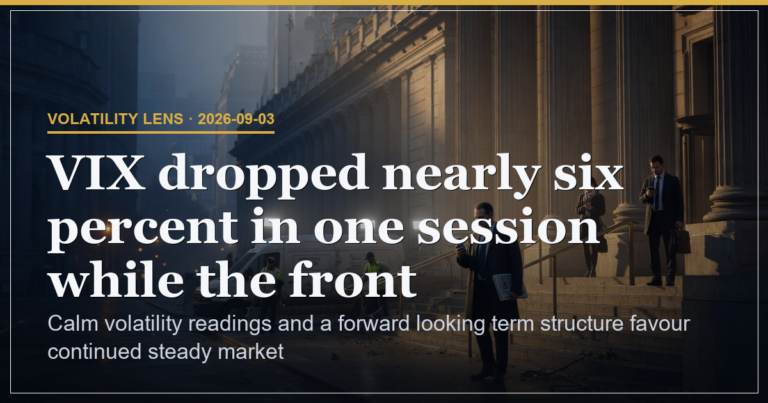
The VIX’s spike from 19.25 open to 19.44 high, followed by a fall to 17.70, is characteristic of negative gamma sessions. The sharp move up triggered dealer selling, which pushed volatility higher. Then when buyers stepped in to absorb the selling — visible in the dark pool data — the reversal was equally sharp, and dealers had to reverse their hedges, amplifying the recovery.
Max Pain: Where the Options Market Wants Price to Go
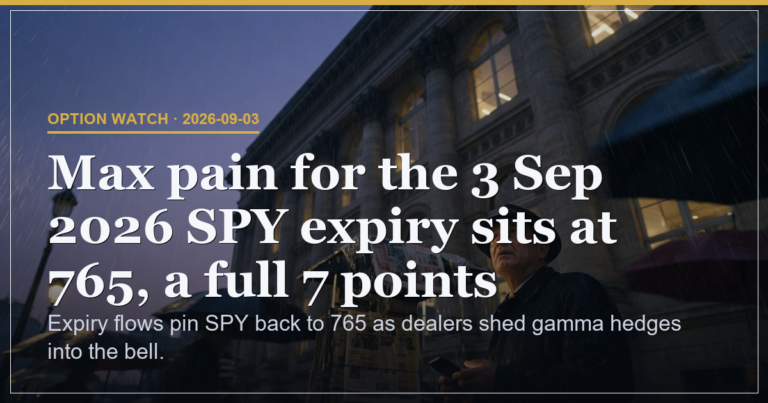
Max pain is not a prediction — it is a gravitational pull. It represents the strike price at which the aggregate of open options contracts would expire with the least total value, meaning option sellers (typically market makers) experience the minimum loss. Because market makers hedge their positions in ways that naturally push price toward this level as expiration approaches, max pain tends to act as a magnet in the final days before an expiry.
TSLA’s max pain sits at $435 for the current expiration cycle. TSLA closed Monday’s session in the vicinity of that level. The implication is not that TSLA will stay exactly at $435 — it is that any move away from $435 creates pressure from market maker hedging that attempts to pull it back. A strong earnings result or a sharp macro move could override that gravity. But in the absence of a strong catalyst, the $435 level is where the options market would prefer TSLA to settle.
For SPX and SPY, max pain dynamics are equally relevant heading into Friday’s expiry, but the catalyst risk from Tuesday makes this a live variable rather than a stable reference. If Tuesday’s news is benign, max pain gravity reasserts itself and you likely see contained price action into the weekend. If the news is significant — in either direction — the gamma environment will override max pain entirely, and the move will be determined by dealer positioning rather than option seller preference.
| Instrument | Max Pain / Key Level | GEX Environment | Behaviour Expected |
|---|---|---|---|
| TSLA | $435 | Negative | Gravity toward $435. Breaks amplified. |
| SPY | Range: 735-742 | Negative | Choppy. Dealer hedging amplifies both directions. |
| QQQ | Put-heavy skew intact | Negative | Downside protected by institutional hedges. |
| IWM | Most put-loaded | Negative | Small caps most vulnerable to negative catalyst. |
| MSFT | Call-dominated (P/C 0.24) | Negative (overall) | Upside call pressure from institutional buying. |
The Skew Story: Why QQQ and IWM Tell a Different Story to SPY
The put/call ratios across the index products create an interesting tension. SPY’s overall put/call sits at 0.58 — that is mildly bullish. More puts than calls would be above 1.0, so at 0.58, the S&P 500 ETF has more calls than puts outstanding. In isolation, that looks like the market is positioned for upside.
But QQQ at 1.40 and IWM at 1.49 tell you something has been deliberately separated. When investors are cautious on the broader index, they tend to express that caution in QQQ and IWM — the products most sensitive to rate hikes, small-cap credit risk, and technology multiple compression. SPY is weighed by mega-caps that have earnings power regardless of the macro cycle. QQQ and IWM reflect what happens to everything else.
The skew between these products is essentially institutions saying: “We trust the big five to hold up. We do not trust everything else.” That is a quality-versus-breadth bet. It has worked for most of 2025 and 2026. But it carries a specific risk: if one of the big five misses materially on earnings this week, the entire thesis unwinds at once, because the institutions who own the calls on those names will also sell, and the QQQ puts they hold as a hedge will pay off — but the damage to the broader portfolio of people who did not own those puts will be severe.
| Product | P/C Ratio | Skew Direction | What It Means for Tuesday |
|---|---|---|---|
| SPY (S&P 500 ETF) | 0.58 | Mild call bias | Broad market anchored by mega-cap call buying |
| QQQ (Nasdaq 100 ETF) | 1.40 | Significant put skew | Tech ex-mega-cap treated as risk-off territory |
| IWM (Russell 2000 ETF) | 1.49 | Heaviest put skew | Small caps most exposed if yields stay elevated |
| MSFT | 0.24 | Strong call dominance | Institutional conviction play — earnings week |
| TSLA | 0.77 | Near-neutral | Max pain gravity dominant ahead of expiry |
Unusual Activity: What Stood Out in 125 Lines of Flow
From 125 lines of options flow analysis as of on Monday, several patterns stood out as unusual relative to recent baseline activity.
The first was the size of the MSFT call flow. A put/call ratio of 0.24 is more than two standard deviations from the average P/C reading for a mega-cap stock in a normal week. That kind of skew requires significant institutional participation — retail participants buying calls do not move the ratio to this level unless the absolute volume is very large, and retail tends not to trade MSFT in the size required to do that. The MSFT call flow looks institutional in both its scale and its strike selection.
The second unusual item was the IWM put positioning. The Russell ETF’s P/C of 1.49 is elevated even for a period of macro uncertainty. Small caps have underperformed large caps throughout 2025 and into 2026, which means there is an existing body of put protection on IWM from prior hedging cycles. But the Monday flow suggests fresh put buying was added — not just rolling of existing positions. Fresh put buying on IWM, ahead of a catalyst and in a negative gamma environment, is a deliberate risk-management decision, not a passive roll.
The third observation is the silence in the financials options market. Given that 10-year yields hit 15-month highs on Monday and the standard assumption is that financials benefit from rising rates (wider net interest margins), you might expect to see call buying on bank names. The flow data does not show that. Financials options were relatively quiet, suggesting institutions are not yet convinced the yield rise translates to earnings improvement — particularly given the potential for credit deterioration visible in the student loan default data from the macro post.
VVIX at 91: The Volatility of Volatility Signal
The volatility post flagged the VVIX at 91. VVIX measures the implied volatility of VIX options — it is the volatility of volatility itself. A reading of 91 is elevated. When VVIX is high, it means the options market expects large swings in the VIX itself. Participants are paying premium to hedge against scenarios where fear spikes sharply, not just scenarios where the market drifts lower.
This matters for options strategy in a specific way: when VVIX is elevated, VIX options are expensive. That means protective strategies that use VIX calls as their hedge are more costly than normal. Participants who want to hedge their portfolios have to pay up for that protection. The fact that institutions are still paying for it — as evidenced by the put-heavy skew on QQQ and IWM — tells you the protection is seen as worth the premium. That is a statement about how seriously large participants are taking the downside scenarios in front of them.
Navigating Options Week With 300 Earnings in the Queue
Treat negative gamma as a warning label: moves will be sharper than expected in both directions. Do not hold positions through Tuesday’s catalyst without a defined exit. The environment punishes complacency more than uncertainty.
The TSLA max pain at $435 gives you a reference range. A move meaningfully above $435 or meaningfully below it becomes tradeable with a tight stop back at $435. The max pain gravity tells you where the equilibrium is before news changes the equation.
The call/put skew divergence between SPY (0.58) and QQQ (1.40) creates a spread trade: short QQQ relative to SPY is a bet that the broad Nasdaq underperforms the index. This mirrors the institutional positioning and has a defined risk if mega-cap earnings disappoint and drag SPY down with QQQ.
Scenario Analysis: How Options Structure Resolves
The sector-level breakdown — which industries absorbed capital today and which saw outflows — is the subject of Post 09: Sector Flow. The institutional flow picture from Post 07 maps directly onto Monday’s sector performance. The options skew you have read here explains why energy sold off harder than the crude move alone would suggest.
This content is for informational and educational purposes only. It does not constitute financial advice. Options data reflects positioning at a point in time and does not predict future market direction. Always apply your own risk management.
Deepen Your Understanding
Related articles from the Titan Protect Foundry: