Monday 18 May 2026 | Signal Synthesis Series | Post 18 of 19 | Members Only
Every day in markets there is the story the headlines are telling and the story the price action is actually telling. Monday 18 May 2026 had an unusually wide gap between the two. The geopolitical narrative was dire — an Iran deal described as “insufficient” by the White House, Trump convening his national security team in the Situation Room on Tuesday to discuss military options, a crude oil price that spiked above $107 in the Asian session on genuine fear. The story the market told was different: the VIX dropped 3.3% from open to close, equities posted a flat day rather than a sharp sell-off, and gold held its ground with a constructive 0.31% gain. Understanding why those two stories diverged is the read that matters most for Tuesday.
As you’ll find in our Commodities brief, Monday’s crude story was more precisely characterised as “selling the news before the event” — the market unwound the Iran war premium in crude before the Situation Room meeting even occurred, leaving crude at $101.52 with an asymmetric risk profile: roughly $2 downside to fundamental support, roughly $5 upside if Tuesday’s meeting produces negative headlines. That crude price behaviour is the single clearest measure of how the market is actually pricing Tuesday, which is why the gap between the crude and gold moves documented in the Commodities post matters so much for reading this news environment. The Earnings context from Post 16 is also essential here: the same 300 companies reporting this week are sitting against a macro backdrop that includes rising freight costs, 6.1% electricity inflation, and $171B in consumer credit stress — all structural inputs that shape guidance language in ways that matter more than the backward-looking beat-or-miss headline.
Iran Was the Headline. Equities Disagreed With the Conclusion.
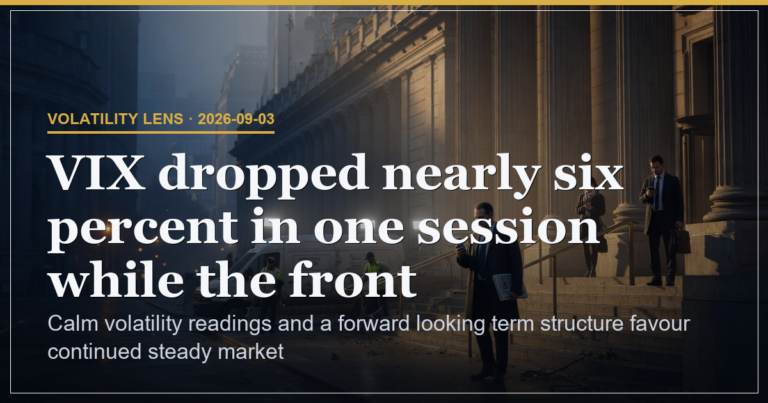
The Iran narrative on Monday was genuinely concerning at face value. The White House publicly stated Iran’s proposal was insufficient. Trump was expected to convene a Situation Room meeting on Tuesday. Military options were reportedly on the table. If you read those headlines without looking at a chart, you would expect equities to have sold off sharply, crude oil to have closed above $107, and gold to have surged well above its $4,570 level. None of those things happened. Equities closed flat. Crude reversed hard from its $107 intraday high to close at $101.52, a 3.7% fall. The VIX, which should expand on geopolitical risk, contracted.
The explanation is visible in the global cross-asset picture from Post 06 (Global Grid). Markets have learned to front-run geopolitical headlines and then fade them the moment the worst case fails to materialise. The crude oil spike above $107 was the market pricing Iran escalation at maximum intensity in the Asian session. By the New York afternoon, as no further escalation occurred, the fear premium was systematically unwound. The $5.50 reversal in crude from high to close is the market pricing de-escalation, not because de-escalation happened, but because the marginal participant decided to take risk off the table before Tuesday’s event rather than hold it through.
This creates a specific dynamic heading into Tuesday. The geopolitical premium has been partially priced back out of crude. If Tuesday’s Situation Room meeting produces language consistent with ongoing diplomacy — even if no deal is reached — crude is likely to remain soft, the VIX will continue to compress, and equities will have space to advance. If the meeting produces something more alarming — military action language, sanctions escalation — crude re-prices the fear premium in one fast move and the VIX spike from 19.44 on Monday becomes a preview of something larger.
The Trade Deal Is the Background Positive Nobody Is Talking About
While Iran dominated the headline feed, the US-China trade architecture continued to develop quietly. The Board of Trade and Investment announced following the Trump-Xi engagement is not a dramatic single-day headline. It is a structural positive that slowly improves business confidence, reduces tariff uncertainty, and creates a supportive backdrop for corporate earnings guidance. Companies with significant China revenue exposure — technology names, industrial conglomerates, semiconductor manufacturers — benefit from a trade environment where the direction of travel is constructive even if the pace is slow.
From the macro read in Post 01, the US-China framework provides one of the few genuine positive inputs into a macro picture that is otherwise dominated by yield pressure, consumer debt stress, and input cost inflation. It is not enough to resolve the bond-equity divergence on its own. But it is a real counterweight to the Iran narrative, and it explains in part why equities did not sell off more aggressively than they did on a day when the geopolitical headlines were genuinely threatening.
The Bond Market Is Telling a Different Story
Here is the sentence that should be in every market watcher’s head this week: the 10-year Treasury yield at 4.63% is the highest reading since February 2025. That is not a marginal move. In April 2025, when the yield hit this level, it was sufficient to trigger a 90-day tariff pause from the Trump administration. The yield itself forced a policy response. Now the yield is back at those levels, and equities are sitting near record-adjacent prices in “greed” territory on the Fear and Greed Index.
The bond market and the equity market cannot both be right. The bond market at 4.63% yields is pricing tighter financial conditions, a Fed that cannot cut, and a fiscal trajectory that is eroding confidence in US government paper. The equity market at 7,403 on the S&P 500 is pricing solid earnings growth, a soft landing, and a consumer that continues to spend. One of these markets is mispriced. Historically, when yields and equities diverge this sharply, it is equities that eventually adjust to where bonds are, not the other way around. The adjustment is not always immediate. But it does come.
The data supporting the bond market’s read is not ambiguous. Student loan defaults at $171.4B in delinquencies. Freight costs rising. Electricity prices up 6.1% year-on-year. The Iran-driven crude spike (above $107 intraday) adding to input cost pressures even before it reversed. These are not one-off events. They are compounding pressures on the same consumer the equity market is counting on to sustain the growth story.
Freight Costs, Electricity Prices, and the Slow-Moving Inflation Story
Freight costs surging and electricity prices rising 6.1% year-on-year are not front-page news items. They are slow-moving structural inputs that build quietly into margin compression for every company that moves and powers physical goods. When freight costs rise, the companies that bear the pain first are mid-cap logistics-dependent manufacturers and retailers — exactly the kinds of names that do not have MSFT’s software margins or NVDA’s pricing power.
The electricity price rise has a particular implication for one sector that many participants are not considering: data centres. The AI infrastructure buildout that has driven semiconductor concentration in the S&P 500 — with semiconductors accounting for more than half of the index’s year-to-date gain, and NVDA alone contributing 110 index points — requires enormous power consumption. A 6.1% year-on-year rise in electricity costs does not disappear from AI infrastructure operators’ income statements. It compresses their margins, which is precisely the kind of slow-building headwind that shows up in guidance rather than in the current quarter’s results.
| Narrative | Headline Read | Market’s Actual Response | What It Means |
|---|---|---|---|
| Iran / Situation Room | Risk-off fear | VIX -3.3%, equities flat | Fear front-run and faded. Tuesday is the actual event. |
| US-China Trade Deal | Risk-on positive | Background support held | Structural floor. Slow-burning positive. Not a catalyst. |
| Bond Yields (4.63%) | Tightening conditions | Equities ignored it | Divergence that historically resolves in bonds’ favour. |
| Freight / Electricity | Input cost inflation | Not priced in yet | Shows up in guidance this earnings season, not headlines today. |
| Student Loan Defaults ($171.4B) | Consumer stress | Not in equity price | Consumption drag building. Discretionary names most exposed. |
| Crude Reversal ($101.52) | Geopolitical premium unwound | Energy sector sold | De-escalation pricing. Binary reversal on Tuesday escalation. |
The Real Conversation the Market Is Having
Strip away every headline and what you have is a market in a holding pattern. It does not want to sell because the longer-term structure is intact and institutions are still long. It does not want to buy aggressively because the Iran event is 24 hours away and the bond market is flagging a condition that eventually has to be reconciled. The flat close is not indecision in the emotional sense. It is the rational positioning of participants who know something big is coming and have no edge in guessing which way it goes.
The levered long to short ETF trading volume ratio is at 3.3-to-1 — the highest since July 2024. That statistic sounds bullish. It means retail participation is leaning long with leverage. The problem is that this level of retail levered positioning tends to appear at inflection points, not at the beginning of sustained moves. When retail sentiment runs this far ahead of institutional caution — visible in the QQQ and IWM put buying from Post 08 — the mismatch is usually resolved by a shakeout that punishes the leveraged longs and rewards the patient institutional hedgers.
The market moved on Monday by not moving. And that non-movement, in the context of everything around it — Iran, yields, student loan stress, negative gamma — is the most informative data point of the session.
Reading the Narrative for Your Timeframe
When headlines and price action diverge, follow the price. The VIX fell today despite the Iran story. The market is not as scared as the news feed suggests. But Tuesday is real — do not let Monday’s calm convince you the risk has passed. It has not. It is waiting for Tuesday.
The bond-equity divergence is the structural tension that does not resolve quickly. It is not the trade for this week. It is the context for this month. This week’s trade is positioning for Tuesday’s binary: small size, defined risk, and the patience to let the catalyst create the opportunity rather than trying to predict the direction ahead of it.
The narrative gap between Iran headlines and VIX price action is a setup, not a contradiction. The market has told you it is not selling here. That means the reaction to Tuesday’s resolution is likely asymmetric to the upside if benign — fast, institutional-driven, and powerful. Pre-position for de-escalation with a stop below Monday’s low. If escalation occurs, the move is also fast but you are already small.
VIX close: 17.82 (Monday 18 May 2026). 10-year yield: 4.63%. Crude close: $101.52. Student loan defaults: $171.4B. Electricity YoY: +6.1%. Levered L/S ratio: 3.3x. Cross-references: Post 01 (Macro), Post 06 (Global Grid), Post 08 (Options).
Analysis only. Not financial advice. Always manage your own risk.
Deepen Your Understanding
Related articles from the Titan Protect Foundry: