Monday 18 May 2026 | Macro Foundations Series | Post 3 of 4
The positioning data showed institutions hedging while staying long. The macro data showed yields at 15-month highs and economic stress building under the surface. Now the question is: how does the crowd feel about all of this? The answer is one of the more interesting sentiment setups of 2026. The numbers are contradicting each other, and that contradiction is worth understanding before you put money to work.
Fear and Greed at 61.8: What “Greed” Actually Looks Like Right Now
The Fear and Greed Index sits at 61.8, which is comfortably in “greed” territory. A reading above 60 historically correlates with periods where the crowd is leaning into risk rather than away from it. In isolation, this reading would suggest the market has momentum and participants are willing to buy dips.
But context matters. Two weeks ago, this reading was lower. The greed reading has expanded during a period when bond yields surged to 15-month highs, crude oil spiked above $107 on Iran tensions, and Bitcoin lost $500 million in leveraged longs overnight. The crowd is calling itself greedy during a week when the macro backdrop has genuinely deteriorated. That is a warning sign, not a green light.
When sentiment reads greedy in a deteriorating macro environment, one of two things typically follows. Either the macro deterioration reverses and sentiment was right to be optimistic — or sentiment catches up to the macro reality sharply and quickly. The speed of any sentiment correction is what makes this setup worth watching.
| Measure | Reading | Interpretation |
|---|---|---|
| Fear and Greed Index | 61.8 — Greed | Crowd leaning bullish despite macro stress |
| AAII Bulls | 39.3% | Below 40% — historically a cautious reading |
| AAII Bears | 36.6% | Bears almost matching bulls — genuine uncertainty |
| AAII Neutral | 24.1% | Large fence-sitting cohort. Uncommitted either way. |
| Options P/C (Overall) | 0.682 | Options market reading bullish |
| VIX | 17.82 (-3.31%) | Fear falling from intraday highs — some relief |
The AAII Survey: Individual Investors Are Not Actually That Bullish
The American Association of Individual Investors survey is the oldest continuous sentiment measure in the market. When it has a bull-bear spread of less than three percentage points, you are looking at a genuinely divided investing population. That is exactly what we have today: 39.3% bulls versus 36.6% bears, with 24.1% sitting on the fence.
This matters because the AAII data represents real retail participants — the people who are actually allocating savings, not professional traders adjusting book risk. When retail is this evenly split, it tells you that the narrative has not won them over. Half the room is not convinced the move is real.
Historically, when AAII bulls fall below 40% while the S&P 500 remains within 2% of its highs, it tends to be a precursor to one of two outcomes. Either price catches down to sentiment (a 5-8% correction as the bulls give up) or price holds and sentiment catches up (bulls jump back above 45% in the following two surveys). The current macro backdrop — yields at 4.63%, Iran risks, Bitcoin liquidations — suggests the first outcome is more likely if any of these catalysts deteriorate further.
VIX at 17.82: The Market Calmed Down, But From What Level?
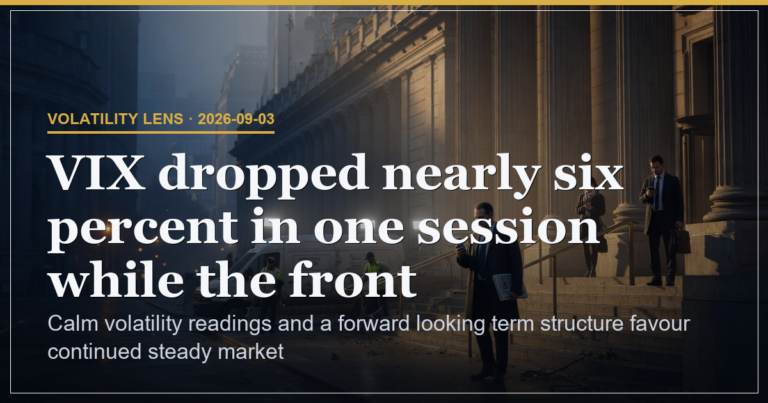
The VIX closed at 17.82, down 3.31% on the day. That sounds like fear is easing. But the starting point for Monday was a VIX at 19.2 during the London session — a 4.2% rise from Friday’s close of 18.43. The day started with genuine fear and ended with some relief. Where it sits tomorrow depends entirely on what comes out of Tuesday’s Situation Room meeting.
The VIX open was 19.25. The intraday high was 19.44. The low was 17.70. That is a 1.74-point range in a single session — meaningful movement for a volatility index. The fact that it closed near the lows suggests buyers stepped in during the US afternoon session to fade the fear. Whether those buyers were right will be determined by Tuesday’s headline risk.
Context from the previous Friday: the VIX closed at 18.43. Monday’s close at 17.82 is technically lower than Friday. But the path the VIX took to get there — opening at 19.25, spiking to 19.44, then grinding back — tells you the session was not calm. Markets were genuinely uncertain for most of the day before ending on relief.
Breadth: When the Index Hides What Is Actually Happening
The S&P 500 closing at 7,403 (-0.07%) looks like nothing happened. It was a near-flat day. But this reading is heavily distorted by the mega-cap names in the top ten weightings. The options whale flow showed institutional accumulation in Apple, Nvidia, Meta, Microsoft, and Amazon. If these five names held up or rallied while the remaining 495 stocks in the index softened, the headline index number would look flat even if the broader market deteriorated.
This is the environment where breadth matters more than price. When the advance-decline line is weak — more stocks falling than rising — while the index holds flat, it signals narrowing market leadership. A small number of large stocks are carrying the index. When those stocks eventually rotate or face their own headwinds, there is nothing underneath to catch the fall.
The practical implication: do not use the S&P 500’s near-flat close as confirmation that the market is stable. Look at what small and mid-caps did. The IWM (Russell 2000) gex-max-pain-and-putcall-ratios/” style=”color:#D8AF44;text-decoration:underline” title=”What is Options Intelligence?”>put/call ratio at 1.49 — the most bearish of all the major index products — suggests participants are protecting against a small-cap selloff specifically. Small caps are more sensitive to credit conditions. At 4.63% yields, credit conditions are tightening.
What Happens to Sentiment from Here
Sizing Your Risk Around Sentiment
The greed reading of 61.8 is not a licence to be aggressive. When greed is this high while bears and bulls are almost evenly matched in the actual survey, the market is one headline away from a sentiment shift. Keep positions small enough that you can ride the volatility without being stopped out on the first move.
The VIX at 17.82 is low enough to make options protection relatively cheap. If you have directional equity exposure, spending a small percentage of the position on put protection is not expensive at this VIX level and could save a significant drawdown if Tuesday’s news is negative.
The AAII split is the contrarian setup. When the crowd is almost evenly divided, the eventual move tends to be larger than when sentiment is unanimous. Whoever is wrong here gets squeezed hard. Position for the move, not the grind.
The final piece of this week’s macro picture is the volatility structure itself — what options pricing, VVIX, and gamma positioning tell you about the speed and size of the next move. Continue with Post 04: Volatility Lens to complete the picture.
This content is for informational and educational purposes only. It does not constitute financial advice. Sentiment indicators are backward-looking and do not guarantee future price direction. Always apply your own risk management.
Deepen Your Understanding
Related articles from the Titan Protect Foundry: