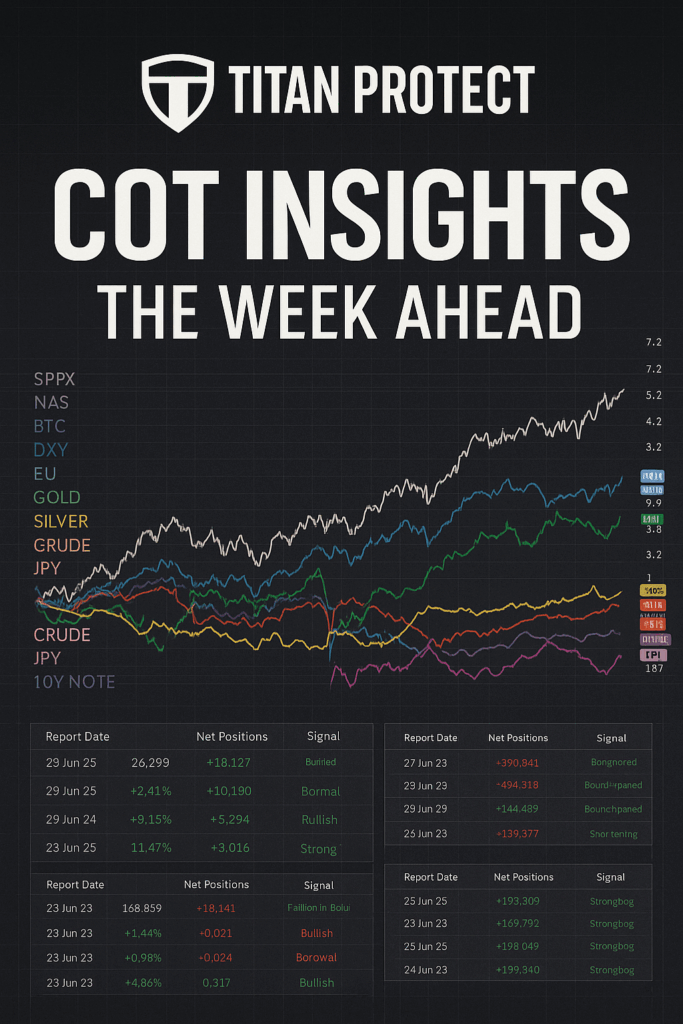
Institutional Flow: Dark Pool Campaigns, COT Extremes and the Whale-Level Positioning Map for NFP Week
Date: Saturday 30 May 2026 | Weekend Edition, Data: Friday 29 May 2026 close
Series: Institutional Flow — following the large-account money, not the retail noise
Published: ~14:00 BST / 09:00 EDT / 22:00 JST (Sat)
COT Positioning Summary: The Large-Account Picture
| Asset | Category | Net Position | Trend | Extreme? | Read |
|---|---|---|---|---|---|
| S&P 500 Futures | Asset Managers | +1,000,000+ net long | Building | Yes — cycle high | Crowded. Not a sell signal, but fuel is deployed. |
| S&P 500 Futures | Leveraged Funds | Net short / reducing | Covering | Moderate short | Short covering = upside fuel remaining |
| Gold Futures | Managed Money | Near multi-year high net long | Extending | Extended but not 2020-level | Trend intact. Consolidation risk, not reversal. |
| DXY / USD | Non-Commercial | Building short positions | Accelerating | Approaching extreme | Strong NFP triggers mass short covering |
| Crude Oil Futures | Managed Money | Reducing longs / adding shorts | Organised exit | Not extreme yet | Distribution, not capitulation. More to come. |
| GBP Futures | Leveraged Funds | Net long and building | Consistent | Below extremes | Room to extend. 1.35 is supported long-term. |
| NZD Futures | Leveraged Funds | Historically short, now covering | Covering fast | Short squeeze in progress | Squeeze has further to run. 0.6050 is the next stop. |
The Three Institutional Campaigns Active This Week
Campaign 1: The Dollar Short Is Becoming a Theme, Not a Trade
Non-commercial dollar short positioning is building at a rate that suggests this is no longer a tactical hedge against a single data point. When institutional money builds a theme-level position, it typically has a six to twelve week target in mind, not a one-week trade. The last time the dollar short reached this pace of accumulation was early 2020, when DXY subsequently fell another 12% over the following two months despite multiple strong data points along the way.
The macro analysis in the daily read confirmed the structural case: PCE soft, real yields falling, fiscal concerns about US debt sustainability growing among foreign creditors. Those are not one-week concerns. The institutional dollar short is positioned for a multi-week move, with individual data releases as the pace-setters, not the direction-setters. A strong NFP does not kill the dollar short — it creates the entry opportunity for the next leg of it.
Campaign 2: Gold as a Regime Hedge, Not an Inflation Trade
The $101 two-day move in gold following PCE was not inflation-linked buying. Gold’s traditional inverse relationship with real yields would have suggested selling after a soft PCE — because soft inflation means real yields can stabilise. Instead, gold surged. That tells you the institutional buyer is not hedging against inflation. They are hedging against something else: the regime uncertainty of an administration running a $2 trillion deficit, a central bank that has lost credibility on its 2% target, and foreign central banks reducing Treasury holdings.
That buyer does not exit on a single data point. The regime hedge is structural. The consolidation risk flagged in the setup radar — a pullback to $4,480 to $4,510 — is normal profit-taking by tactical traders, not an exit by the structural buyer. The COT data confirms this: net longs are near multi-year highs but not at the extreme that has historically marked major tops. The 2020 extreme at $2,075 had a more extended positioning picture than we see at $4,589 today.
Campaign 3: The NZD Short Squeeze Is Institutionally Organised
NZD’s 1.64% surge on Friday was the largest single-day G10 FX move this week. COT data shows leveraged funds were heavily short NZD coming into this week — positioned for a global growth slowdown and risk aversion. When the opposite happened — soft PCE, risk appetite returning, dollar weakening — the forced covering of that short position amplified the move significantly.
The squeeze is not finished. The COT short positioning, even after Friday’s covering, is still elevated relative to the prior three months. If risk appetite holds through the early-week data (ISM on Monday), a second leg of NZD covering is likely. The 0.5960 to 0.5975 entry in the setup radar is targeting exactly that second-leg opportunity, not a chase of Friday’s spike.
Dark Pool Signals: Where the Large Prints Landed
Dark pool activity is opaque by design, but the volume patterns in specific instruments give readable signals. Three clusters stood out this week.
The first cluster was in gold-related equities — the major miners and royalty companies — with disproportionate volume relative to their typical daily average. When dark pool volume in a sector runs two to three times its usual level on the same session that the underlying commodity makes a $50+ move, it is not a coincidence. It is the institutional expression of a trade that the futures market has already moved.
The second cluster was in large-cap technology on Wednesday, ahead of the PCE print. This is the pattern of front-running a data release: institutional buyers absorbing supply in the dark pool before the public data creates a crowd. The fact that technology underperformed on Friday despite this dark pool activity tells you the position was entered at a discount and is now being held, not added to at higher prices.
The third cluster — and the one that is most instructive for the week ahead — was in defensive sector ETFs (utilities and staples) during Thursday’s session. When large prints accumulate in low-volatility, income-oriented sectors ahead of a major data week, that is institutional risk management, not alpha generation. It says: we are long equities, we expect volatility around NFP, we are hedging by rotating into sectors that hold up in a correction.
The Leverage Risk Ahead of NFP
The most important observation from the institutional positioning picture is the asymmetry of leverage. Asset managers are over one million net long S&P contracts. Dollar shorts are building rapidly. Gold longs are near multi-year highs. All three of these positions lean the same direction: soft economic data, dollar weakness, Fed cutting. If NFP on Friday comes in strong — say 220,000 or above — all three positions are wrong simultaneously and the unwind is fast, because all three trades have become consensus.
This is the scenario where the stops in the setup radar are not optional. The gold stop at $4,420, the NZD stop at 0.5920, the GBP stop at 1.3440 — those are not conservative suggestions. They are the line at which the institutional thesis is wrong and the reversal accelerates. Being stopped out at those levels on a strong NFP is the correct outcome, not a failure. The failure would be holding through those levels hoping the institutional thesis reasserts.
Institutional Positioning Risk Scorecard
| Asset | Position | Stretch Level | Strong NFP Risk | Sizing |
|---|---|---|---|---|
| Gold | Long (near highs) | Moderate | Drop to $4,380–$4,420 | STANDARD |
| S&P 500 | Long (cycle high) | High | -2 to -4% fast | REDUCED |
| Dollar Short | Short (building) | Moderate-High | Mass covering, DXY to 101 | STANDARD (stops tight) |
| NZD (squeeze) | Covering short (room) | Low — squeeze still early | Drops to 0.5880 | STANDARD |
| Crude Short | Short (adding) | Low | Brief spike to $91 then resumes | REDUCED |
| Bitcoin | No clear signal | — | Drops with equities on strong NFP | AVOID |
This analysis is produced for informational and educational purposes. It does not constitute financial advice or a recommendation to buy or sell any financial instrument. All trading involves risk. Past performance does not guarantee future results. You should always conduct your own research and consider your financial circumstances before making any investment decision. Risk percentages are estimates based on market conditions at time of writing and may change rapidly. Position sizing guidance is general in nature and must be adapted to your own risk tolerance and account size.
Deepen Your Understanding
Related articles from the Titan Protect Foundry: