Sentiment Shift • Thursday 28 May 2026 • Pre-Market Read
Sentiment Shift | Thursday 28 May 2026 | Pre-PCE read
The S&P 500 has printed two consecutive record closes and retail investors are more bearish than bullish. That is not a contradiction — it is a signal. AAII bullish sentiment stands at 31.7%, nearly six points below its long-run average of 37.5%, even as the index trades at 7,520. The Fear & Greed Index reads 60.7, down from 65 just days ago, and VIX closed at 16.29 after shedding 4.23% on Wednesday. The aggregate put-to-call ratio across our monitored universe sits at 0.606 — firmly bullish — which tells you the options flow does not match the survey mood. When retail says bearish and smart money buys calls, history rewards the latter. Thursday’s Core PCE at 08:30 EDT is the number that decides whether this divergence resolves upward or snaps shut.
Core Sentiment Read
Retail surveys are bearish at all-time highs. Options flow and VIX say the opposite. The divergence is not noise — it is the most reliable contrarian signal in this sequence. A cool PCE print Thursday morning closes the gap fast. A hot print confirms the retail fear and everything that institutional positioning has ignored suddenly matters.
The Survey Says Bearish. The Market Disagrees.
AAII bullish sentiment dropped 7.6 percentage points in a single week to land at 31.7%. That is the first time in five weeks it has fallen below the historical average of 37.5%. Simultaneously, bearish readings hit 43.6% — well above the long-run mean of 31.0%. Neutral sentiment is sitting at 24.7%.
The title is not describing a market in crisis. It is describing a market at all-time highs. That is the anomaly worth understanding.
The previous four weeks had retail leaning bullish — 38-39% range. Something changed in the week ending 20 May 2026. Our read: the debt ceiling resolution and the Iran strike narrative reduced the acute fear, but the fresh geopolitical uncertainty from Middle East comments in the flow intelligence — Fed’s Kashkari warning of an “inflationary shockwave,” Trump’s continued Iran positioning — has reopened a softer, more structural anxiety. Retail is not panicking. It is quietly refusing to trust a market at records.
That quiet scepticism is historically bullish. The AAII survey, used as a contrarian indicator, performs best at exactly this configuration: sub-35% bulls, above-40% bears, and the index trading within 2% of all-time highs.
| Week Ending | Bullish % | Neutral % | Bearish % | Note |
|---|---|---|---|---|
| 20 May 2026 | 31.7% | 24.7% | 43.6% | First below 37.5% avg in 5 wks |
| 13 May 2026 | 39.3% | 24.1% | 36.6% | Above avg bullish |
| 6 May 2026 | 38.3% | 28.7% | 33.0% | Stable sentiment |
| 29 Apr 2026 | 38.1% | 22.2% | 39.7% | Pre-rotation nervousness |
| Historical Average | 37.5% | 31.5% | 31.0% | Since 1987 |
| 1-Year Bearish High | — | — | 52.0% | Wk ending 18 Mar 2026 |
| 1-Year Bullish High | 49.5% | — | — | Wk ending 14 Jan 2026 |
The bearish reading of 43.6% is 12.6 points above the historical average. The 1-year peak was 52.0% in mid-March 2026 — and that turned out to be the exact sentiment bottom that preceded the rally to current record highs. We are not at peak fear again, but the directional move in one week — from 39.3% bullish to 31.7% — is the fastest sentiment deterioration in this recent cycle.
Retail pulled confidence at exactly the wrong moment. That is our read from yesterday’s positioning analysis — the institutional accumulation story is intact — and the survey data confirms who is on the wrong side of it.
Fear & Greed at 60.7: Greed is Slowing, Not Reversing
The CNN Fear & Greed Index closed at 60.7, down from 65 earlier in the week. That is a 4.3-point retreat into territory still rated “Greed.” It is not a crash. The slowdown matters because it mirrors the VIX story perfectly.
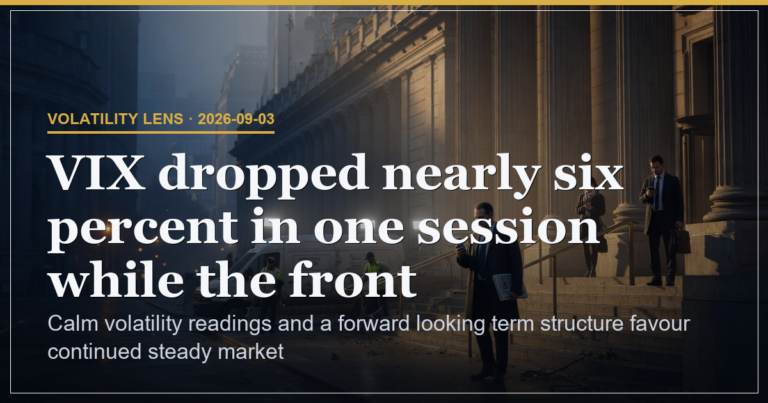
VIX closed at 16.29, down 4.23% on the session — from 17.01 at the open. The 5-day average sits at 17.95, meaning yesterday’s close printed well below recent trend. Volatility sellers drove the late session. The range for the day was 16.29 to 17.18, and it closed at the low. When VIX closes at the day’s low on a record index close, that is textbook complacency formation.
| Indicator | Current | Prior | Change | Signal |
|---|---|---|---|---|
| CNN Fear & Greed | 60.7 | 65.0 | -4.3 | Greed slowing, not reversing |
| VIX (close) | 16.29 | 17.01 | -4.23% | Complacency at session low |
| VIX 5-day avg | 17.95 | — | Current below avg | Vol suppressed vs recent trend |
| VIX intraday range | 16.29 – 17.18 | — | — | Closed at low = vol selling |
| AAII Bullish | 31.7% | 39.3% | -7.6pp | Fastest weekly drop this cycle |
| AAII Bearish | 43.6% | 36.6% | +7.0pp | 12.6pp above 31% historical avg |
| S&P 500 (at same time) | 7,520 | ATH | Record close #2 | Divergence confirmed |
The tension is this: F&G at 60.7 and VIX at 16.29 both signal market participants are not frightened. Yet the survey data says retail investors are. The resolution is straightforward — the survey captures opinions, options flow captures money. Right now, money is not afraid.
That does not mean the survey is worthless. It means the survey is a contrarian signal, not a directional one. The crowd is wrong at peaks and troughs — and the crowd is wrong right now, but only if PCE cooperates.
The Read vs The Risk
The read says retail is wrong and institutions are right. The contrarian case is compelling on every metric: sub-32% bulls, above-43% bears, VIX below 17, options flow net bullish. Every indicator points the same direction. That unanimity is itself worth questioning.
Here is what we are holding honestly: breadth at 46.6% advancing on a record close is not a healthy market. Fewer than half the stocks rose on the day the index made history. When institutional money is long through breadth deterioration into a macro print, the correction, if it comes, will be fast. VIX at 16.29 cannot protect you — it is priced for calm. Thursday’s Core PCE is the only thing standing between the contrarian thesis and a sharp re-rating.
Options Flow: 0.606 P/C Ratio — Money Disagrees With the Survey
The aggregate put-to-call ratio across our ten-symbol universe came in at 0.606. A reading below 0.7 indicates net bullish positioning — call buyers outnumber put buyers when adjusted across the universe. The market-wide sentiment reading is “bullish” even as AAII registers its weakest retail confidence in five weeks.
Six of our ten names showed bullish options characteristics: AAPL, NVDA, TSLA, META, MSFT, AMZN. None showed outright bearish flow. IWM was the one cautious exception with a put-to-call ratio of 1.042 — puts outnumbered calls on the small-cap index, which is consistent with the rotation uncertainty flagged in yesterday’s positioning read.
| Symbol | P/C Ratio | P/C OI Ratio | Max Pain | Flow Lean |
|---|---|---|---|---|
| SPY | 0.881 | 1.969 | $749 | Calls dominate volume, puts dominate OI |
| QQQ | 0.829 | 2.855 | $727 | Heavy call buying at 729-730 |
| IWM | 1.042 | 2.065 | $288 | Puts leading — small-cap caution |
| AAPL | 0.476 | 0.676 | $305 | Strongly bullish options flow |
| NVDA | 0.570 | 0.464 | $215 | Calls 2:1 over puts in OI |
| META | 0.332 | 0.439 | $607.50 | Most bullish in universe |
| MSFT | 0.293 | 0.438 | $415 | Calls dominate by 3:1 on volume |
| TSLA | 0.534 | 0.628 | $427.50 | Bullish but unusual put activity at $437.50 |
| AMD | 0.774 | 1.112 | $440 | Neutral-cautious; high IV skew |
| AMZN | 0.329 | 0.400 | $262.50 | Calls dominant across all measures |
| Aggregate | 0.606 | — | — | Net bullish |
The unusual flow intelligence highlights two notable trades. In META, a 612.5 put at zero days to expiry generated a 142% move — caught before it moved. That is tactical hedging by fast money, not structural fear. In SPY, the top unusual activity was a 751 call with 771,417 contracts of volume against 10,281 open interest — a volume-to-OI ratio of 75. Fresh call buying into the expiry, not pre-positioned fear.
IWM is the exception worth watching. Put-to-call on the small-cap index is the only ratio above 1.0 in our universe. The positioning analysis from earlier in this sequence identified the rotation pause — small caps underperformed on Wednesday with the Russell essentially flat. The options market is hedging that the rotation stalls further before PCE.
The Breadth Problem: 46.6% Advancing Into an All-Time High
This is the number that keeps the sentiment picture complicated. Fewer than half the S&P 500 components rose on the session when the index hit its second consecutive record. 46.6% advanced. 49% declined. The rest were flat.
Narrow breadth at all-time highs is not automatically a sell signal — but it is a warning about the quality of the rally. When breadth deteriorates as the index rises, it means the gains are increasingly concentrated. A small number of mega-cap names are doing the lifting while the broader market stalls. The institutional positioning story from our earlier analysis — which confirmed concentrated large-cap accumulation — is consistent with this reading.
| Metric | Wednesday Close | Implication |
|---|---|---|
| S&P 500 close | 7,520.36 | 2nd consecutive record |
| Advancing stocks | 46.6% | Below 50% on ATH day |
| Declining stocks | 49.0% | Majority of market fell |
| Nasdaq (QQQ) | -0.09% | Lagged while S&P made ATH |
| Russell 2000 | -0.02% | Rotation paused — not confirmed |
| Dow Jones | +0.36% | Mega-cap value carrying the index |
| VIX close | 16.29 | Priced for calm, not for this divergence |
The Dow at 50,644 and S&P at 7,520 are being driven by a shrinking cast. The Nasdaq could not participate — QQQ at $729.45 was marginally in the red while SPY held flat. That internal rotation — from growth to value — was visible yesterday and continued Wednesday. The breadth number captures it: value mega-caps are going up, growth mid-caps are not.
This is why the AAII survey is actually not irrational. The average retail investor is spread across the market. They own ETFs. They own small-cap and mid-cap exposure. From their portfolio’s perspective, Wednesday was not a record day — it was a flat-to-down day. The survey reflects lived experience, not headline performance.
Flow Intelligence: DELL, ECB, Kashkari and the Macro Pressure Building
The flow intelligence from Wednesday highlights three macro signals relevant to sentiment positioning ahead of PCE.
First: the ECB risk warning. The European Central Bank said publicly that Donald Trump risks triggering a financial crisis. That is not a minor statement — the ECB does not make those comments lightly. For US traders, it reads as a tail risk acknowledgement from a credible institution. This is the kind of headline that moves retail surveys bearish while institutional desks hold positions — they can absorb policy volatility, retail cannot.
Second: Kashkari’s inflation warning. The Federal Reserve’s Kashkari explicitly warned that an inflationary shockwave from the Middle East war could persist. That lands directly on tomorrow’s Core PCE. If the Fed is already flagging geopolitical inflation pass-through, a hot PCE print becomes more credible — and more dangerous for the record highs.
Third: DELL’s Pentagon deal. A $9.7 billion five-year software contract, disclosed alongside reports of significant Trump personal DELL holdings and a public presidential buy recommendation in May. The flow intelligence flagged this as unusual. For sentiment purposes: defence and government tech contracts are returning to the spotlight. Sectors outside the mega-cap AI complex are getting institutional attention.
| Signal | Source | Sentiment Implication |
|---|---|---|
| ECB “financial crisis” warning | Flow intelligence | Tail risk narrative keeps retail bearish |
| Kashkari: inflation shockwave from Iran | Flow intelligence | Hot PCE credibility raised — raises stakes |
| DELL $9.7B Pentagon deal | Flow intelligence | Broadening beyond mega-cap AI |
| Nvidia $150B Taiwan investment | Flow intelligence | Structural AI capex commitment intact |
| Iran uncertainty ongoing | Flow intelligence | Geopolitical premium not fully removed |
| US weapons stockpile depletion | Flow intelligence | Defence spend narrative extending |
The Nvidia announcement — $150 billion committed to Taiwan annually — is the contrasting signal. That is not a company preparing for a bear market. That level of capital commitment requires multi-year visibility. When the largest AI infrastructure provider is accelerating spend at that scale, institutional sentiment around the structural growth story does not waver based on a weekly AAII survey.
Positioning into Core PCE: What the Sentiment Picture Means for Thursday
Core PCE is released Thursday 08:30 EDT. Consensus is around 2.6% year-on-year. The sentiment configuration ahead of this print is important context for what happens on a miss or a beat.
If PCE comes in cool (at or below 2.5%): The AAII bears are wrong. Options positioning (0.606 P/C) is validated. VIX at 16.29 gets compressed further. The contrarian thesis — retail scepticism at all-time highs is fuel for the next leg — plays out quickly. That rally will be thinner still because breadth has been deteriorating, but the index can extend.
If PCE comes in hot (above 2.7%): Retail’s 43.6% bearish reading looks prescient rather than irrational. VIX at 16.29 reprices sharply because it is not priced for any macro surprise. The SPY put OI wall at 714 (22,705 contracts) and 731 (21,534 contracts) becomes relevant — those are the levels where institutional hedges kick in. The breadth deterioration story gets cited immediately as the warning that was visible in advance.
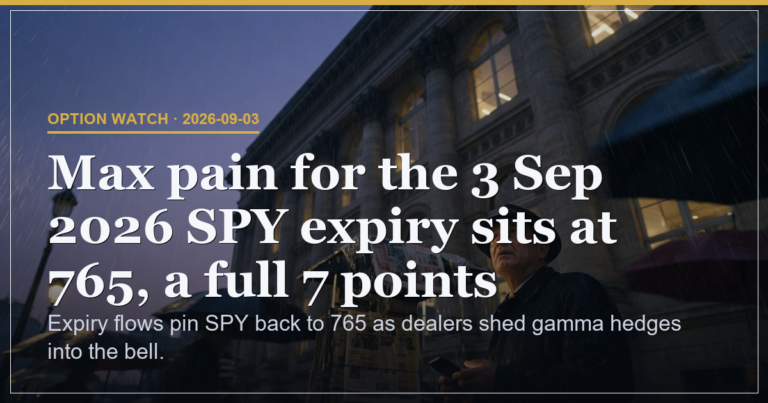
What we are watching: the SPY max pain for the nearest expiry is $749. Current price is $750.46. The market is sitting 0.19% above max pain. That is unusually tight. Into a macro print, that configuration tells us market makers are positioned for minimal movement — any surprise in either direction creates an outsized response because the books are not set up for volatility.
| PCE Outcome | F&G Implication | VIX Implication | AAII Reading |
|---|---|---|---|
| Cool (≤ 2.5%) | F&G pushes back toward 65+ | VIX tests 15 or below | Bears capitulate next week |
| In-line (2.6%) | F&G holds 58–63 range | VIX stays 15.5–17.5 | Survey stays mixed, breadth key |
| Hot (≥ 2.7%) | F&G drops toward 45–50 | VIX spikes, 19+ quickly | Bears vindicated — survey reprices further |
Thursday/Friday Scenarios: How Sentiment Resolves
PCE at or below 2.5% year-on-year. The institutional long thesis is vindicated. VIX drops below 16. The 43.6% AAII bears begin unwinding over the following week. F&G pushes back above 65. SPY tests 755 — the 754 call wall at 182,061 volume on Wednesday becomes a magnet. The breadth concern does not disappear, but a cool inflation print gives the rotation fuel: rates stay accommodative, small caps and mid-caps catch a bid, breadth improves.
Sentiment trajectory: AAII bulls recover toward 37-38% within two weeks. F&G sustainable above 60. VIX range 14.5–16. Best configuration for the institutional accumulation thesis from our positioning read to compound.
PCE prints in-line at 2.6%. The market holds 7,480–7,560 into the weekend. VIX stays flat in the 16–17.5 range. Sentiment stays mixed — the AAII bears do not capitulate, but they do not gain fresh reason to add. F&G holds 58–62. The breadth story becomes the dominant narrative as we head into June: record index level, narrow participation, waiting for a catalyst. Core PCE Thursday gives the market nothing new to trade on.
Sentiment trajectory: Sideways surveys, sideways markets. The put-to-call ratio stays below 0.65. Options players stay positioned bullish but trim. We are watching this for a week of distribution risk — rallies getting sold rather than bought.
PCE at 2.7% or above. The 43.6% AAII bears were right. The ECB warning carries. Kashkari’s inflation shockwave thesis gets traction. VIX spikes from 16.29 — potentially to 19-21 intraday. SPY tests the 749 max pain level, then the 731 put wall at 21,534 open interest. A 2% correction from 7,520 lands at approximately 7,369 — still above the 7,400 level that was resistance-turned-support. The AAII survey next week prints 28-30% bulls. F&G drops to the 45-50 “neutral” zone.
Sentiment trajectory: If this happens, the contrarian signal gets stronger, not weaker. Sub-30% AAII bullish with the index near all-time highs is historically the most powerful buy signal in the survey’s history. We are not there yet — but a hot PCE print accelerates us toward it. Core PCE Thursday is the forcing function for this scenario.
Probabilities reflect our current sentiment read. They are revised following the PCE release Thursday 08:30 EDT.
Three-Timeframe Sentiment Verdict
| Timeframe | Bias | Key Driver | Risk |
|---|---|---|---|
| Short (24-48h) | Cautious-neutral | Core PCE Thursday 08:30 EDT | VIX at 16.29 not priced for surprise |
| Medium (1-4 weeks) | Bullish-contrarian | AAII 31.7% bulls historically precedes rallies | Breadth must broaden to confirm |
| Long (1-3 months) | Structurally bullish | Institutional accumulation intact; AI capex commitment | Geopolitical tail risks (Iran, policy) |
What We Are Allocating: Pre-PCE Sizing Tiers
Sentiment divergence into a binary macro print is not the environment for full conviction. VIX at 16.29 means options protection is cheapest right now — and if you need it after the print, it will cost 20-30% more. Here is how we are sizing across the tiers heading into Thursday morning.
| Tier | Allocation | Rationale |
|---|---|---|
| MAX | Not applicable pre-PCE | Binary event prevents full conviction on any thesis |
| STANDARD | Core equity longs (large-cap, confirmed strength) | Institutional positioning intact; contrarian sentiment support; breadth caution limits upside surprise |
| REDUCED | Small caps (IWM), speculative growth | Rotation unconfirmed; IWM P/C above 1.0; breadth weak |
| AVOID | New entries without defined stops into PCE | VIX underpriced; SPY at max pain; 0.19% above pain means any direction gets amplified |
The one trade that makes sense in this environment regardless of directional conviction: defined-risk structures. VIX at 16.29 and SPY implied volatility compressed means the cost of knowing your maximum loss is at a multi-week low. We are not making directional bets on PCE — that is speculation, not analysis. We are staying positioned in what the institutional accumulation pattern confirms, with stops that reflect the actual risk environment.
What We Are Watching: Seven Sentiment Gauges After PCE
| # | Gauge | Bull Confirmation Level | Bear Warning Level |
|---|---|---|---|
| 1 | VIX | Holds below 16 | Breaks above 18.5 |
| 2 | SPY price vs max pain | Moves above 752 | Breaks below 749 |
| 3 | Aggregate P/C ratio | Stays below 0.65 | Spikes above 0.85 |
| 4 | F&G Index | Recovers above 63 | Drops below 52 |
| 5 | Breadth advancing % | Recovers above 52% | Falls below 40% |
| 6 | IWM P/C ratio | Drops below 0.9 (calls take over) | Spikes above 1.3 |
| 7 | AAII next survey (27 May) | Bulls recover toward 34-36% | Bulls drop below 28% |
Continue Reading
Each post in this sequence extends the argument. Read the full picture before Thursday’s open.
Prior Read
The institutional accumulation story — where the large money was positioned going into PCE day
Session Context
Wednesday’s record close and the crude oil crash — the full session breakdown that built this setup
Next: Macro Read
How the rates picture and PCE path intersects with the sentiment story above
Deepen Your Understanding
Related articles from the Titan Protect Foundry: