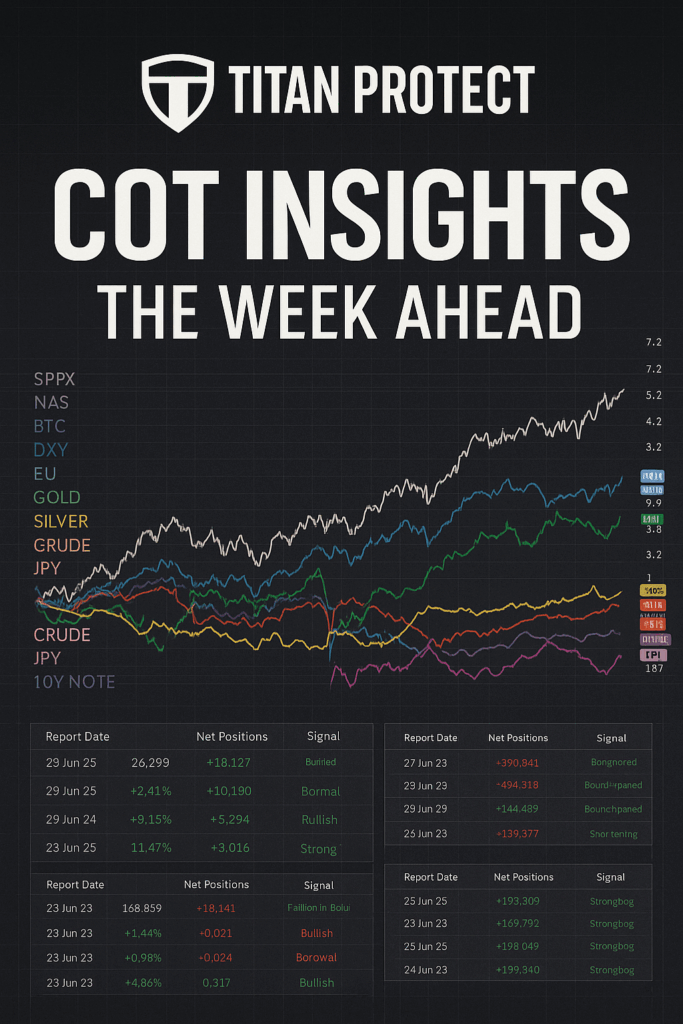
Positioning Pressure • Thursday 28 May 2026 • Foundation Read
Institutional Positioning Before PCE: Dark Pool Billions and COT Extremes Reveal the Real Bet
Yesterday the S&P printed its second consecutive record close at 7,520. The Dow crossed 50,644 for the first time in history. VIX dropped to 16.29. On the surface, that is a clean risk-on tape. Underneath it: breadth at 46.6%, crude in freefall at $89.41, and a put-to-call open interest ratio on SPY of nearly 2:1. The divergence between what the indices are showing and what the institutional positioning books say is the story heading into Thursday’s PCE release at 08:30 EDT. This is not a moment for comfortable assumptions. The smart money has already made its bet. Here is what the positioning data reads.
Core Positioning Read
Asset managers are running the largest net long position in S&P 500 futures in months, at +1,002,779 contracts net. Leveraged funds are running the opposite: net short 383,426 contracts in equities. Dark pool volume landed $27B+ across SPY, NVDA, AAPL, MSFT and QQQ in Wednesday’s session. The aggregate options put-to-call ratio of 0.606 is bullish by classification. But SPY’s own put open interest outweighs calls by nearly 2:1. The market is long at the index level, hedged underneath it, and positioned for volatility at the PCE print. Both sides of this trade cannot be right. One of them reprices at 08:30 EDT Thursday.
Where the Institutions Printed
Wednesday 27 May 2026 dark pool session totals
The dark pool tape for Wednesday tells a concentrated story. Five names commanded over $21B in combined institutional dark flow: SPY at $5.64B, NVDA at $5.31B, MU at $4.1B (the day’s third-largest print by notional), AAPL at $3.69B, and MSFT at $2.03B. The breadth of that list matters. Three ETF proxies and two single-name semiconductors dominated the concealed flow. That is not diversification. That is tech and large-cap equity concentration at the highest dollar level of the week.
The MU print deserves its own paragraph. $4.1B across 1,503 orders in a single session is extraordinary. MU simultaneously led the options flow table at $188.18M notional across 22,727 contracts. When the same name is printing billions in dark pool volume and hundreds of millions in options on the same day, the thesis is not ambiguous: institutional money was making a directional statement on MU specifically. The $65M to $1.5B unrealised gain reported on existing MU calls only amplifies this.
The index-level proxies, VOO ($1.98B) and IVV ($1.5B), printed in quiet size. Passive rebalancing or ETF creation does not typically produce that kind of dark pool activity in a session where breadth is sub-50%. This is not passive. Somebody was building or adjusting index-level equity exposure at scale.
| Symbol | Type | Orders | Shares | Notional | Read |
|---|---|---|---|---|---|
| SPY | Dark Pool | 43 | 7.5M | $5.64B | Index-level accumulation |
| NVDA | Dark Pool | 771 | 25M | $5.31B | Largest share count on the tape |
| MU | Dark Pool | 1,503 | 4.5M | $4.10B | Highest order count; conviction print |
| AAPL | Dark Pool | 220 | 11.8M | $3.69B | Heavy share accumulation, $311 range |
| MSFT | Dark Pool | 212 | 4.9M | $2.03B | Steady accumulation ahead of AI events |
| VOO | Dark Pool | 5 | 2.9M | $1.98B | Passive proxy; unusually large for dark pool |
| META | Dark Pool | 252 | 2.1M | $1.32B | Continued large-cap tech bid |
| QQQ | Dark Pool | 8 | 1.8M | $1.28B | Index proxy buying alongside SPY |
| AMD | Dark Pool | 357 | 2.3M | $1.15B | Semiconductor confirmation trade |
| TSLA | Dark Pool | 288 | 2.3M | $998.9M | Below $1B — relatively quiet |
Dark pool data: Wednesday 27 May 2026 session
The Options Flow Picture
Institutional options activity Wednesday 27 May 2026
The aggregate put-to-call ratio of 0.606 classifies as bullish. On the surface: institutions are buying more calls than puts. That is the correct headline. But the detail underneath it is where the positioning story gets complex heading into PCE Thursday.
MU dominated the options tape at $188.18M notional. UBER printed $163.31M in options flow. QQQ saw $96.26M. NVDA followed at $86.14M. The first thing to notice: MU and NVDA together represent semiconductor AI infrastructure plays. The second thing: QQQ options flow at nearly $100M alongside $1.28B in dark pool volume confirms the institutional focus was on technology and nothing else. There was no broad-market diversification in the flow on Wednesday. This is a concentrated bet.
Here is the tension in the read: the aggregate P/C of 0.606 looks bullish, but SPY’s own put-to-open-interest ratio is 1.969. For every call contract sitting open in SPY, there are nearly two put contracts. The bulk of that put open interest is stacked at strikes $731, $734, and $714. That is 2.5-5% below current price. Institutions bought the tape with calls and hedged the portfolio with deep puts. That is not a fearless bull. That is a long position with insurance.
| Symbol | Orders | Contracts | Notional | Bias |
|---|---|---|---|---|
| MU | 152 | 22,727 | $188.18M | Bullish |
| UBER | 2 | 79,394 | $163.31M | Mixed |
| QQQ | 98 | 51,143 | $96.26M | Bullish |
| NVDA | 91 | 52,485 | $86.14M | Bullish |
| AAPL | 47 | 59,508 | $66.93M | Mixed |
| SPX | 36 | 8,223 | $66.64M | Hedging |
| SPY (calls) | 56 | 41,004 | $49.78M | Bullish |
| SPY (puts) | 52 | 62,204 | $35.48M | Defensive |
Options flow notional: Wednesday 27 May 2026 session
SPY Options Architecture Heading Into PCE
Strike-level positioning tells the real story
This is the section that matters most heading into PCE Thursday. The implied straddle on SPY prices the expected move at just $0.96: upper bound $751.42, lower bound $749.50. The market is pricing an 0.13% move from the PCE print. That is the calmest possible read. It could be right. PCE in-line would be the consensus outcome and the straddle would expire worthless on both sides.
But look at what is open. On the call side: maximum open interest sits at the $752 strike (15,052 contracts), followed by $750 (12,354), then $751 (10,281). Calls are stacked in a tight band right around current price. The highest volume call on the session was the $751 strike with 771,417 contracts traded against 10,281 open interest: a 75x volume-to-OI ratio. That is not hedging. That is a directional bet that the market breaks $751 into PCE.
On the put side: the picture is different. The largest open interest concentrations are at the $714 strike (22,705 contracts), $731 (21,534), and $734 (21,379). These are not near-dated hedges expiring Thursday. They are further out. They represent the institutional insurance book against a PCE shock that forces a repricing of the rate path. Somebody is paying for that protection right now.
The IV skew is extreme. Average OTM put IV for SPY reads at 195.6 versus average OTM call IV at 4.0. Puts are priced 48 times more expensively than calls on an implied vol basis. The market is telling you it fears the downside far more than it is excited about the upside, regardless of what the P/C ratio headline says.
| SPY Options | Top Strike | OI at Strike | Total OI | P/C OI Ratio |
|---|---|---|---|---|
| Calls | $752 | 15,052 | 155,486 | 1.97 |
| Puts | $714 | 22,705 | 306,082 | |
| Implied Move (PCE) | $749.50 – $751.42 | 0.13% | ||
| OTM Put IV | 195.6% (puts expensive: fear) | |||
| OTM Call IV | 4.0% (calls cheap: complacency) | |||
SPY options data: session close Wednesday 27 May 2026 | Max pain: $749.00
The max pain point of $749.00 sits $1.46 below Wednesday’s close of $750.46. If PCE prints in line and the market drifts slightly lower into the number, max pain and the straddle lower bound converge. The path of least resistance into the print is a quiet drift rather than a ramp higher.
Futures Positioning: Who Is Long, Who Is Short
Weekly commitment of traders data as of 19 May 2026 | Next update Friday post-PCE
The weekly futures positioning report carries data through 19 May, meaning the current reading pre-dates the last week of tape. But it provides the structural backdrop that the dark pool and options flow was layered on top of. The story it tells is stark.
In S&P 500 futures: asset managers are net long 1,002,779 contracts. That is institutional money at scale betting on equities. Leveraged funds are net short 383,426 contracts. Dealers are net short 717,880 contracts. The setup is a tug of war between long-term institutional money and the hedge fund community, which has been fading this rally with conviction. If PCE prints benign on Thursday and equities extend higher, the leveraged fund shorts are the accelerant. A squeeze off a soft PCE number could be violent precisely because of this positioning imbalance.
The Nasdaq positioning amplifies the message. Asset managers are net long 93,078 contracts in Nasdaq futures. Leveraged funds are net short 64,581. The same tug of war, but on the most rate-sensitive index in the market. Nasdaq is where PCE matters most. A hot PCE forces rate expectations higher. Rate expectations higher crushes growth multiples. That is why the leveraged fund short in Nasdaq futures is the cleanest hedge against a surprise Thursday.
Treasury bonds confirm the macro thesis. Leveraged funds are net short 344,131 treasury bond contracts. Asset managers are net long 472,569. The bond market’s institutional longs are positioned for yields to fall: consistent with a soft PCE reading. A hot PCE reverses that, and the bond short squeeze unwinds in the wrong direction for equities.
| Market | Asset Mgr Net | Leveraged Net | Dealer Net | Open Int. | PCE Risk |
|---|---|---|---|---|---|
| S&P 500 | +1,002,779 | -383,426 | -717,880 | 3,016,677 | Squeeze potential on soft PCE |
| NASDAQ-100 | +93,078 | -64,581 | -44,134 | 366,455 | Most rate-sensitive: hot PCE = pain |
| T-Bonds | +472,569 | -344,131 | -198,502 | 2,211,434 | Positioned for lower yields (soft PCE) |
| Euro FX | +298,772 | -20,890 | -319,687 | 971,639 | EUR long vs USD short |
| GBP | -113,996 | +30,708 | +87,494 | 319,502 | Asset mgrs net GBP short |
| JPY | -39,727 | -81,624 | +71,003 | 437,785 | Both categories net short JPY |
Futures positioning data as of 19 May 2026 | Positive = net long, Negative = net short
The Read Says Long. The Hedge Book Says Not So Fast.
Here is the honest version of where the positioning analysis sits right now.
The bullish case is real. Asset managers have not allocated 1,002,779 net long contracts in S&P futures by accident. Dark pool operators printed $5.64B in SPY, $5.31B in NVDA, $4.1B in MU, and $3.69B in AAPL in a single session. The P/C ratio at 0.606 confirms more money went into upside calls than downside puts in aggregate. The VIX dropped to 16.29. Fear and Greed sits at 60.7, Greed territory. The regime is unambiguously risk-on.
But SPY’s put-to-call open interest ratio of 1.97 does not lie. There are almost twice as many put contracts open as call contracts. QQQ’s put OI ratio is 2.855: nearly three puts for every call sitting in the book. IWM’s ratio is 2.065. The institutional hedge book is enormous relative to the rally’s apparent calm. These puts did not appear overnight. They were built over weeks. Somebody has been systematically purchasing downside protection while the market makes new highs.
The VIX five-day average of 17.95 versus yesterday’s close of 16.29 is also a nuance worth holding. The market dropped the VIX 1.66 points in one session. That speed of VIX compression typically precedes one of two things: a continuation of the rally where vol sellers are proven right, or a sharp reversal when the catalyst arrives and the suppressed vol snaps back. PCE is precisely the catalyst that resolves this ambiguity. If the number lands hot, that 16.29 VIX reprices violently to the upside.
The AAII retail sentiment reading of 31.7% bullish is below the historical average of 37.5%. Retail is not celebrating the record highs — they are cautious. History suggests retail caution at index all-time highs is a contrarian bullish signal, not a bearish one. But AAII reads institutional positioning at 1M+ contracts net long in S&P futures alongside a 31.7% retail bull reading, and the divergence becomes uncomfortable. The crowd is not all in. If the crowd joins, the fuel for the next leg exists. If PCE stops them from joining, the institutional longs will need an exit.
What the Rest of the Market Is Saying
Crude oil collapsing 4.45% to $89.71 in the today’s lock data (the post-close brief cited $89.41 at the NYSE close) is a positioning catalyst on its own. The institutional tape in inverse crude ETFs was historic. One analyst tracking institutional dark pool flow noted that the two-times inverse crude ETF saw the largest single-day cluster in its history, including the largest individual trade since inception and two of the top four all-time trades. That is not a casual hedge. That is a conviction bet that the oil geopolitical premium is done.
Bitcoin dropped 2% to $74,307 with Ethereum down 2.35% to $2,022. Crypto weakness on a day equities made records is notable. Risk appetite is not uniform. The flow went into large-cap technology stocks in the dark pool, not crypto. When crypto underperforms equities on a risk-on day, it typically reflects either sector-specific weakness or dollar pressure. DXY at 99.17 with near-zero change confirms the dollar was not the driver. The crypto weakness stands as a standalone data point.
Gold at $4,487.60 (down 0.28%) and Silver at $74.92 (down 1.82%) reflect the crude oil containment narrative rippling through the commodity complex. Geopolitical premium being priced out of energy is also being priced out of the safe-haven metals — to a point. Gold’s decline is modest relative to crude’s 4.45% crash. The gold market is not abandoning the safe-haven thesis entirely. It is still pricing the possibility that a PCE surprise could shift the rate narrative and send capital back into the metal. Gold remains the binary event hedge.
| Asset | Price | Change | Positioning Read |
|---|---|---|---|
| S&P 500 | 7,520 | +0.02% | 2nd consecutive record; asset mgrs net long 1M+ futures |
| SPY | $750.46 | -0.02% | $5.64B dark pool; put OI ratio 1.97 (defensive) |
| Nasdaq 100 | 29,974 | -0.09% | Lagging; lev funds net short 64,581 futures; PCE most impactful here |
| Crude (WTI) | $89.71 | -4.45% | Historic inverse ETF cluster; containment priced with conviction |
| Gold | $4,487.60 | -0.28% | Modest dip; not abandoning rate hedge for PCE |
| VIX | 16.29 | -4.23% | 5-day avg 17.95; vol compression before binary event = snap risk |
| Bitcoin | $74,307 | -2.0% | Risk appetite not uniform; flow went to equities, not crypto |
| EUR/USD | 1.1631 | -0.05% | Asset mgrs net long +298K EUR futures; USD net short positioning |
Single Name Options: The Divergences That Matter
The single-name options data carries the clearest directional reads below the index surface.
NVDA: The call-to-put ratio of 1.75:1 (call volume 849,062 vs put volume 484,340) is bullish with conviction. The top open interest call strike is $215 with 21,959 contracts — just above current price of $212.60. The put OI skew is lighter. This is a market positioned for NVDA to continue higher after the dark pool printed $5.31B on Wednesday. The post-close analysis noted this positioning yesterday; it has not changed.
TSLA: This is the most interesting single-name in the data. A put-to-call volume ratio of 0.534 (calls dominate) looks bullish. But the unusual activity section shows a $437.50 put with 104,999 contracts traded against just 270 open interest: a 388.89x volume-to-OI ratio. That is the most extreme ratio in the entire dataset. Someone was aggressively opening new downside protection on TSLA at the $437.50 strike Wednesday. TSLA closed at $440.36. That put was barely out of the money when it was bought. This is not a casual hedge. This is a specific, large, directional bet.
META: The call-to-put ratio is 3:1 by volume (404,142 calls vs 134,202 puts). Calls dominate the flow at strikes $635, $637.50, and $640 — all above current price of $635.26. This is unambiguously bullish positioning on META, consistent with the $1.32B dark pool print. The max pain for META is $607.50, which is 4.4% below current price. The options market has pushed well past max pain, which means option sellers will not be pulling price down passively.
AMD: The implied move of 4.73% priced into AMD’s options is the largest in the dataset. That expected move range — $472.10 to $518.98 around the $495.54 current price — reflects genuine uncertainty about AMD’s near-term trajectory. AMD’s OI ratio is slightly net short at 1.11 puts to calls. This is a name the market is not sure about heading into PCE, and it is pricing that uncertainty accordingly.
| Symbol | Price | P/C Ratio | Max Pain | Impl. Move | Options Bias |
|---|---|---|---|---|---|
| NVDA | $212.60 | 0.57 | $215.00 | 0.12% | Bullish call bias |
| META | $635.26 | 0.33 | $607.50 | 0.21% | Strong call dominance |
| MSFT | $412.67 | 0.29 | $415.00 | 0.32% | Extreme call bias; $2B dark pool |
| AMZN | $271.85 | 0.33 | $262.50 | 0.29% | Calls dominant; 3.4M dark pool shares |
| TSLA | $440.36 | 0.53 | $427.50 | 0.21% | Calls lead but $437.50 put extreme |
| AAPL | $310.85 | 0.48 | $305.00 | 0.29% | Call dominant but $312.50 put unusual |
| AMD | $495.54 | 0.77 | $440.00 | 4.73% | High uncertainty; largest impl. move |
| IWM | $290.37 | 1.04 | $288.00 | 0.19% | Only index proxy net put bias |
Options data: session close Wednesday 27 May 2026
IWM: The Canary in the Positioning Mine
IWM is the only index proxy in the entire dataset with a put-to-call volume ratio above 1.0. At 1.042, it is barely net put-biased in volume terms. But in open interest, the divergence is stark: 2.065 puts for every call sitting open. The largest put concentrations are at the $270 (10,143 contracts), $275 (9,533), and $280 (6,225) strikes. Those are 5-10% below IWM’s current price of $290.37. Somebody bought those strikes expecting IWM to fall sharply.
The volume leaders analysis noted the largest SRTY trade since 2024 arrived as a dark pool sweep. SRTY is the three-times inverse IWM. When the inverse triple-leveraged small-cap ETF records its largest dark pool trade in two years, it is a directional statement: institutional money is positioned for IWM weakness, not strength.
This matters for the PCE read. Small caps are the most rate-sensitive corner of the equity market. A soft PCE (lower than expected inflation) reduces rate pressure and benefits IWM more than any other index. A hot PCE is the worst outcome for small caps because they carry more floating-rate debt, more consumer-facing exposure, and less ability to defend margins. The institutional hedge book in IWM puts tells you where the risk sits in the PCE tail scenario.
Three PCE Scenarios: How the Positioning Plays Out
Core PCE releases 08:30 EDT Thursday 28 May 2026 | Probabilities sum to 100%
PCE is the Federal Reserve’s preferred inflation measure. The market consensus is for a benign reading. Here is how each outcome translates through the institutional positioning book we have read above.
Scenario A: Soft PCE
45%
PCE at or below consensus. Rate cut path reopens.
The leveraged fund short in S&P futures (383,426 contracts net short) becomes a squeeze catalyst. Asset managers hold their 1M+ net long and add. The dark pool prints in SPY, NVDA, and MU get follow-through. VIX, already at 16.29, compresses further. QQQ reclaims its rate-sensitive premium. Gold holds as rate expectations drift lower. The IWM put book expires worthless. Regime extends: risk-on. What we are monitoring for: SPY breaking above $752 and QQQ call OI at $730-$732 being absorbed cleanly.
Scenario B: In-Line PCE
35%
PCE lands at consensus. Market prices no new information.
The options straddle expires with the market inside its $749.50-$751.42 bounds. Volatility compresses further. The put OI book at $714-$731 stays dormant. Max pain gravity at $749.00 holds SPY in a tight range. Breadth remains the nagging concern: 46.6% advancing stocks at a record high is not healthy, and in-line PCE does not fix breadth. The rally becomes more selective, semiconductor and mega-cap tech lead, and the concentration risk we have been flagging since the post-close session yesterday deepens. Risk-on regime holds but the quality of the bid narrows.
Scenario C: Hot PCE
20%
PCE above consensus. Rate cut expectations price out.
This is the positioning tail risk. VIX at 16.29 snaps towards its 5-day average of 17.95 and beyond. The asset manager long book in equities stays intact but does not add. Leveraged fund shorts in S&P and Nasdaq are vindicated. The SPY put OI at $714-$731 comes alive. QQQ put OI at $705 (15,851 contracts) becomes relevant. Gold reprices higher as rate-cut hopes collapse. The IWM puts and SRTY dark pool sweep prove prescient. Breadth, already sub-50%, deteriorates further. The crude crash loses its tailwind interpretation: lower oil becomes a demand concern rather than a containment narrative. Regime shifts: risk-on to risk-off transition begins.
Positioning Allocation Tiers Into PCE
What we are allocating heading into the 08:30 EDT binary event
| Instrument | Pre-PCE Tier | Positioning Rationale | Key Level to Watch |
|---|---|---|---|
| SPY / S&P 500 | STANDARD | Asset mgrs long 1M+ contracts; dark pool $5.64B. But put OI 2:1 and breadth 46.6% | $749 max pain / $751-752 call wall |
| Nasdaq / QQQ | STANDARD | Dark pool $1.28B; options call bias. But lev funds net short 64K futures ahead of PCE rate risk | QQQ $729-730 call concentration |
| IWM / Small Caps | REDUCED | SRTY largest dark pool trade since 2024; IWM only proxy with net put bias in volume; most PCE-sensitive | $288 max pain; $270-280 put wall |
| NVDA / MU / AMD | REDUCED | Dark pool conviction but single-name event risk. AMD 4.73% implied move; MU $4.1B dark pool needs follow-through | NVDA $212.50 call wall; AMD $495-500 |
| Gold | MAX | Binary event hedge. Soft PCE: gold holds above $4,480. Hot PCE: gold reprices higher on rate-cut collapse. Wins either way if PCE surprises | $4,480 structural floor / $4,502 high |
| Crude (WTI) | AVOID | Historic institutional short in inverse crude ETFs already made. New longs risk fighting the trend. Below $90 changes the narrative | $90.00 reclaim vs $87-88 support test |
Three-Timeframe Verdict
Short-Term (24-48hrs)
NEUTRAL-LONG
Hold into PCE. Positioned but not overcommitted. Dark pool confirms institutional bid. Put OI confirms hedges in place. Wait for the number.
Medium-Term (1-2 weeks)
LONG BIAS
Asset manager net longs of 1M+ contracts do not unwind in a week. Concentration in mega-cap tech and semiconductors has momentum. The PCE print needs to be genuinely hot to change this.
Long-Term (4+ weeks)
CAUTIOUS
46.6% breadth at ATH is unsustainable. The rally needs to broaden or it corrects. The institutional hedge book (306K put OI on SPY alone) suggests the smart money agrees.
The Levels That Decide PCE Day
Every positioning read needs a price framework to be actionable. Here is where the options architecture and dark pool concentration define the key zones for Thursday.
| Level | Price | Why It Matters | Type |
|---|---|---|---|
| SPY Call Wall (PCE bull target) | $751-752 | 771K call volume at $751; 15,052 OI at $752; resistance above current $750.46 | Resistance |
| SPY Max Pain | $749 | Option expiry gravity; pre-PCE drift level; $1.46 below close | Magnet |
| SPY Major Put Support | $731-734 | 21,534 and 21,379 contracts OI; first real institutional put defence | Support |
| QQQ Call Concentration | $729-732 | Top call OI zone; 369K volume at $730; where the tech bull bet sits | Target |
| QQQ Major Put Zone | $700-705 | 13,155 and 15,851 OI; hot PCE downside target if rate fears accelerate | Support |
| NVDA Options Wall | $215 | 21,959 call OI; 215K volume; dark pool $5.31B all pointing higher | Target |
| Gold Floor | $4,480 | Structural support; called in post-close brief yesterday; max conviction allocation | Floor |
What the Institutional Positioning Book Says
Standing back from all of it, here is the positioning picture that matters as PCE approaches.
The big money is long equities. Asset managers have 1,002,779 net long contracts in S&P 500 futures. They printed over $27B in dark pool flow across the major names in a single session. The options aggregate P/C of 0.606 confirms more dollars went into upside bets than downside. This is not a market that thinks it is going down.
But the hedge book is the biggest we have seen this cycle. SPY put open interest outweighs calls nearly 2:1. QQQ puts outweigh calls nearly 3:1. The SRTY dark pool trade is the largest since 2024. The institutional community has simultaneously made the biggest long bet and the biggest hedge in recent memory. That combination is only rational if the distribution of outcomes is genuinely binary. PCE is that binary event.
One honest admission: the AAII data at 31.7% bullish versus the 37.5% historical average creates a genuine uncertainty in the positioning read. The retail investor is not celebrating these records. If PCE lands soft and retail gets confident enough to participate, the institutional long gets the ammunition it needs for a proper extension. If PCE comes hot and the retail investor who was already cautious gets scared out entirely, the institutional hedge book becomes the floor. Either way, the next 24 hours determine which side of this trade is right.
Build the Full Picture
This positioning read is the foundation. The full picture requires each layer of analysis that builds on it throughout the day.
Coming Next
The Macro Backdrop Driving the Institutions
Rate path, inflation trajectory, and how PCE fits the broader economic sequence
Coming Next
Volatility Structure and VIX Term Analysis
What the 16.29 VIX and its 17.95 five-day average tell us about the options market’s real expectations
Yesterday’s Read
Post-Close: Crude Crashed Below $90 While the S&P Printed Another Record
The session that set up today’s PCE positioning. Breadth, the FOMC Minutes non-event, and the crude collapse
Deepen Your Understanding
Related articles from the Titan Protect Foundry: