Here is the one observation that frames everything else: on a day when the S&P 500 gained 0.37%, the worst-performing sector (Technology at +0.55%) and the best-performing sector (Real Estate at +3.72%) were separated by 3.17 percentage points. That is not a quiet market. That is active rotation between parts of the equity universe that are pricing very different economic outcomes. The question is which outcome is right.
—
Complete Sector Performance Table: Friday 23 May 2026
| Rank | Sector | Fri Change % | Market Cap | P/E | Stocks | Institutional Signal |
|---|---|---|---|---|---|---|
| 1 | Real Estate | +3.72% | $1,798B | 32.73 | 255 | Rate-cut pricing — PCE binary |
| 2 | Energy | +3.43% | $4,742B | 19.83 | 256 | XLE dark pool $1.14B — conviction block |
| 3 | Utilities | +2.91% | $1,976B | 21.09 | 109 | Defensive rotation — pre-Thursday hedging |
| 4 | Consumer Defensive | +2.37% | $4,484B | 26.73 | 246 | Flight to quality — 74-year consumer sentiment low |
| 5 | Financial | +1.97% | $13,944B | 16.93 | 1,095 | Cheapest sector by P/E — risk-on COT aligned |
| 6 | Basic Materials | +1.94% | $2,887B | 22.73 | 283 | Commodity bid — DXY soft at 99.24 |
| 7 | Healthcare | +1.59% | $8,382B | 28.98 | 1,075 | MCK dark pool $1.01B — selective accumulation |
| 8 | Industrials | +1.07% | $7,650B | 32.24 | 690 | Neutral — no dark pool confirmation |
| 9 | Consumer Cyclical | +0.78% | $9,375B | 30.38 | 545 | Consumer sentiment headwind — avoid the sector ETF |
| 10 | Technology | +0.55% | $31,325B | 38.89 | 779 | Sector lags — individual names accumulate |
| 11 | Communication Services | +0.50% | $13,560B | 38.75 | 263 | Most expensive by P/E — sector ETF unattractive |
—
Reading the Rotation: What Friday’s Pattern Actually Means
There are two legitimate ways to read Friday’s sector data. The first reading says: money is rotating defensively (Utilities, Consumer Defensive), which signals institutional caution ahead of Thursday. The second reading says: money is rotating into rate-sensitive sectors (Real Estate) and commodity plays (Energy), which signals confidence in a soft inflation outcome on Thursday.
Both readings are partially right. That is what makes Friday interesting.
The defensive rotation into Utilities (+2.91%) and Consumer Defensive (+2.37%) on a day when the market was up overall is a portfolio management move, not a panic move. It says: I am not selling my equity exposure, but I am shifting the character of that exposure toward lower-volatility, higher-yield sectors ahead of a binary event. That is rational institutional behaviour.
The Real Estate move (+3.72%) is the speculative layer on top of that defensive base. Real Estate only outperforms by that magnitude if enough money is pricing a dovish PCE outcome. A 3.72% sector move in a day that the S&P gained 0.37% is not passive — it is a loud bet that Thursday’s data will support rate cut expectations.
Defensive hedge: Utilities, Consumer Defensive (existing positions — already moved)
Rate-cut bet: Real Estate (speculative — requires Thursday to confirm)
Geopolitical bid: Energy (binary — Iran determines the outcome)
Value play: Financials (P/E 16.93 — cheapest sector, works in risk-on or sideways)
Avoid sector, trade names: Technology, Communication Services
—
Sector Breadth: Beyond the Headline Numbers
The sector performance percentages from ethical-trading/” style=”color:#D8AF44;text-decoration:underline” title=”Ethical Trading”>ethical-screener/” style=”color:#D8AF44;text-decoration:underline” title=”Ethical Screener”>screener data cover the full universe — 255 Real Estate stocks, 779 Technology stocks, 1,095 Financial stocks. The breadth behind those numbers matters as much as the headline move.
| Sector | Stocks | Sector Move | Market Cap | Breadth Read |
|---|---|---|---|---|
| Real Estate | 255 | +3.72% | $1,798B | Broad — 255 stocks all moved on rate-cut narrative |
| Energy | 256 | +3.43% | $4,742B | Broad — geopolitical bid affects the whole sector |
| Utilities | 109 | +2.91% | $1,976B | Very broad — only 109 stocks, sector-wide move |
| Consumer Defensive | 246 | +2.37% | $4,484B | Broad — defensive positioning is not concentrated |
| Financial | 1,095 | +1.97% | $13,944B | Very broad — 1,095 stocks gaining 1.97% is meaningful |
| Healthcare | 1,075 | +1.59% | $8,382B | Broad but moderate — no concentrated catalyst |
| Technology | 779 | +0.55% | $31,325B | Narrow — sector average dragged down by small-cap tech, not mega-caps |
| Communication Services | 263 | +0.50% | $13,560B | Narrow — META and GOOGL had dark pool activity, but the sector average is poor |
The Financial sector breadth number is the most impressive data point when you think about it correctly. 1,095 stocks gained an average of 1.97%. That is not driven by one or two large names — it is genuine sector-wide buying. Financials have the cheapest P/E on the board (16.93) and a risk-on COT reading behind them. When 1,095 stocks all move in the same direction, that is institutional money, not momentum chasers.
—
Sector Gamma Overlay: How Options Structure Interacts with Rotation
From Post 08, we have gamma direction for the major sector ETFs. All are in negative gamma territory. Here is how that interacts with the sector rotation picture:
| Sector ETF | Gamma Direction | Max Pain | Current Price (Fri) | Gap | Sector Trade Implication |
|---|---|---|---|---|---|
| SPY (S&P 500) | Negative | $739 | $745.64 | $6.64 above | Modest downward gravity — amplified if PCE hot |
| QQQ (Nasdaq 100) | Negative | $712 | $717.54 | $5.54 above | Larger relative gap — QQQ more exposed than SPY |
| IWM (Russell 2000) | Negative | $279 | $285.12 | $6.12 above | Dark pool long ($818M) limits downside; call options at $291 active |
| XLE (Energy) | N/A (not in top 10 options) | N/A | $59.49 | N/A | Dark pool $1.14B conviction block — geopolitical not options driven |
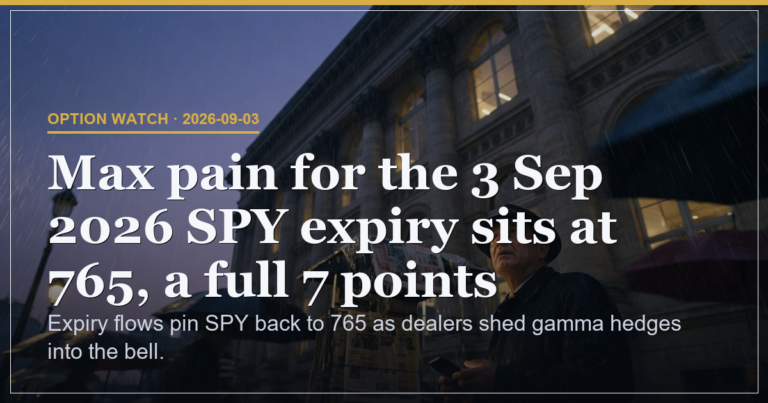
The QQQ gap of $5.54 above max pain is the most significant sector-level options structure for the week. The QQQ put/call OI ratio of 2.181 is the highest of all instruments — meaning for every call in open interest, there are 2.181 puts. That is a heavily hedged index. If Thursday’s PCE gives the market a reason to sell tech, QQQ has no natural support from options mechanics until the $712 max pain level is reached. Below $712, QQQ has a wall of put open interest at $710 (5,068 contracts), $685 (7,125 contracts), and $670 (8,472 contracts). Those put walls become support — they are where options sellers (market makers) will be forced to buy to hedge their short puts.
—
The Three Sector Trades That Matter This Week
Trade 1: Energy (XLE) — The Conviction Block Play
Energy at +3.43% with $1.14 billion in dark pool block trades across just 17 orders is the clearest institutional footprint of the week. The average order size was $67 million — that is a decision, not a rebalance. The Iran geopolitical context (Crude WTI at $96.60 with a military alert) gives the fundamental reason, and the COT data (risk-on at full conviction from Post 00) gives the macro backdrop.
Energy’s P/E of 19.83 is the second-cheapest sector on the board — behind Financials at 16.93. You are not paying a premium to own this sector. At a time when Technology trades at 38.89x earnings and Real Estate at 32.73x, Energy at 19.83x with an active geopolitical bid is the cheapest source of potential upside in the market.
| Parameter | Value |
|---|---|
| ETF | XLE (Energy Select Sector) |
| Friday Close | $59.49 |
| Entry Zone | $58.50 – $59.20 (Tuesday pullback to dark pool range) |
| Stop | $57.20 (below institutional block range) |
| Target 1 (base case) | $61.50 (geopolitical premium hold) |
| Target 2 (Iran escalation) | $64.00 – $65.00 |
| Risk % | Around 60% |
| Risk Factor | Binary geopolitical — de-escalation reverses the entire premium |
| Institutional Confirmation | $1.14B dark pool, 17 orders — strong |
Trade 2: Financials (XLF) — The Value Sector Play
Financials gained +1.97% with 1,095 stocks participating. P/E of 16.93 — by far the cheapest sector in the US market. XLF closed at $51.94. This is not a glamorous trade. It is a value trade backed by COT risk-on positioning (Post 00), broad sector participation (1,095 stocks), and the cheapest earnings multiple available anywhere in the equity universe.
The financial sector benefits from two conditions that are both present: risk-on positioning drives transaction volumes and asset management revenues, and a steeper yield curve (positive slope from short to long rates) benefits bank net interest margins. With the Fed expected to hold near current levels through the summer, the yield curve shape is not hostile to banks. Financials are the sector that works in both the bull and sideways scenarios.
| Parameter | Value |
|---|---|
| ETF | XLF (Financial Select Sector) |
| Friday Close | $51.94 |
| Entry Zone | $51.40 – $51.80 (any Tuesday pullback) |
| Stop | $50.50 (below recent range support) |
| Target 1 | $53.50 |
| Target 2 | $55.00 (risk-on continuation) |
| Risk % | Around 35% |
| Risk Factor | PCE hot and rate cut bets pulled — flatter curve hurts bank margins |
| Institutional Confirmation | COT risk-on, broad sector breadth (1,095 stocks) |
Trade 3: Technology Names (Not the ETF) — The Disconnect Opportunity
Technology as a sector gained +0.55% on Friday — near the bottom of the table. The XLK ETF closed at $180.39, up 1.0% — outperforming the sector reading because XLK is market-cap weighted toward the very names with institutional accumulation. The sector underperformance is the tail of smaller-cap tech names with no institutional backing pulling the average down.
The specific names with both dark pool confirmation (Post 07) and bullish options structure (Post 08):
| Name | Dark Pool $ | P/C Ratio | Max Pain | Current | Options Implication |
|---|---|---|---|---|---|
| NVDA | $4.31B | 0.504 (bullish) | $220 | $215.33 | Below max pain — upward mechanical pull toward $220 |
| AAPL | $1.48B | 0.569 (bullish) | $300 | $308.82 | Above max pain — modest headwind, but call OI at $310 (3,335 contracts) is support |
| MSFT | $1.37B | 0.311 (very bullish) | $412.50 | $418.57 | MSFT has lowest P/C of all tech names — institutions heavily positioned on upside |
| AMD | $1.07B | 0.546 (bullish) | $400 | $467.51 | Stale max pain — live reference is the $500 call wall |
| MU (Micron) | $2.76B | Not in top 10 | N/A | 685 dark pool orders | Semiconductor breadth name — secondary play to NVDA |
The trade is not XLK. The trade is the individual names. XLK will reflect the sector average (which includes smaller names with no institutional backing) and potentially underperform the conviction names you want to be in. If you want technology exposure for the week of 27 May, the data says NVDA first, MSFT second, AMD third, MU as a speculative add.
—
Sectors to Avoid: The Specific Reasoning
Real Estate (XLRE) — Speculative, Not Structural
Real Estate was the best-performing sector on Friday at +3.72%. But this post’s job is to tell you the truth about that move: it is entirely dependent on Thursday’s PCE print. Real Estate’s P/E of 32.73 is not supported by current earnings in a world where rates stay elevated. The sector gained 3.72% because options and institutional money is pricing a meaningful probability of a dovish PCE surprise that brings rate cut expectations back into view.
If you are a speculative trader who wants to bet on that outcome, XLRE is your vehicle. Entry around $44.00 – $44.40, target $46.50, stop $43.00. But size it at 30% of normal position — this is a binary event trade, not a structural sector play. If PCE is hot, XLRE reverses harder than almost any other sector because the entire gain is borrowed from a rate expectation that immediately becomes invalid.
Risk: Around 65% — the single highest risk rating in today’s posts. Factor: PCE prints above 2.3% and the rate-cut narrative evaporates.
Consumer Cyclical (XLY) — Trade the Names, Avoid the ETF
Consumer Cyclical at +0.78% is a below-market performer with a headwind from the worst consumer sentiment reading in 74 years (Post 02). XLY (Consumer Discretionary ETF) includes Amazon, Tesla, and the broader retail universe. The problem is that TSLA has a bullish options book and Amazon (AMZN) has bullish options flow (P/C 0.358, call volume dominant) — but the sector ETF also includes hundreds of smaller consumer discretionary names that are genuinely struggling under the weight of poor consumer sentiment.
XLY is not your vehicle. TSLA and AMZN as individual names are a different calculation. TSLA dark pool: $56.83M in options flow (39,544 contracts). AMZN call OI heavy at $270 (1,772 contracts, 24,297 volume). Trade the names, not the sector average.
Communication Services — Expensive and Broad
Communication Services at +0.50% and P/E of 38.75 is the joint-most-expensive sector alongside Technology. The sector includes META and GOOGL, both of which had meaningful dark pool activity on Friday ($1.51B and $1.35B respectively). But the sector also includes a long tail of streaming, telecom, and media names with no institutional backing and elevated multiples.
The XLC (Communication Services ETF) closed at approximately its sector-implied level. If you want exposure to the specific institutional conviction names in this sector, buy META and GOOGL directly. Buying XLC means owning the sector average — which includes names actively losing the institutional bid.
—
Breadth Signal: The Defensive Rotation Warning
Here is the sector rotation signal that most people missed on Friday. Four of the top five sectors by performance are either defensive (Utilities, Consumer Defensive) or binary event plays (Real Estate, Energy). Technology — the largest sector by market cap at $31.3 trillion — was near the bottom. That is a rotation pattern.
When defensive sectors outperform growth sectors on a day when the overall market gains, it tells you that within the bull market structure, investors are repositioning toward protection. They are not selling equities — they are changing which equities they hold. That is different from a bear market, where everything goes down. This is a bull market with internal rotation toward lower-risk sectors ahead of a known binary event.
If you had held Utilities and Consumer Defensive on Friday instead of Technology, you made 2.91% and 2.37% versus 0.55%.
If Thursday’s PCE is hot and tech sells off, Utilities and Consumer Defensive become the defensive ballast that limits portfolio drawdown.
If Thursday’s PCE is soft and tech rips, you give back the relative outperformance but your equity exposure is intact.
The institutions who rotated defensively on Friday are not making a call on direction — they are managing the distribution of outcomes.
—
Multi-Strategy Breakdown
Position Traders (multi-week)
The sector allocation for multi-week positions heading into 27 May should reflect the three pillars of the current environment: geopolitical (Energy), value (Financials), and quality tech (individual names, not ETF). Real Estate is a speculative addition only if you have a specific view on PCE coming in soft. Defensive sectors (Utilities, Consumer Defensive) function as portfolio ballast — they are not high-return trades, but they are the sectors that hold up when the rest corrects.
Allocation concept: Energy 20%, Financials 25%, Individual tech names 35%, Defensive mix 20%. Zero direct Technology ETF or Communication Services ETF exposure until the sector-level story improves.
Swing Traders (2-5 days)
The cleanest sector swing is XLE Energy: dark pool confirmation, Iran binary, COT backing, cheap P/E. The risk is fully understood — it is Iran. Entry in the $58.50 – $59.20 zone, stop $57.20, target $61.50. Size at half-normal position given the binary tail. Second cleanest: XLF Financials. Less exciting, but lower risk (35%) and the value argument is structural, not event-dependent.
Intraday Traders
For intraday sector plays, the semiconductor names (NVDA, AMD, MU) are the highest-volatility opportunities given the dark pool accumulation and the expected move ranges from Post 08. NVDA ±2.10%, AMD ±7.17% — these names will move intraday in a negative GEX environment. Trade them individually, not through XLK, to capture the specific institutional conviction rather than diluting it with sector average noise.
Watch for sector leadership rotation at the open on Tuesday. If Energy opens with a gap (Iran news), XLE momentum trading is the first session opportunity. If Energy is quiet, the attention shifts to Financials and individual tech names for the mid-session directional trade.
Scalpers
Sector ETF scalping is generally poor relative to individual name scalping — the spreads are tighter in names, and the dark pool data gives you specific levels to work around. If you want a sector scalp, XLE around the $58.50 support is the cleanest structure (dark pool block provides a clear stop reference). Everything else: use the individual names from the dark pool table.
—
Scenario Analysis: Sector Winners and Losers
| Scenario | Probability | Best Sectors | Worst Sectors | Rotation Pattern |
|---|---|---|---|---|
| Bull — PCE soft, risk-on extends | 30% | Real Estate (rate cut), individual tech names, Consumer Cyclical names | Utilities (defensive rotation reverses), Consumer Defensive | Money flows from defensive back into growth — XLRE and XLK lead |
| Sideways — data mixed, market waits | 35% | Energy (Iran bid holds), Financials (value), Healthcare (defensive with growth) | Real Estate (rate-cut narrative ambiguous), Consumer Cyclical | Sector leadership unclear — broad participation, no dominant theme |
| Correction — PCE hot, selloff | 25% | Utilities (maximum defensive), Consumer Defensive, Energy (inflation hedge) | Real Estate (worst performer — rate expectations collapse), Technology (multiple compression) | Classic flight to defensives — XLU and XLP outperform; XLK and XLRE sell off |
| Black Swan — Iran escalation | 10% | Energy (largest winner), Basic Materials, Gold-adjacent | Consumer Cyclical, Technology, Communication Services | Geopolitical rotation — energy and real assets dominate; growth sells off sharply |
—
Position Sizing by Sector
| Sector | Vehicle | Risk % | Sizing | Why |
|---|---|---|---|---|
| Energy | XLE | Around 60% | 50% of normal | Binary Iran risk — use defined-risk entry, options if available |
| Financials | XLF or individual banks | Around 35% | 80% of normal | Cheapest P/E, broad breadth, structural not event-dependent |
| Real Estate | XLRE | Around 65% | 30% of normal | PCE binary — speculative position only; use half-size and defined stop |
| Utilities | XLU | Around 40% | 60% of normal | Defensive ballast — holds in correction, lags in bull scenario |
| Individual Tech (NVDA, MSFT) | Individual stocks | Around 40% | 60% of normal | Dark pool + options confirmation — not the sector ETF |
| Technology ETF (XLK) | Avoid as sector trade | Around 55% | 30% maximum | Sector lags; dilutes conviction names with non-institutional tail |
| Consumer Cyclical (XLY) | Individual names only | Around 60% | 30% maximum | 74-year sentiment low weighs on the sector; trade TSLA/AMZN directly |
—
Experience Level Guidance
Beginner: The lesson from Friday’s sector data is that the sector with the most money in it (Technology at $31.3 trillion market cap) was near the bottom of the performance table (+0.55%). The sector with the least money (Utilities at $1.97 trillion) outperformed it by 2.36 percentage points. Market cap does not equal performance. The direction of money flow beats the size of the existing stock. Pay attention to the rotation numbers, not the absolute sizes.
Intermediate: The key decision for the week is whether you trade sector ETFs or individual names. The data says: trade individual names in Technology (NVDA, MSFT, AAPL), trade the ETF in Energy (XLE is the cleanest expression of the institutional block trade) and Financials (XLF captures the broad breadth). The general rule is: where dark pool activity is concentrated in the ETF (XLE, $1.14B in 17 orders), trade the ETF. Where dark pool activity is concentrated in specific names (NVDA, AAPL, MSFT), trade those names. Following the money at the right level of resolution is what separates a good week from a mediocre one.
Advanced: The defensive sector outperformance on a positive market day, combined with the negative GEX environment across all index ETFs and the PCE binary on Thursday, creates a specific hedging opportunity. Running long XLU or XLP as a partial hedge against a long technology book is the institutional equivalent of buying cheap index puts — except that XLU and XLP are positively convex in a correction (they go up when tech goes down) rather than just paying off via options premium. The cost of that hedge is the opportunity cost of underperformance if Thursday is a non-event and tech catches up. Size both sides accordingly — this is a portfolio structure decision, not a directional trade.
—
Cross-References: Completing the Picture
- Post 05 (Hot Zones): The hot zone identification — Energy, Real Estate, Utilities, Consumer Defensive, Financials — is the foundation of this post. Post 09 adds the institutional flow context and options gamma overlay that explains why those hot zones have the staying power they do.
- Post 07 (Institutional Flow): The dark pool data is the proof layer behind the sector calls. XLE’s $1.14B block print, NVDA’s $4.31B, MCK’s $1.01B — these confirm the sector moves have institutional conviction behind them, not just retail momentum.
- Post 08 (Option Watch): The gamma structure and max pain levels for the sector ETFs (SPY, QQQ, IWM) set the boundaries within which sector rotation operates this week. Knowing that QQQ has a 2.181 put/call OI ratio and $712 max pain tells you the downside scenario for Technology-heavy indices is more structured than the upside.
—
This analysis reflects data as of the Friday 23 May 2026 close. Markets were closed Monday 25 May (UK Bank Holiday). All positions and data are for information and education only, not personal financial advice. Capital is at risk.
Deepen Your Understanding
Related articles from the Titan Protect Foundry: