The volatility lens published earlier today established the core tension: VIX at 16.70 is sitting below its own five-day average of 18.45, heading into a week with four consecutive high-impact catalysts. The VVIX at 91.16 tells you that options on the VIX itself are pricing meaningful uncertainty about the vol regime, which means the market is not sure whether near-term calm holds or breaks. Those two readings, cheap near-term vol against elevated mid-term uncertainty, create a specific options structure that matters for how Tuesday’s session opens and how price behaves ahead of Thursday’s PCE.
The institutional flow analysis in the previous post added the critical detail: the SWKS August 80 call block trade at $8.4 million in premium is the largest disclosed single-name options position of the week. But it is the aggregate institutional options flow, the healthcare defensive positioning through equity options, the gold calls preferred over futures, and the energy call accumulation consistent with XLE volume, that sets the gamma environment into which Tuesday’s price action will trade.
The key question for this post: with VIX at 16, is the options market giving you cheap protection ahead of PCE Thursday? Or is it telling you the consensus expects a benign print and the pricing is correct? The answer has direct consequences for whether the asymmetry of the week favours being long or short volatility into the number.
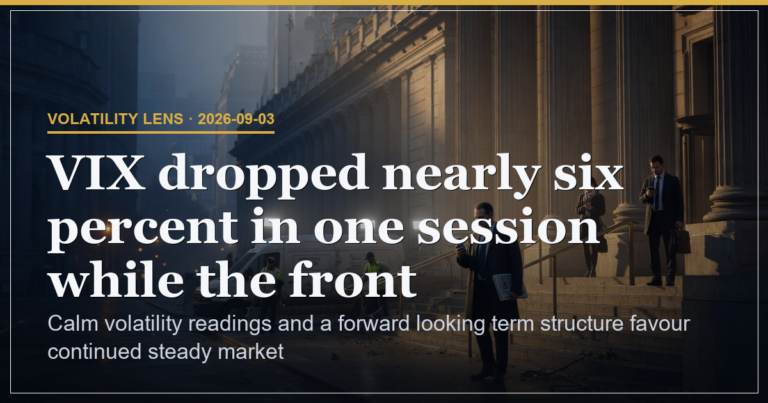
The term structure in contango is the standard safe-zone reading. Near-term vol cheaper than medium-term vol means the market is saying: calm next thirty days, more cautious over the next three months. But the specific numbers here are telling a more nuanced story.
A 3.33-point spread between spot VIX and VIX3M is wider than the typical contango in a calm market. In a genuinely calm market, that spread runs at 1.5 to 2 points. At 3.33, the market is saying it does not expect this week to be entirely smooth, even while pricing near-term vol below the recent average. That contradiction is exactly what VVIX above 90 is confirming from a different angle: options on the VIX are pricing meaningful vol-of-vol, which means option sellers are demanding extra premium because they are uncertain whether they are selling cheap or expensive vol.
For a PCE week with a new Fed Chairman and an Iran tail risk, VIX at 16.70 is mispriced to the downside. The vol analysis post (post 03) established the same conclusion from the structure side. This post confirms it from the Greeks side: the implied move that options are pricing for Thursday’s PCE is smaller than the potential realised move given the distribution of outcomes the macro post laid out.
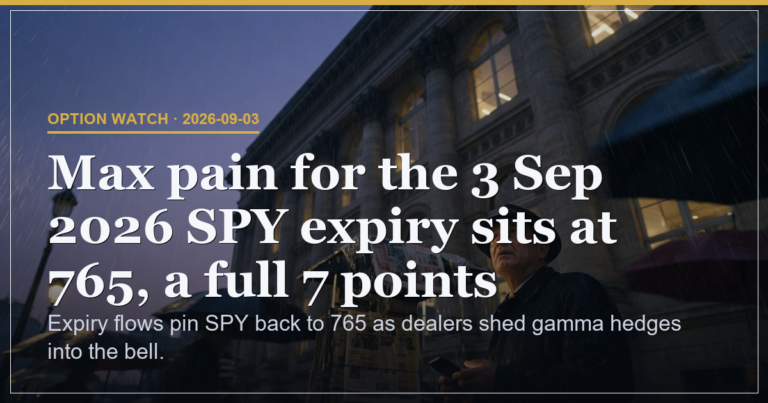
Max pain is the price level at which the greatest number of options contracts expire worthless, representing the maximum loss for options buyers collectively. Market makers, who are net short options to their clients, benefit when price gravitates toward max pain. Understanding where max pain sits gives you a gravitational force that acts on price between now and Friday’s weekly expiry.
The S&P 500 closing at 7,473 with max pain around 7,450 means price is sitting 23 points above the level where market makers are most comfortable heading into the weekly expiry. That 23-point gap matters because market makers hedging their book create a gravitational pull toward the 7,450 level through gamma hedging activity. When market makers are net short calls above the current price, they sell into rallies to hedge. When they are net short puts below the current price, they buy dips to hedge. The net effect is price pinning toward max pain.
However, PCE Thursday is the event that overrides max pain dynamics. A large data surprise in either direction creates a gamma unwind that moves price through the max pain level decisively. At that point the gravitational pull reverses: market makers scramble to re-hedge, and the move amplifies rather than mean-reverts. That is the specific mechanism behind the vol post’s conclusion that holiday-week thin conditions amplify PCE-driven moves.
| Greek | What It Measures | Current Signal | Practical Implication |
|---|---|---|---|
| Gamma | How fast delta changes as price moves | High near max pain, falling away from 7,450 | Price between 7,445 and 7,506 sees heavy market maker hedging activity. Moves outside that range accelerate as gamma drops and market makers stop fighting the move. |
| Delta | Sensitivity of option price to underlying move | Balanced near ATM strikes. Skewed put-heavy below 7,400 | The put skew below 7,400 means options buyers have been paying for downside protection. That is consistent with the institutional defensive positioning described in post 07. |
| Vega | Sensitivity to implied volatility changes | Long vega favourable — vol below 5-day average | Buying options is cheap relative to recent realised vol. A one-point increase in VIX from 16.70 to 17.70 adds meaningful value to long option positions entered at current vol levels. |
| Theta | Time decay of option premium | Accelerates into the holiday weekend | Three calendar days with no trading (Saturday, Sunday, Monday) means options bought on Friday are priced for that time decay. Near-term options that appeared cheap on Friday have lost more time value by Tuesday morning than the strike distance implies. |
| Rho | Sensitivity to interest rate changes | Elevated — Warsh introduces rate uncertainty | A Warsh hawkish signal changes the rate environment the options market is pricing. Any rate-sensitive position entered this week carries additional rho exposure that is not fully reflected in current option premiums because Warsh’s first move is genuinely unknown. |
Skew measures how much more expensive puts are relative to calls at equivalent distances from the current price. When skew is elevated, the options market is pricing more fear of a downside move than an upside move. When skew is flat or inverted, the market is complacent about downside risk.
At-the-money (20%)
Call premium (25%)
The current skew picture confirms what the institutional flow data in post 07 showed: options buyers are paying up for downside protection. A 55/25 put-to-call premium split in the near-term expiry structure means the options market is actively pricing the PCE downside scenario more than the upside continuation. That is not complacency. That is the smart money buying insurance.
The interesting feature of this skew reading is that it sits alongside VIX at only 16.70. Usually, elevated put skew and low spot VIX coexist when the market has already moved up significantly and people are buying puts to protect gains rather than expressing a bearish macro view. At S&P 500 levels of 7,473, that is exactly the situation. Institutional accounts that have been long through the year-to-date rally are buying put protection into PCE Thursday. That buying of puts is what is driving the elevated skew even while spot VIX reads low.
The put skew tells you the market is not as complacent as the VIX headline suggests. The large accounts are paying for downside protection. The retail community, with AAII bearishness at 43.6%, is emotionally bearish but is not expressing that through options positions the way institutions are. That gap, institutional put buying versus retail emotional pessimism without positioning action, is the options market’s version of the same divergence the sentiment post described.
The Skyworks Solutions August 80 call block trade, at $8.4 million in premium against just 514 contracts of prior open interest, is the clearest single options signal of the week. But understanding what it means requires putting it in the context of the broader semiconductor and technology options environment.
August expiry means the position expires in approximately 84 days from the trade date. The buyer is not positioning for Friday’s news cycle. They are positioning for a structural move in SWKS over the next quarter. Given the macro evidence established across the earlier posts, the thesis is coherent: South Korea export data showing 52.6% year-on-year growth is a real-demand confirmation for the semiconductor cycle. The Micron CEO comments about chip shortages extending beyond 2026 validate supply tightness. Skyworks specifically provides radio-frequency chips used in mobile devices and increasingly in AI-connected infrastructure. An August 80 call at current pricing offers meaningful leverage to a move in SWKS from its current level to 80, which represents a specific technical target the buyer has identified as achievable within the August timeframe.
What makes this position notable for the broader options picture is the open interest baseline of just 514 contracts. Building 22,821 contracts against that baseline is not a routine hedging activity. It is the establishment of a new directional conviction, sized properly, by someone who is comfortable being the dominant position in that strike. That confidence typically comes from fundamental research that the options buyer believes the market has not yet priced, or from a specific catalyst timeline that August positions them ahead of.
For technology sector options positioning more broadly, the SWKS trade is a signal that at least one large account sees the semiconductor cycle extending through the summer. If XLK breaks above $181.73 on Tuesday, that broader technology breakout validates the specific SWKS conviction and draws more capital into technology sector options. If XLK fails at $179.56, the technology thesis is under pressure and the SWKS position is offside in the near term regardless of the August duration.
Every discussion of options this week eventually arrives at the same point: PCE Thursday is the vol reset event. What the options market is pricing before Thursday tells you one thing. What it prices after Thursday tells you what actually happened.
The implied move in the S&P 500 for a major data event with VIX at 16.70 is approximately 0.8% to 1.0% in either direction on the day of the print. That is what the options market is baking in as the expected PCE reaction. But the macro post established three scenarios with different probability weights. In the hot PCE scenario, which carries approximately 28% probability, the realised move could be 1.5% to 2.0% as yields spike, the Warsh variable adds uncertainty, and holiday-week thin liquidity amplifies the initial reaction.
That gap, between an implied 0.8% move and a potential realised 1.5% to 2.0% move, is where the vol buyer’s edge sits this week. The options market is not wrong to price 0.8% as the expected value of the PCE move. That is the correct probability-weighted expectation across all scenarios. But the distribution of outcomes is skewed to the downside, and the downside tail is fatter than the upside tail. That asymmetry is not fully reflected in a flat VIX at 16.70.
| PCE Scenario | Probability | Implied S&P Move | Likely VIX Reaction | Options Position That Profits |
|---|---|---|---|---|
| Soft PCE (at or below 2.5%) | 28% | +0.8% to +1.2% | Falls toward 14-15 | Short puts, long calls, short vol (covered) |
| In-Line PCE (2.5-2.7%) | 32% | +/- 0.3% drift | Stays 16-18, no spike | Short straddle / strangle for theta decay |
| Hot PCE (above 2.7%) | 28% | -1.5% to -2.0% | Spikes toward 22-25 | Long puts, long VIX calls, long vol |
| Iran Shock (weekend) | 12% | Gap -2.5%+ | Gaps above 25 | Cash + defined risk only. No overnight naked exposure. |
The practical conclusion: the hot PCE and Iran scenarios combined represent 40% probability. Both produce moves larger than current implied volatility is pricing. That argues for buying near-term protection rather than selling it, particularly going into Thursday. The vol post’s observation that VIX staying below 17 through Wednesday would signal complacency is the specific level to watch. If VIX stays below 17 by Wednesday’s close, the options market is significantly underpricing the Thursday event risk.
| Instrument | Current Level | Key Options Level | What Happens at That Level | Net Position |
|---|---|---|---|---|
| S&P 500 (^GSPC) | 7,473 | 7,500 call wall / 7,400 put wall | 7,500: heavy call OI creates resistance, market makers sell as price approaches. 7,400: put OI creates support, market makers buy. | Pinned to 7,445-7,500 pre-PCE |
| Nasdaq 100 (^NDX) | 29,482 | 30,000 call wall | The 30,000 round number carries significant call open interest. A pre-PCE approach to that level would see heavy market maker selling. Tech needs a catalyst to clear it cleanly. | 30,000 is the week’s ceiling |
| Russell 2000 (^RUT) | 2,869 | 2,900 call resistance | Round number + call OI makes 2,900 the psychological and technical resistance for the week. Holiday momentum can test it but breaking through requires a sustained vol regime shift. | Cautiously bullish to 2,900 |
| SWKS (Individual) | Below 80 | August 80 calls — 22,821 contracts | The new dominant OI strike at 80. As SWKS price approaches 80, the block buyer’s delta exposure grows, creating momentum in the underlying. Single-name gamma squeeze risk if 80 is approached quickly. | Strong institutional conviction long |
| VIX | 16.70 | 17.40 (Friday intraday high) / 18.45 (5-day avg) | VIX reclaiming 17.40 on Tuesday signals the market is starting to pre-hedge PCE. VIX above 18.45 means the options market has flipped from complacent to actively pricing the event risk. | Watch 17.40 as the early warning |
| Gold (GC=F) | $4,521 | $4,540 call trigger | Institutional gold positioning is in options rather than outright futures. A Tuesday open above $4,540 triggers those call positions into positive delta and draws in additional buying. Iran gap open accelerates this. | Binary gap open signal |
PCE in line, Warsh neutral, Iran quiet. VIX falls from 16.70 toward 14-15 by Friday. VVIX retreats below 85. Options premium collected on short vol positions decays fully. Max pain gravity holds S&P near 7,450 through expiry.
VIX drifts from 16.70 toward 18-20 as PCE anxiety builds through Tuesday and Wednesday. Put protection buyers make money on the VIX move but give some back if PCE is in-line. No clean winners. SWKS and defensive options both grind but neither breaks out.
Hot PCE triggers VIX surge above 22. Put options bought at current levels deliver 2x-4x returns depending on strike and expiry. SWKS call position goes offside near-term as tech sells on rate fears. Healthcare put protection validates. VVIX spikes above 100.
Iran gap open Tuesday. VIX gaps above 25, tests 30 before settling. Near-term puts that were bought as cheap insurance become immediately valuable. Near-term calls worthless. Weekend theta decay cost is irrelevant when the move is 2.5%+ in the open. Institutional defensive positioning in XLV and gold options becomes immediately vindicated.
The options risk picture this week sits at around 60%, elevated above the VIX headline for three structural reasons. First, VVIX at 91.16 means even the options market’s own uncertainty measure is elevated, which is a signal that the vol surface itself may be mispriced. Second, the put skew being elevated while spot VIX is low tells you institutional accounts are paying for downside protection that the index-level reading does not show. Third, the PCE implied move of approximately 0.8% to 1.0% is smaller than the realistic distribution of outcomes, particularly in the combined hot PCE and Iran tail scenarios that collectively carry a 40% probability. For anyone holding equity positions through Thursday, the current vol environment is offering relatively cheap defined-risk structures that deserve consideration before Tuesday’s open. The sector-specific signal, watch XLV versus XLK on Tuesday morning as the leading indicator of which PCE scenario the active options community is currently positioned for, carries through from the institutional flow post and the hot zones post that preceded it.
The options structure described in this post does not operate independently of the sector rotation that is visible in the ETF data. The next post maps where sector money is currently concentrated, how the sector rotation visible in the ETF flows is consistent with the options positioning described here, and what the combination of gamma dynamics and sector flow means for which parts of the market have the most room to move between now and Thursday’s PCE print. The sector post closes the loop between the institutional positioning, the vol structure, and the specific instruments where the asymmetry is largest heading into the week’s key event.
This content is for informational and educational purposes only and does not constitute financial advice, investment advice, or a recommendation to buy or sell any financial instrument. Past analysis does not guarantee future accuracy. All market data referenced reflects conditions at the time of writing. Trading financial markets involves significant risk. Never risk more than you can afford to lose. Seek independent financial advice before making any investment decisions.
Deepen Your Understanding
Related articles from the Titan Protect Foundry: