Monday 18 May 2026 | Macro Structure Series | Post 7 of 10
The first four posts today covered positioning, macro, sentiment, and volatility. Each one told a version of the same story: institutions are not fully committed. They are long the things they like, hedged on the things that worry them, and waiting for a Tuesday catalyst before making their next big move. This post looks at the execution side of that story — 143 dark pool lines and 125 options flow lines captured across Monday’s session, and what the block tape tells you about where the real money went.
As you’ll find in our Hot Zones brief, the sector rotation on Monday was unusually concentrated — five mega-cap names carrying the index while everything else drifted lower, with institutional call buying confined to that narrow group rather than spreading across the broader market. Our Global Grid coverage confirms this as a multi-asset pattern: the same narrowing visible in US equities also showed up across European session behaviour and the dollar-yield divergence, building a case that the institutional repositioning documented here has global rather than domestic roots.
143 Lines of Dark Pool Activity: What the Block Tape Shows
Dark pools exist to let institutions move size without moving price. When volume concentrates in a dark pool rather than on a lit exchange, it means a large participant has decided that showing their order to the market would cost them money. On a day like Monday — where SPX closed down just 0.07% — the dark pool tape is more informative than the price action itself. The close told you nothing. The block tape told you where the conviction was.
Monday’s dark pool capture showed 143 notable order lines across equity instruments. The concentration was not evenly distributed. Large-cap technology — particularly the five names that dominated the options whale flow from the positioning post — attracted the most significant block activity. SPY, QQQ, and individual mega-cap names each registered meaningful dark pool prints. Crucially, the direction of those prints was not uniformly one-sided. What emerged was a picture of institutional repositioning, not directional conviction.
The near-flat SPX close at 7,403 alongside elevated dark pool volume is itself a signal. When a market has 143 block-level institutional order flows and closes essentially unchanged, one of two things is happening: either buyers and sellers are perfectly balanced (rare), or one side is absorbing the other’s flow to manage price. Monday looked like the latter. There was selling pressure in the European session — visible in the DAX and FTSE weakness — and the dark pool prints during the US morning session suggest large buyers stepped in to absorb that pressure without letting it cascade.
| Category | Volume Signal | Direction Read | Implication |
|---|---|---|---|
| Index ETFs (SPY/QQQ) | Elevated block prints | Mixed — absorption pattern | Institutions managing price at close |
| Mega-Cap Tech | Concentrated flow | Accumulation bias | Selective buying in high-conviction names |
| Energy Names | Distribution activity | Selling into crude -3.7% | Institutions reducing energy exposure |
| Financials | Light but present | Cautious — yield concern visible | No strong directional commitment |
| Small Caps (IWM) | Options-heavy vs block-light | Hedged not accumulated | Institutions buying puts, not shares |
125 Options Flow Lines: Where Smart Money Is Paying Premium
The 125 options flow lines captured on Monday sit alongside the dark pool data and together they sharpen the picture considerably. The positioning post (Post 01) showed the headline gex-max-pain-and-putcall-ratios/” style=”color:#D8AF44;text-decoration:underline” title=”What is Options Intelligence?”>put/call ratios — SPY at 0.58, QQQ at 1.40, IWM at 1.49. What the deeper flow lines add is granularity about where premium is being paid and at what strikes.
MSFT stood out with a put/call ratio of 0.24. That is a strong call-buying signal. When a stock has three times as many calls purchased as puts, and those purchases are in size consistent with institutional block flow, it is telling you that a large participant has conviction that MSFT moves higher from here. This is not speculative retail buying — retail tends to buy out-of-the-money lottery tickets that skew put/call ratios differently. Block call buying on MSFT at near-the-money strikes is institutional accumulation through the options market.
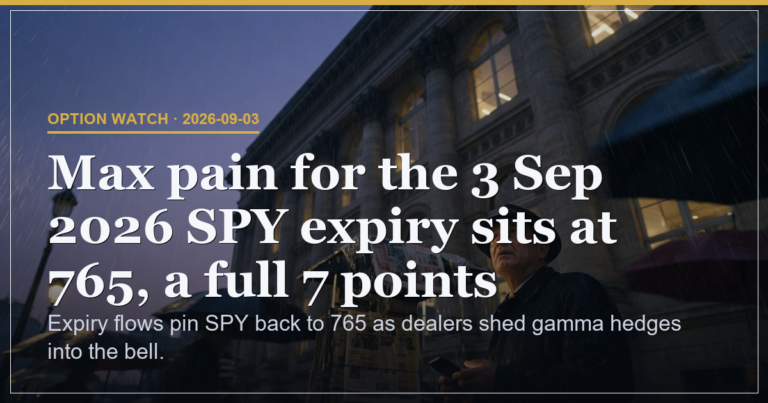
TSLA presented a different picture. Max pain sits at $435. Max pain is the strike level at which option sellers — the institutions who sold those contracts — experience the least pain at expiry. When price gravitates toward max pain into expiration, it is because market makers are hedging in ways that naturally pull price in that direction. TSLA trading near max pain into Friday’s expiry would represent approximately neutral ground. A move away from $435 in either direction represents an opportunity for positioned participants and a hedging cost for market makers.
| Name | Signal Type | Read | Conviction Level |
|---|---|---|---|
| MSFT | Strong call bias (P/C 0.24) | Institutional accumulation | High |
| TSLA | Max pain gravity at $435 | Neutral — range-bound into expiry | Medium |
| QQQ Index | Put-heavy (P/C 1.40) | Broad Nasdaq protection buying | High — size confirmed |
| IWM (Russell) | Most put-heavy (P/C 1.49) | Small cap most at risk in their view | High |
| AAPL/NVDA/META/AMZN | Selective call flow | Targeted mega-cap longs | Medium-High |
The Smart Money Split: Long the Names, Short the Index
The single most important thing the institutional flow is telling you today is this: large participants are not making a binary market call. They are not “all in bullish” and they are not “going short.” They are doing something more sophisticated and more difficult to trade against — they are buying the stocks they believe in while simultaneously buying protection on the indices that contain those stocks.
In practical terms, this means an institution can be net long MSFT, AAPL, and NVDA in their equity book while simultaneously holding QQQ puts that pay off if the Nasdaq sells off broadly. Their individual name picks make money if those companies execute. Their index puts make money if macro conditions deteriorate and drag everything lower. They cannot lose both bets at the same time. That is the position the flow data is describing.
For retail participants watching this, the implication is not to try and replicate the strategy but to understand what it means for market behaviour. These participants are not going to panic-sell their mega-cap longs on a bad headline. They have protection. But they are also not going to aggressively add to their longs in front of Tuesday’s Iran catalyst, because their hedge has a cost and they want the uncertainty resolved first.
Cross-Reference: What COT Says About Institutional Positioning
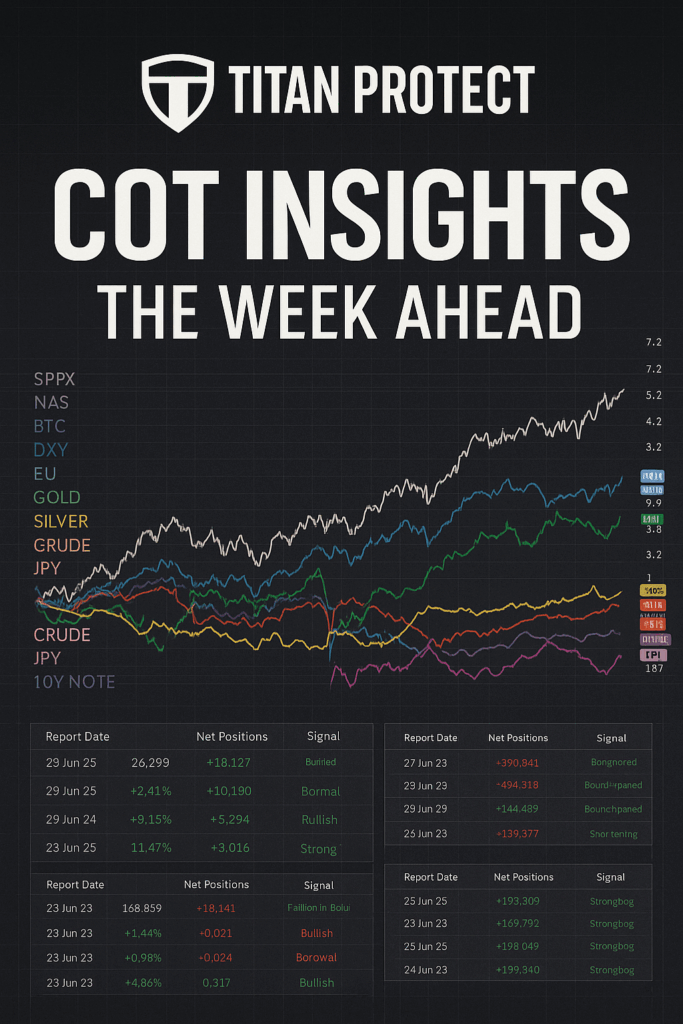
The COT data highlighted in the positioning post (Post 01) adds a currency dimension to the institutional picture. Non-commercial participants — the speculative hedge fund cohort — have been building Japanese yen longs while maintaining Canadian dollar net longs. These are not independent decisions. The yen positioning is a geopolitical hedge (yen strengthens in risk-off environments). The CAD positioning reflects residual commodity optimism that has not yet caught up to crude oil’s 3.7% sell-off on Monday.
The crude move is worth flagging in this context. Crude fell to $101.52 on Monday after trading above $105 intraday. The COT data for crude has shown non-commercial participants at elevated long exposure in recent weeks. A -3.7% session is the kind of move that forces those positions to be trimmed or rolled. If crude continues lower on Tuesday, there may be secondary pressure on commodity-linked equities and currencies from institutional deleveraging in the futures market.
| Asset | COT Bias | Monday Price Action | Risk to Position |
|---|---|---|---|
| Japanese Yen | Building non-commercial longs | Strengthening (USD/JPY 158.90) | Low — trend in their favour |
| Canadian Dollar | Net long maintained | Under pressure from crude -3.7% | Medium — commodity drag |
| Crude Oil (WTI) | Elevated longs at risk | Closed $101.52 (-3.7%) | High — potential forced deleveraging |
| Gold | Institutional longs intact | Closed $4,570 (+0.31%) | Low — safe-haven demand active |
300 Earnings This Week: How Institutional Flow Will React
With 300 companies reporting earnings this week, the institutional flow picture becomes more dynamic than a normal week. Block prints and dark pool activity around individual names will spike as results come in. The key thing to understand is how institutional participants use earnings to either validate or exit positions they have been building in the dark pool.
A company that has seen consistent dark pool accumulation in the weeks before earnings, and then reports strong results, typically sees a sharp move higher as the institutional participants who built the dark pool position no longer need to hide their buying — they can let the price run. Conversely, a name that has seen dark pool distribution before a disappointing result will fall harder than the headline miss suggests, because the selling pressure was already loaded and waiting.
This week, watch the mega-cap tech names closely. The call buying visible in the options flow — MSFT at P/C 0.24, and similar signals in AAPL, NVDA, META, and AMZN — suggests institutions believe results from this cohort will be solid. If those results deliver, the dark pool accumulation converts to public buying and the S&P 500’s tech-led gains accelerate. If they disappoint, the hedges activate, and the QQQ puts that looked like protection become the trade.
How to Trade Alongside Institutional Flow
Do not try to front-run institutional flow. Use it as a filter instead. If the dark pool and options data suggest institutions are long MSFT and cautious on IWM, let that tell you which direction to look for setups rather than which setups to force.
The MSFT call bias makes it a higher-probability long candidate on any pullback to support this week. Keep size at 40-50% of normal given the macro uncertainty. The institutional accumulation gives you a tailwind, but Tuesday’s catalyst can override any single-name thesis.
The long-mega-cap/short-index structure that institutional flow describes is itself tradeable. Long MSFT or AAPL with a defined stop, offset by small QQQ put spread as a hedge, mirrors what the flow is showing. Adjust ratio based on Tuesday’s outcome.
Scenario Analysis: How Institutional Flow Resolves
The options market detail behind this institutional flow story — max pain levels, gamma exposure, and unusual activity reads — is the subject of Post 08: Option Watch. The sector-level breakdown of where institutional capital actually landed today follows in Post 09: Sector Flow.
This content is for informational and educational purposes only. It does not constitute financial advice. Past flow data does not guarantee future market direction. Always apply your own risk management.
Deepen Your Understanding
Related articles from the Titan Protect Foundry: