
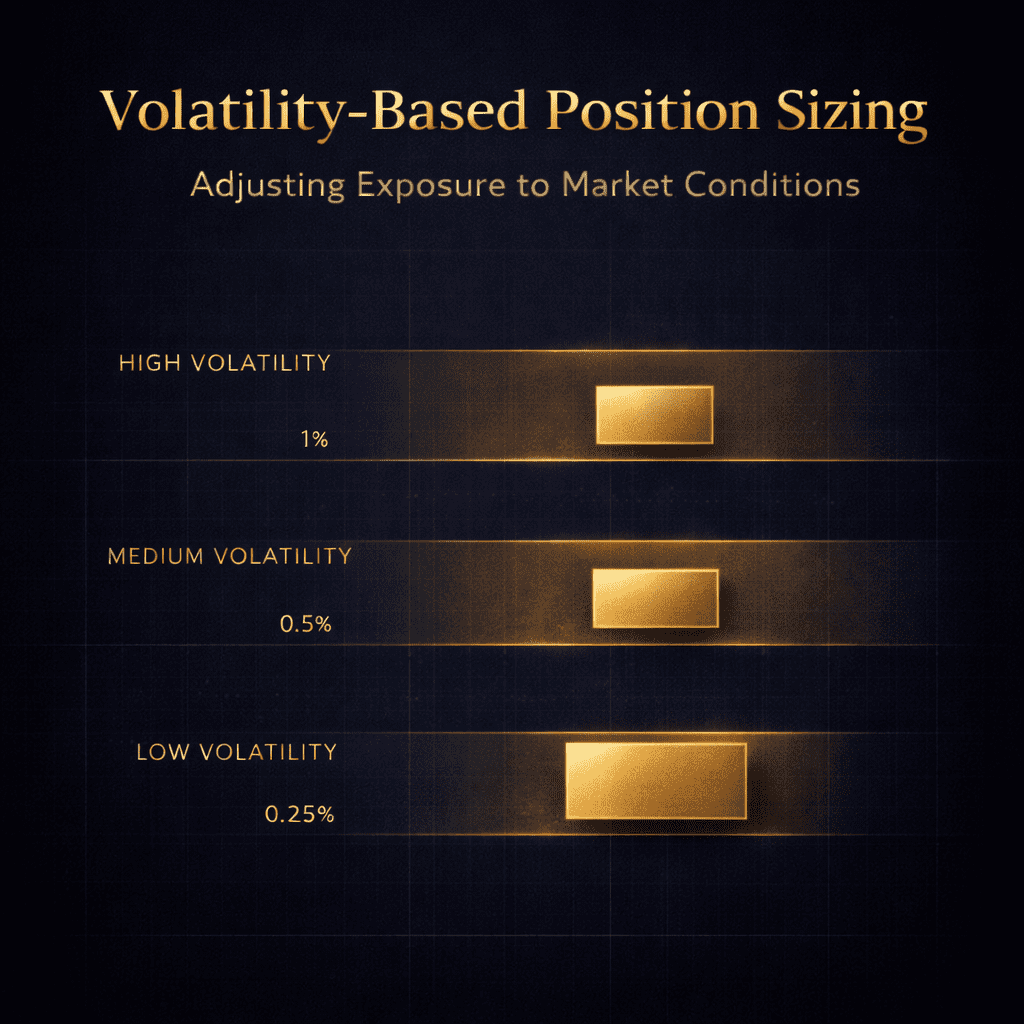
🛡️ SL/TP Intelligence Series — Article 3 of 10 | Video: 16 min
📋 What You’ll Learn:
- 🎯 Why volatility should dictate your position size
- 💡 How to measure volatility (explained simply — no jargon)
- ⚠️ The #1 mistake: using the same size in calm vs wild markets
- 📊 Simple formulas anyone can use
- 🔢 Real examples: when to trade bigger, when to trade smaller
🎥 Video coming soon — Subscribe to @Titan_Protect for the full breakdown with live charts.
🛡️ The Sizing Mistake That Costs Traders Everything
Most traders use the same position size no matter what the market is doing. That’s like driving the same speed in a school zone and on a highway. It’s dangerous, and it doesn’t make sense.
Markets breathe. They have calm days and crazy days. Yesterday’s quiet movement becomes today’s wild swings. And if you’re using the same lot size through both, you’re either:
- Leaving money on the table in calm conditions, OR
- Getting destroyed when volatility explodes
Neither is acceptable. Your position size should match the market’s mood.
📊 What Is Volatility, Really?
Volatility is just how much the price moves. That’s it.
On a calm day, NAS100 might move 100 points. On a wild news day, it might move 400 points. That difference is volatility. Most traders ignore it when deciding how much to trade. Don’t be one of them.
Three Simple Ways to Measure Volatility
1. ATR (Average True Range) — The “Daily Wiggle Room” Indicator
ATR tells you how much a market typically moves in a day. Think of it as the market’s “daily wiggle room.”
> Example: If NAS100 has an ATR of 200 points, that means on average it moves 200 points up or down each day. Some days more, some days less, but 200 is the average.When ATR is high, the market is wild. When ATR is low, it’s calm. You can find ATR on any chart — it’s a standard indicator in TradingView and most platforms.
2. Recent Range — The Quick Check
Look at the last 5-10 candles on your chart. How big are they? If candles are small, volatility is low. If candles are huge, volatility is high. No math required.
3. VIX — The Fear Gauge (for Stock Traders)
VIX measures how much traders expect the stock market to move. High VIX = fear and big moves. Low VIX = calm and small moves. It’s like a weather forecast for market volatility.
💡 The key insight: Volatility isn’t good or bad. It’s just information. Use it to adjust your size, and you turn a threat into an edge.
🎯 The Simple Volatility Sizing Formula
Here’s how professionals do it:
Normal Position Size × (Normal Daily Movement ÷ Current Daily Movement) = Adjusted Position Size
In plain English: When the market is moving more than usual, trade smaller. When it’s moving less, you can trade bigger.
💡 Example — High Volatility:
| Normal daily movement (ATR) | 200 points |
| Current daily movement (ATR) | 400 points |
| Volatility ratio | 200 ÷ 400 = 0.5 |
| Your normal size | 2 contracts |
| Adjusted size | 2 × 0.5 = 1 contract |
Why? Because when the market moves twice as much, your stop loss needs to be twice as wide. Same dollar risk means half the position size.
📉 Real Example: Calm Market
Scenario: NAS100 is quiet. The daily movement (ATR) is only 120 points instead of the usual 200.
| Normal daily movement | 200 points |
| Current daily movement | 120 points |
| Volatility ratio | 200 ÷ 120 = 1.67 |
| Normal size | 2 contracts |
| Adjusted size | 2 × 1.67 = 3.3 contracts |
Lower volatility = smaller daily moves = tighter stops possible = larger position for the same risk. You’re optimizing for the conditions.
📈 Real Example: Wild Market
Scenario: It’s Fed announcement week. News is hitting the market and NAS100 daily movement spikes to 450 points.
| Normal daily movement | 200 points |
| Current daily movement | 450 points |
| Volatility ratio | 200 ÷ 450 = 0.44 |
| Normal size | 2 contracts |
| Adjusted size | 2 × 0.44 = 0.9 contracts |
High volatility requires wider stops. Same dollar risk means smaller position. You’re protecting yourself from getting stopped out by random noise.
⚠️ Three Mistakes That Wreck Traders
❌ Mistake #1: Same Size Every Day
“I always trade 2 lots.”
Not if you want to survive. Markets change daily. Your size should too.
💡 What to do instead: Check the daily movement (ATR) before every trade. Adjust your size to match current conditions.
❌ Mistake #2: Ignoring News Days
CPI (inflation reports), Fed meetings, earnings announcements — these aren’t normal days. Volatility can double or triple instantly. Your normal size becomes dangerous.
💡 What to do instead: Cut your position size by 50-75% on big news days. Or sit out entirely until the dust settles.
❌ Mistake #3: Tight Stops in Wild Markets
When daily movement is 400 points, a 50-point stop is noise. You’ll get stopped out by random movement, not because your analysis was wrong.
💡 What to do instead: Your stop should be proportional to volatility. In wild markets, give your trade room to breathe — or trade smaller so you can.
💼 How Pros Adjust for Volatility
Professional traders have volatility checks built into their routine:
- Pre-trade check: Look at today’s ATR vs. the average
- News awareness: Know when big announcements are coming
- Dynamic sizing: Position size changes based on conditions
- Wider stops in chaos: Give trades room or size down
- Same risk, different exposure: $200 risk is constant; position size varies
📊 Quick Reference: Volatility Guide
| Market Condition | Daily Movement | Size Adjustment | Stop Adjustment |
|---|---|---|---|
| Calm | Less than 75% of normal | Trade 25-50% MORE | Tighter stops OK |
| Normal | 75-125% of normal | Use normal size | Normal stops |
| Volatile | 125-175% of normal | Trade 25-50% LESS | Wider stops |
| Extreme | More than 175% of normal | Trade 50-75% LESS or skip | Much wider or don’t trade |
📚 What’s Next in This Series
This is article 3 of 10. Coming up:
- Dynamic vs. Static Stops → When to move your stop (and when to leave it alone)
- Profit Target Strategies → Taking money off the table like a pro
- Advanced Exit Strategies → Scaling out, trailing stops, and partial exits
A Thought to Take With You:
Volatility isn’t your enemy — ignorance of volatility is. The market tells you how wild it is every single day. Listen, adjust, and survive.
This week: Before your next trade, check the ATR. Is it higher or lower than normal? Adjust your size accordingly. Same dollar risk, different position size. That’s professional trading.
— Titan
