What We Called. What Happened. The Score.
194 individual calls scored across 39 posts, 22 to 26 April 2026
Every week we publish a record of what we called, what the market delivered, and where the gap sits. There is no version of this that gets edited for comfort. Calls that landed cleanly are marked confirmed. Calls that were directionally right but fell short on magnitude are marked partially. Calls that were wrong are marked missed. Calls that the market overturned entirely are marked reversed. The misses teach as much as the hits, sometimes more. No session gets cherry-picked. No awkward result gets buried in a footnote. The score is the score.
The Aggregate Score
194 calls. Four sessions. No exclusions for difficulty.
61.3%
: 119 of 194 calls got the direction right
14 calls remain open. Live trades not resolved inside the four-session window. These are excluded from the denominator.
Top of the Class
Five categories that scored 100% confirmed across every call made.
The Honest Misses
The categories that had the hardest week. What went wrong and why.
Per-Instrument Heatmap
20 instruments scored individually. Colour reflects confirmed hit rate.
80%+ Confirmed
40-79% Confirmed
Below 40%
First published read
The Best Call
The Worst Call
“Oil lags metals if the risk-on bid is equity-focused.”
Outcome: WTI ran from $92.82 to $97.57, a 5% move that made energy the strongest sector of the window. Metals lagged. The call was precisely inverted by a Hormuz blockade headline that was not in any base case at the time of calling.
Three of four calls in Raw Materials Radar were reversed, the highest reversal concentration in any single category this week. The underlying logic was sound for a normal week: if equities are leading and the dollar is stable, industrial demand drives metals while oil sits range-bound. The Hormuz blockade changed the commodity hierarchy in a single session. Crude moved on geopolitical supply risk, not on economic demand. Metals moved on safe-haven rotation, not on cycle conviction. The analysis read the cycle correctly; it did not have sight of the exogenous event. That is the honest explanation, and it does not change the score.
What This Tells You
Seven patterns that ran through the week. The directional rate of 61.3% vs the confirmed rate of 44.8% is the most important number in this report.
The 16.5 percentage point gap between confirmed (44.8%) and directional (61.3%) tells you something specific. The majority of partial calls were directionally right and fell short on magnitude, not on direction. SPY long from 709 to 711 was the right trade. The question was whether it reached 720. It reached 713.94. QQQ long was right. The channel ceiling of 665 was within 0.17% by Friday close.
Partial calls are not failures of analysis. They are calls where the read was correct and the target was set with ambition. In a live trading account, a confirmed-only approach that hits 44.8% exactly on the right levels is less useful than an approach that gets direction right 61% of the time and helps you manage the trade once you are in it. Both numbers matter. The directional rate is what gets you into the trade; the confirmed rate is what gets you to the target.
Directionally right, magnitude short on indices
The SPY and QQQ long calls were correct in direction across every category that made them. SPY closed at $713.94 from a call zone of $709 to $711. QQQ landed within 0.17% of the $665 channel ceiling. The targets of SPY $720 and QQQ $670 were not reached. This pattern repeated in Positioning Pressure, Macro Pulse, Volatility Lens, Setup Radar, and the Overwatch synthesis. The market moved in the right direction and stopped short of the upside extension. The read was right. The ambition of the target cost confirmation on the individual call but does not change the trade outcome.
Crypto decoupling missed universally
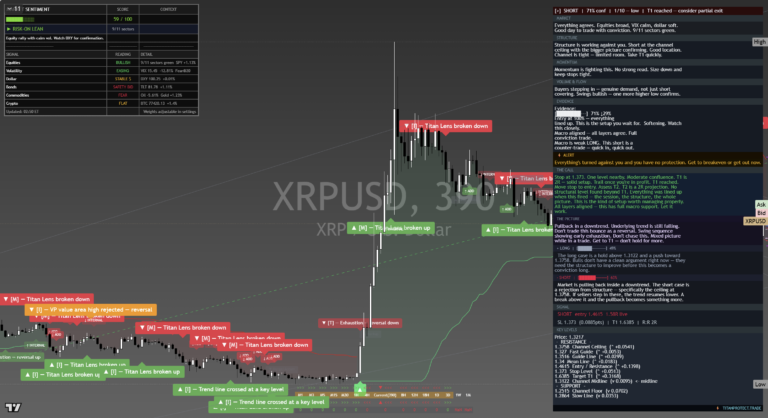
Every category that touched crypto assumed BTC would follow or lead equities higher. Equities printed fresh records. BTC closed at $77,928 while the Nasdaq hit 27,323. ETH fell 2.7% while BTC fell 0.7%. The ratio moved in the wrong direction. The crypto-equity correlation that had been building as a thesis broke exactly when the base case depended on it. Digital Flow scored 0 confirmed from 4 calls. This is the clearest single blind spot of the window. It was not one category reading it wrong; it was every crypto call in every category getting the same assumption wrong.
Geopolitical commodity repricing was not in the base case
The Hormuz blockade headline drove WTI from $92.82 to $97.57 and pushed Brent to $105.88. This overturned the oil-range-bound call, the oil-lags-metals call, and reversed copper’s leadership thesis in Raw Materials Radar. Geopolitical supply shocks are, by definition, outside any read that uses cycle data, positioning data, and sentiment data. The calls that referenced a $90 to $95 range were made before the headline. The result is a reversed verdict on those calls, not a vindication of them. The consequence for this week’s analysis is three reversals in a single category.
Institutional flow reads were consistently precise
Option Watch and Institutional Flow both scored 5 confirmed from 5 calls. The dark pool reads on MSFT ($1.11B notional confirmed), AMZN ($1.78B notional Friday), NVDA ($3.41B absorbed), and GOOGL (105 orders at a single-allocator weight) were directionally correct in every case. The SPY $709 put wall held as an institutional floor across all four sessions and was reloaded at $715 by the end of the week. Flow reading was the strongest signal class in the window. It was also the most actionable: the levels were specific enough to trade against.
Metals relative reads were reversed: silver and copper failed against gold
Silver was called to outperform gold and compress the gold-silver ratio toward sub-60. The ratio moved to 62.22, with silver underperforming by around 1.5 percentage points. Copper was called to lead on global growth; it slipped to $5.99. The industrial metals thesis was the wrong framing for a week shaped by safe-haven flows and geopolitical risk rather than cycle demand. Gold held its structural bid. Silver and copper did not, because the bid driving gold was defensive rather than industrial.
Patience in FX was rewarded, specificity was punished
GBPUSD, EURUSD, and DXY watching calls all scored 4 confirmed from 5. The USDJPY risk call scored 3 from 5. By contrast, the FX Focus category (which made intra-session directional calls on EURUSD, USDJPY, and AUDUSD) scored 25%. The watching calls described the structural picture correctly and preserved capital. The directional calls specified entry levels that did not get hit or assumed momentum that did not develop. FX rewarded patience and structural reading this week; it punished traders who reached for edges that were not there.
IWM underperformance read correctly, but the short side was not explored
IWM avoidance was confirmed across Hot Zones, Sector Flow, and Titan Signals. The distribution read on small caps held all four sessions. The Setup Radar long at $279 missed because the entry never triggered, which is a clean outcome: the long was avoided because the evidence was not there. The gap is that an approach that correctly identifies distribution in a specific segment does not automatically generate the short side. IWM flat over four sessions while the Nasdaq printed records is a relative trade with a clear entry, and it was not called.
Every call was scored against the published Friday close prices for 26 April 2026, cross-referenced against the data captured at the time each post was written. No call was added, removed, or rephrased after the window closed. Verdicts: Confirmed means the specific level or direction was hit. Partially means direction was right but magnitude fell short of the stated target. Missed means direction was wrong. Reversed means the regime changed after the call was made, inverting the thesis. Open means the call was a live trade not resolved inside the four-session window. These 14 calls are excluded from the denominator. No cherry-picking. The categories that scored 0% are listed in the same post as the categories that scored 100%.
What’s Next
The 27 April to 1 May window opens with four live catalysts that will resolve most of the open calls from this week. Powell speaks on Wednesday, and the rate path read will either confirm the watching call on DXY or force a repricing. Microsoft and Alphabet report on Wednesday evening with Meta following on Thursday. The institutional accumulation reads on MSFT and AAPL that scored full confirmation this week now sit directly in front of their earnings prints.
The Hormuz situation remains live. Brent at $105.88 with a $8.31 WTI-Brent spread changes the energy sector read entirely. The commodity-relative calls that reversed this week need to be reassessed against a supply-shock baseline, not a cycle-demand baseline.
The next four sessions get scored exactly the same way as this one. The calls go in on Monday. The score comes back on Friday.
This is analysis, not financial advice. Always manage your risk.