What Are Options?
Options Mastery Series — Article 1 of 10
What You’ll Learn:

- What options actually are (in plain English)
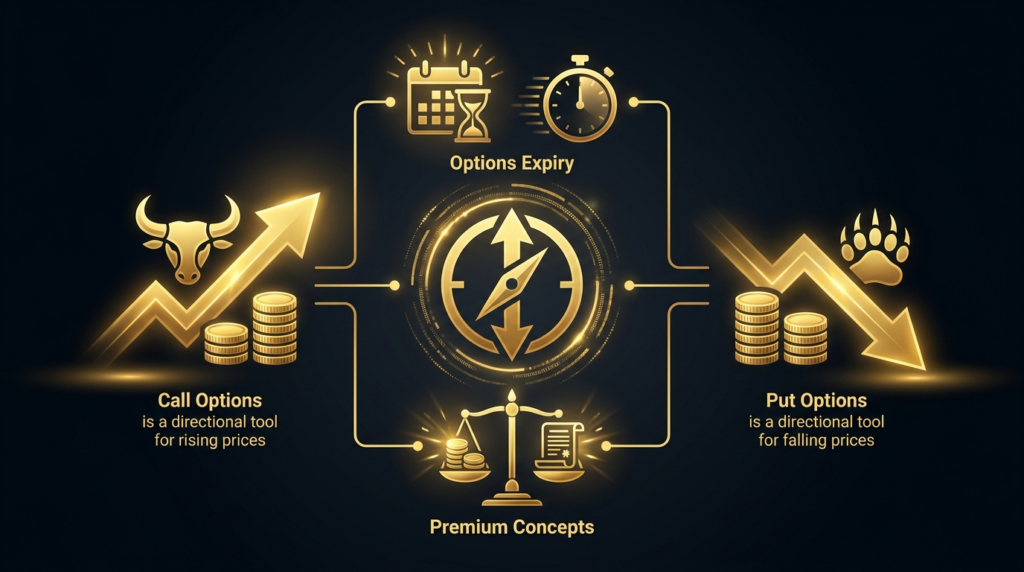
- The difference between calls and puts
- Why options exist and who uses them
- Basic option mechanics without the jargon
- Common myths debunked
Video coming soon — Subscribe to [@Titan_Protect](https://www.youtube.com/@Titan_Protect) for the full breakdown.
The Simple Truth About Options
Options confuse people because they’re explained badly. Let’s fix that.
An option is a contract that gives you the right (not the obligation) to buy or sell something at a specific price, by a specific date.
That’s it. Everything else is detail.
Call Options — The Right to Buy
Think of a call option like a coupon:
“This coupon lets you buy one pizza for $10, anytime in the next 30 days.”
- The pizza costs $15 in the store
- Your coupon locks in $10
- You save $5 if you use it
- If pizzas drop to $8, you throw the coupon away
In trading:
- You buy a call when you think the price will go UP
- You pay a small amount (premium) for the right to buy at a set price
- If you’re right, you profit. If wrong, you lose only the premium.
Put Options — The Right to Sell
Think of a put option like insurance:
“This policy lets you sell your car for $20,000, even if the market price drops.”
- You own a car worth $22,000
- You buy insurance that guarantees $20,000
- If the car crashes and is worth $15,000, you still get $20,000
- If nothing happens, the insurance expires (you paid for peace of mind)
In trading:
- You buy a put when you think the price will go DOWN
- Or to protect what you already own
- You pay premium for the right to sell at a set price
The Four Ways to Trade Options
| Position | Bullish (Price rises) | Bearish (Price falls) |
|
-|
-|
-|
| Buy Option | Buy CALL | Buy PUT |
| Sell Option | Sell PUT | Sell CALL |
Why Sell Options?
Selling an option is like selling insurance:
- You collect the premium upfront
- You take on obligation if the buyer exercises
- Most options expire worthless (good for sellers)
- Higher probability of small gains, but unlimited risk if wrong
Key Terms (Finally Explained Simply)
Strike Price
The “deal price” in the contract.
- Call @ $100 strike = right to buy at $100
- Put @ $100 strike = right to sell at $100
Expiration Date
The deadline. Use it or lose it.
- After this date, the option is worthless
- Time works against option buyers
- More time = more expensive option
Premium
The price you pay for the option.
- Like the cost of the coupon or insurance policy
- Your maximum risk (as a buyer)
- Sellers collect this, but take on obligation
In-the-Money (ITM)
The option has real value right now.
- Call ITM = stock price above strike
- Put ITM = stock price below strike
Out-of-the-Money (OTM)
The option has no real value yet.
- Call OTM = stock price below strike
- Put OTM = stock price above strike
- Pure speculation — needs a move to become valuable
Why Do Options Exist?
Options aren’t just for speculation. They serve real purposes:
1. Risk Management (Insurance)
You own 100 shares of Apple at $200. You’re worried about a drop.
- Buy a $190 put for $5
- Worst case: You sell at $190 (minus $5 premium = $185 net)
- You capped your loss at $15 per share
- Peace of mind costs $5 per share
2. Income Generation
You own 100 shares of Apple at $200. You think it won’t move much.
- Sell a $210 call for $5
- If Apple stays below $210, you keep $5
- If Apple goes to $220, you sell at $210 (plus keep $5 = $215 total)
- You limited upside but collected income
3. Leveraged Speculation
You think Apple will go from $200 to $220 (10% move).
- Buy 100 shares: Costs $20,000, profit $2,000
- Buy a $200 call for $10: Costs $1,000, could be worth $2,000+
- Same directional bet, 20x less capital at risk
4. Complex Strategies
Options let you build sophisticated positions:
- Bet on volatility (not direction)
- Profit from time decay
- Hedge complex portfolios
- Create synthetic positions
Common Myths (Debunked)
Myth 1: “Options are just gambling”
Reality: They’re tools. A hammer can build a house or break a window. Options transfer and manage risk. Used properly, they reduce risk. Used recklessly, they amplify it.
Myth 2: “Most options expire worthless, so selling is easy money”
Reality: Most OTM options expire worthless. But sellers face unlimited risk (calls) or massive risk (puts). One bad trade wipes out months of premiums.
Myth 3: “Options are too complex for retail traders”
Reality: Start simple. Buy a call. Buy a put. Learn mechanics. Complexity is optional — you can trade successfully with basic strategies.
Myth 4: “You need to exercise options to profit”
Reality: Most traders sell options before expiration. You don’t need to own the stock. The option itself has value and can be sold to someone else.
What You Need to Start
Brokerage Account
Most brokers offer options (Robinhood, Schwab, TastyTrade, Interactive Brokers).
Apply for options approval (usually Level 1: buying calls/puts).
Higher levels require more experience.
Education
- Understand what you’re trading
- Learn the Greeks (coming in this series)
- Start small and learn mechanics
Risk Management
- Only trade what you can afford to lose
- Options can go to zero
- Position sizing matters more than picking direction
Key Takeaways
- Options = contracts giving rights (not obligations)
- Calls = right to buy (bullish)
- Puts = right to sell (bearish)
- Premium = what you pay (buyer) or collect (seller)
- Strike = the deal price
- Expiration = the deadline
- Options manage risk, generate income, or provide leverage
- Start simple. Learn mechanics. Manage risk.
Learn With Titan
At Titan Protect, we believe options should be visual, structured, and learnable — not overwhelming.
Our approach helps you:
See options concepts visually — Greeks, moneyness, and P&L explained graphically
Understand before you trade — Structure-based analysis, not signal chasing
Build skills progressively — From basic calls/puts to advanced flow reading
Manage risk intelligently — Position sizing, stop logic, and portfolio hedging
Want to see how professional options analysis works?
We’d be happy to walk you through real examples — no pressure, no sales, just clarity.
Reach out or explore more inside the Members’ Dashboard.
Coming Next: Options Levels Fundamentals
Learn strikes, moneyness, expiration cycles, and how to read an options chain.
© 2025 Titan Protect. Educational content for traders. Not financial advice.
Get the daily framework intelligence
Trade the framework, not the noise.
The principles in this article are how we read markets every day. Members get the live application: daily Pre-Asia, Pre-London, Pre-NY and Post-Close briefs across 20+ instruments, the indicator suite, the Foundry library, and live community.
Free Explorer tier · No card required · Upgrade when you’re ready