Volatility Lens / Options Flow | Friday 1 May 2026 | Post-Close Read
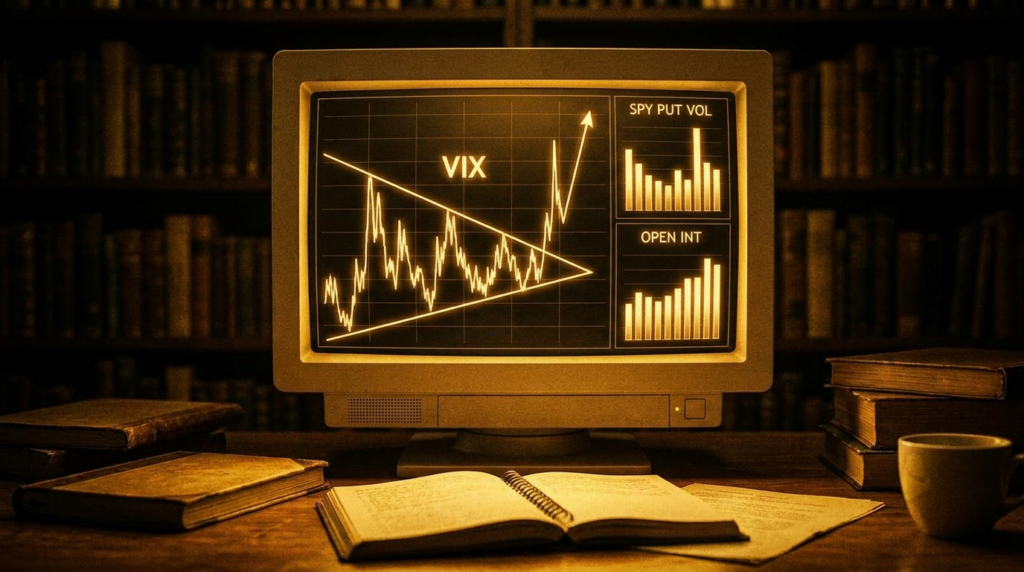
The vol curve wedge the morning brief mapped — VIX9D at 14.37, VIX3M at 21 — spent the entire week coiled and waiting for a single catalyst to collapse it. PCE in-line at 2.5% gave dealers exactly that release: VIX slid from 17.04 to 16.80 within the first minute of the print and held below 17 for the rest of the session, settling the close at 16.99. The front end compressed. What it did not do is fully deflate. That 16.99 close is the tell — the tape is cleared, not all-in. The options market knew this before the equity indices did. The SPY 722-put printed 753,566 contracts against open interest of just 894 — a volume-to-open-interest ratio of 842 — and that is not a structural hedge rebuilding; that is end-of-day tactical covering by desks who needed the Friday close above 720. The QQQ 675-put ran even hotter, V/OI of 2,126, priced in the final hour. Monday’s dealer gamma map — where dealers are short and where they must buy to stay hedged — is already drawn. The pin zones are 720 SPY and 674 QQQ. The vol market is telling you it expects a quiet open and a range-bound first session. The question Monday is whether that expectation survives contact with reality.
Core Volatility Thesis — Friday Close Into Monday
VIX at 16.99 is compressed but not exhausted. The wedge between short-dated and medium-dated volatility has resolved directionally, not structurally. Average gex-max-pain-and-putcall-ratios/” style=”color:#D8AF44;text-decoration:underline” title=”What is Options Intelligence?”>put/call ratio of 0.679 across the tape confirms a bullish skew — but the massive closing-day put activity in SPY and QQQ means sophisticated desks closed the week with one-session insurance rather than new directional conviction. Dealers are short gamma at 720-722 SPY and 673-675 QQQ — which means price movement through those levels accelerates in the direction of the move, not dampens it. Monday’s first hour will tell you whether the tape wants to pin at those levels or break through them. If SPY holds above 720 on the open, dealers are covering calls and the path of least resistance is higher. If SPY opens below 718, dealer hedging flow reverses and the slide can accelerate faster than implied vol suggests.
1. The Vol Wedge — What It Was and How It Resolved
The morning brief identified a compression structure that had been building for several sessions. Short-dated volatility — the VIX9D reading the front week’s uncertainty — had collapsed to 14.37, reflecting the market’s collective bet that the PCE print would be benign. Three-month volatility was holding at 21, anchored by the broader macro backdrop: a dollar testing structural support at DXY 99, yen carry flows unwinding, and a Federal Reserve that has given no clear signal on the timing of the next cut.
That spread — 14.37 versus 21 — was a 6.63-point wedge between the front and the back. It is the kind of structure dealers price as “one event away from resolution.” When PCE came in at 2.5%, in-line with expectations, the binary resolved to the benign side. VIX9D collapsed immediately as the event premium expired. VIX front-month — the headline 16.99 close — compressed from its pre-print level of 17.04 but held its floor.
That is the critical detail. The front end dropped 24 basis points on the print. Three-month vol compressed more meaningfully as the PCE certainty flowed through the curve. But VIX is still at 16.99. It did not push toward 14, 15, or even 16. Something in the macro picture is keeping the medium-term premium elevated even as the immediate event risk clears. The concentration of Friday’s equity rally in six mega-cap tech names — confirmed by the post-close session brief — is the most likely explanation. When six stocks drive the entire market’s record close, the index-level vol cannot fully deflate because single-name risk remains dispersed beneath the surface.
The two-curve story matters because it maps directly to Monday’s trade sizing framework. When the VIX9D is this compressed and the VIX1M has reset below 17, the market is in a low near-term volatility regime — premium for both puts and calls is cheap by recent standards. For a buyer of protection, that is actually a reasonable moment to add a small hedge at modest cost. For a seller of premium, the risk/reward deteriorates quickly if Monday opens with a catalyst that pushes VIX back through 18-19.
2. Friday’s Options Tape — What the Unusual Activity Is Really Saying
Volume-to-open-interest ratios are one of the cleanest signals in the options market. Open interest reflects existing positions accumulated over sessions — it is the slow money, the structural hedge books, the long-dated protection. Volume is the day’s activity — what is being bought and sold right now, on this close, for this session. When volume dramatically exceeds open interest on a single strike, you are watching something being created from scratch in one session. It is almost always a tactical response to immediate price action, not a new directional thesis.
Friday gave us two of the most extreme V/OI ratios of the year on both SPY and QQQ — and they tell a coherent story when read together.
What you are reading across this entire table is a consistent theme: desks that held longs through the PCE print, saw the gain, and bought cheap end-of-day insurance rather than cutting the position. This is the behaviour of money that is still long but not willing to hold unhedged over a weekend at record equity prices. It is not bearish. But it is not recklessly bullish either.
The contrast between SPY (V/OI 842) and QQQ (V/OI 2,126) deserves attention. The QQQ figure is more than twice the SPY ratio, despite QQQ ending the session as the day’s outperformer at plus 0.96%. That seems contradictory — why hedge the winning instrument more aggressively than the laggard? The answer is concentration risk. The post-close brief mapped this precisely: QQQ’s plus 0.96% came from six names. When a rally is that narrow, the tail risk for the index is disproportionately large if any of those six names reverses on a weekend catalyst. The 675-strike is right at QQQ’s Friday close of 674.15 — desks were not betting on a crash, they were buying one-session insurance against a gap-down at the Monday open driven by something nobody saw over the weekend.
3. The Call Side — Where Bullish Conviction Is Actually Positioned
The put tape dominated in volume terms. But the call positioning tells a different story about where the market’s directional conviction sits going into next week. Average put/call ratio of 0.679 across the full options tape is bullish skew — there are more calls outstanding relative to puts than you would see in a neutral or fearful market.
The NVDA 200-strike call with 444,037 contracts against 39,696 OI is the most structurally significant entry in this table. The ratio of 11.2 is not an extreme V/OI — it is a high-volume refresh of an existing position. That is the tell. Desks are not just day-trading NVDA at 200; they are adding to a structural call position that has significant open interest. The $200 call on NVDA is the AI bull market’s beacon strike — every time it refreshes with this kind of volume, it signals sustained directional conviction on the AI infrastructure thesis. This carries forward from what the institutional flow read identified as the week’s anchor positioning trade.
4. Monday’s Gamma Map — Where Dealers Must Act
Dealer gamma positioning is the invisible hand that amplifies or dampens price moves. When dealers are short gamma — meaning they sold options and must hedge dynamically — their hedging activity feeds the move: they buy when price rises, sell when price falls, and the market moves faster than the underlying demand would suggest. When dealers are long gamma, the opposite is true — they fade the move, absorb volatility, and the tape becomes pinned and slow.
Friday’s closing put dominance — the SPY put/call OI ratio at 2.814, the QQQ at 1.567 — tells you dealers are net short puts across the surface. That means they are long delta (net long the underlying for hedging) and short gamma at strikes near current price. As price approaches the major put strikes from above, dealer buying pressure supports the market. As price drops through those strikes, the delta hedge must be unwound — and that selling accelerates the decline.
The gamma picture for Monday is what market structure analysts call a “wide pin regime.” The pin zones at 720 SPY and 673-675 QQQ are close to Friday’s close, which means the magnetic effect of gamma is centered right where the market already sits. This translates to one practical prediction: absent a significant catalyst, Monday is likely to open with a narrower intraday range than Friday. The dealer book is balanced near current price. Tape whips in either direction will be absorbed until something forces the market through the pin zones at 725 (bull trigger) or 718 (bear trigger) on SPY.
5. Per-Symbol Put/Call Architecture — Reading the Full Options Tape
The aggregate put/call ratio of 0.679 is a market-wide read. But the individual symbol breakdowns tell you where money is being put to work — and where it is being protected. The dispersion between these readings is the most useful part of the options tape for understanding what type of Monday trade is in play.
The QQQ put/call OI ratio at 1.567 on the session that QQQ outperformed by the widest margin of the week is the Mentor-voice tension the options tape creates. The read says buy tech — the chart says record close, QQQ up 0.96 percent. But the hedge book says protect tech — QQQ put OI outweighs call OI by 1.567 to one, and the tactical closing-day put activity ran at 2,126 times open interest on the 675-strike. Both of those things are true simultaneously. You can believe the bull and still buy the cheap put. That is not a contradiction. That is how sophisticated desks operate when they are long a concentrated position at record prices over a weekend.
6. The IV Skew — Why Puts Are Still Expensive After a Record Close
Options pricing carries embedded intelligence about what the market fears asymmetrically. Implied volatility skew measures the gap between the price of puts and calls at equivalent distances from the current price. When the skew is steep — puts meaningfully more expensive than calls — the market is pricing in a higher probability of a sharp downside event than an equivalent upside event.
Friday’s skew data, despite the record close, shows that put premium remains elevated across the tape. This is the vol curve telling two stories simultaneously.
The QQQ ATM implied volatility of 33.1% against VIX at 16.99 is a divergence worth reading carefully. The VIX measures S&P 500 vol — it is the headline number. QQQ’s ATM IV of 33.1% means the tech-heavy index is pricing nearly double the implied volatility of the broad market. The reason is concentration. When six names drive an index, the index itself carries single-stock risk — the kind of risk that does not dilute across 500 names but concentrates and amplifies through 100.
This is where the vol surface is most instructive for Monday. The market has not resolved its uncertainty about the fundamental question: is the AI-driven tech rally a durable, earnings-backed extension, or is it concentrated momentum that is one negative catalyst — a disappointing cloud spend print, a geopolitical shock, a hawkish Fed signal — away from unwinding faster than the underlying equity move suggests? VIX at 16.99 says the headline uncertainty is low. QQQ ATM IV at 33.1% says the tech-specific uncertainty has not gone anywhere.
7. Vol-of-Vol: Reading VVIX Behaviour From the Curve
VVIX — the volatility of VIX itself — is the market’s uncertainty about its own uncertainty. When VVIX is elevated, the VIX itself is expected to swing significantly in either direction: hedging is expensive precisely because the hedge might need to be dramatically re-priced. When VVIX is calm, the VIX is expected to stay within a predictable range, and protection is relatively cheap to carry.
Direct VVIX data is not available in Friday’s close reading. But VIX behaviour over the session gives us an indirect read. VIX moved from 17.04 pre-print to 16.80 at the bottom of its session range, then closed at 16.99 — a round-trip of 24 basis points. That is a subdued move for a major data print. In a high-VVIX environment, PCE-day VIX swings of 2-3 full points are common. The contained VIX response to PCE suggests VVIX was not elevated heading into the print — the market had not priced significant vol-of-vol uncertainty for this specific catalyst.
The implication for Monday: VVIX-type risk is not the dominant concern entering the new week. The vol curve has resolved its binary. The next catalyst for elevated vol-of-vol would be a surprise from the Fed — an unexpected hawkish signal, an emergency rate action, or a surprise in next week’s data slate — and none of those are on Monday’s calendar. The economic calendar for Monday is light, as the post-close brief confirmed. This is the clearest reading for a range-bound session in the current cycle.
8. The Tension — Vol Crushed But the Front End Held
The vol curve is telling two stories. One of them is bullish. One of them is a warning.
The bullish story: PCE cleared the binary, VIX compressed from 17.04 to 16.80 at the print, and the regime is formally in a low-vol risk-on phase. Average put/call of 0.679 confirms bullish skew across the tape. The vol wedge that had coiled since last week has resolved directionally toward the upside. Dealers are positioned to buy into strength. The Friday close at 720.65 on SPY is a record. The setup for Monday is bullish continuation.
The warning story: VIX closed at 16.99 — not 15, not 14. It did not fully deflate after the binary cleared. QQQ ATM IV at 33.1% is running nearly double headline VIX. The put skew on QQQ at 670.8 points between OTM put and call IV is one of the steepest readings outside of active correction periods. The macro context — a dollar holding its third session below DXY 99, a yen carry unwind still in progress, and a tech rally concentrated in six names — means the tail risk is not zero even in a record-close session. The six desks that printed SPY 722-put V/OI 842 and QQQ 675-put V/OI 2,126 in the final hour are not panicking. They are experienced enough to buy their insurance when it is cheap. That is what you call reading the room.
Both stories coexist. Monday is not a day to pick one and ignore the other. You trade the confirmed bull with the knowledge that the options market has already drawn its exit plan.
9. Three Monday Vol Scenarios — With Probabilities and Vol Triggers
Each scenario has a vol trigger — the level or condition that confirms which path the tape is taking. The options market has drawn the map. The question Monday is which road the market chooses to drive.
Scenario A — Breakout Continuation (35% probability)
Trigger: SPY opens above 722 and pushes through 725 in the first hour. QQQ clears 676.
Vol implication: Dealer short-call-gamma buying amplifies the move above 725. VIX compresses toward 15.5-16 as post-PCE relief continues. IWM and DIA participate — breadth expands for the first time this week.
Options confirmation: 725 SPY call (16,826 OI) is tested and cleared. Put hedges from Friday’s close expire without rolling — the insurance is torn up, not rolled to next week’s strikes.
Sizing: MAX on the open above 722. Add on the 725 SPY break. QQQ above 676 adds confirmation.
PCE carry-forward: PCE’s in-line print created the runway — Monday confirms whether the market is willing to price in further disinflation progress heading into next week’s slate.
Scenario B — Pin and Rotate (40% probability)
Trigger: SPY opens 719-722. QQQ consolidates 672-675. DIA and IWM outperform QQQ in the session.
Vol implication: The gamma pin effect near 720 SPY / 674 QQQ creates a slow, range-bound tape. VIX holds 16.5-17.5 — the compressed-but-not-deflated regime extends. Intraday IV collapses toward the lower end of recent ranges as the session passes without a catalyst.
Options confirmation: Put activity does not roll to next week — the Friday hedges expire clean. New call buying emerges in DIA and IWM as the rotation trade is identified. QQQ sees balanced flow rather than the put-heavy close it printed Friday.
Sizing: STANDARD. Trade the range — sell the 724-725 resistance, buy the 718-720 support. The healthiest scenario for the broader market to set up the next leg.
PCE carry-forward: The in-line print confirmed the disinflation path but did not accelerate it. Monday’s light calendar gives no new macro input — the rotation reflects accumulated positioning rather than a new catalyst.
Scenario C — Vol Reset / Weekend Gap-Down (25% probability)
Trigger: SPY opens below 718. QQQ below 670. A weekend catalyst — geopolitical, central bank, or macro data from Asia — forces a gap-down re-rating of the Friday close.
Vol implication: VIX spikes through 18 immediately. The short-put-gamma structure below 718 means dealer selling accelerates the decline. The 715 level is the first structural support in the OI map. Below 715, the next significant put OI cluster is in the 695-700 zone — a 3-4% gap from Friday’s close.
Options confirmation: Friday’s hedges — the 722-put at $1.65 and the 675 QQQ put at $1.30 — were worth 10-15x on the Monday morning spike. The desks that printed V/OI 842 and 2,126 on those strikes are now covering their gains and the market needs to find a new equilibrium.
Sizing: AVOID new longs at the open. Wait for the first 30 minutes to establish a range. If VIX holds below 19 and SPY stabilises above 715, re-enter on the support hold. If VIX breaks 19, move to REDUCED and hold through the Vol Reset protocol.
PCE carry-forward: The PCE print that cleared the binary on Friday becomes less relevant — if a new catalyst has entered the picture, the market re-prices the entire regime from the beginning. The vol curve un-resolves. The wedge re-forms at higher VIX levels.
10. Three-Timeframe Volatility Verdict
11. Monday Sizing Framework — Vol-Adjusted Position Guidance
Sizing through a vol regime transition requires adjusting not just position size but also the distance of your stops relative to current price. Low vol environments compress intraday ranges — a stop that would be safely outside the noise in a VIX-22 environment gets hit routinely in a VIX-17 environment because price breathes in a narrower range and then breaks sharply when the gamma support is exceeded.
MAX SIZE
Condition: SPY above 722, QQQ above 675, VIX below 17
Entry: Buy the 725 break on SPY, 676 on QQQ
Stop: Below 720 SPY — below the gamma pin
Target: 728-730 SPY (Pre-NY brief’s original stretch)
STANDARD SIZE
Condition: SPY 718-722, mixed breadth, VIX 17-18.5
Strategy: Range-trade between levels. No directional bias.
Stop: Tighter than usual — low-vol sessions punish wide stops
Target: Take profit at range extremes, not stretch targets
REDUCED SIZE
Condition: SPY 714-718, VIX pushing 18.5-19, QQQ lagging
Strategy: No new longs. Protect existing positions.
Watch: Is this an overshoot before dealer buying kicks in at 718? Or a regime break?
Signal to re-engage: Stabilisation plus VIX fade back below 18
AVOID / FLAT
Condition: Gap-down open below 714, VIX spike above 19.5
Action: Flat. Watch the first 30 minutes. No new positions until structure establishes.
PCE context: If a weekend catalyst has re-priced the macro narrative, Friday’s PCE clear is no longer the dominant input.
Hedge: Cheap SPY 715 puts are available given IV at current levels
12. Single-Name Options Watch — The Six Names That Own Monday’s Narrative
The macro read confirmed tech leadership drove Friday’s record close. The options tape backs this up — and adds detail about where the conviction and the caution are positioned within the six names that matter most. This connects directly to the institutional positioning read, which tracked the same names as the week’s concentrated bullish positioning.
The AAPL 27.8% IV reading stands out as the single most actionable data point in the single-name table. Every other mega-cap is running IV in the 6-11% range. AAPL’s 285-put pricing at 27.8% IV means the options market is pricing a probability of a sharp downside move in Apple that is structurally out of line with the rest of the tech complex. This could be an upcoming event (regulatory, supply chain), a positioning squeeze, or simply a market-maker pricing anomaly on low liquidity in that strike. Whatever the cause, it is worth tracking Monday’s open in AAPL specifically. If AAPL opens weak and the IV has correctly priced an event, the concentration risk the post-close brief warned about materialises through its most widely-held component.
13. Connecting the Threads — How the Vol Read Fits the Full Week’s Picture
The Friday vol resolution was not a surprise to anyone who had been reading the morning briefs. The Pre-London session mapped the VIX9D/VIX3M wedge and called the collapse specifically at 13:30 GMT when PCE printed. The PCE in-line outcome validated that framework exactly. What Friday’s options close adds to that picture is the dimension that the session briefs cannot provide: the real-money response to the resolution.
The macro and structural reads confirmed a bullish regime, a cleared binary, and a risk-on posture across FX, crypto, and metals. Sentiment cooled from 67.4 Fear & Greed to 65 — not the behaviour of euphoric buyers, but of disciplined money taking partial gains. Silver’s 3.14% outperformance of gold — 13 times the gold return — added the industrial metals dimension: this is not just a tech-liquidity trade; it is a growth-expectation trade that the commodities complex is participating in. That read connects back to the week’s institutional positioning thread, which tracked the same broadening theme across asset classes.
The options tape added one critical dimension to all of that: the hedge. The desks that ran V/OI of 842 on the SPY 722-put and 2,126 on the QQQ 675-put were not bearish. They were prudent. They had held their longs through a risk event, earned the gain, and bought themselves one session of breathing room going into the weekend. That is not a sell signal. But it is a signal that the smart money does not consider the trade free-running from here. They are managing it, not abandoning it.
Monday inherits a vol regime that has resolved its binary but not fully deflated. The gamma map pins the market near Friday’s close. The breakout level is 725 SPY — clear that with breadth and Monday becomes a continuation day. Fail to clear it and the rotation scenario becomes the base case: tech consolidates, DIA and IWM catch up, and the market builds the broader base it needs for the next directional leg. Either of those outcomes is constructive. The one to prepare for — but not expect — is the weekend-catalyst gap-down that re-prices everything. The Friday hedgers already bought their insurance against that scenario. Monday’s job is to decide whether they needed it.
Continue Reading — The Full Week’s Analysis
This vol and options read is one layer of Friday’s full picture. Every other dimension of the week’s market story is mapped in the surrounding analysis:
- The PCE clear, VIX crush, and SPY 720 record close — Friday’s full session recap mapped against three session calls — the post-close brief grades every directional call made across the day against actual market outcomes, with Monday carry-forward levels for SPY, QQQ, crude, and the dollar.
- The vol wedge identified at dawn — how the Pre-London brief called the VIX9D/VIX3M compression and the 13:30 GMT resolution window — the morning brief mapped the wedge structure in detail before the open, providing the framework the options tape confirmed into the close.
- The stretch target the Pre-NY brief set and how the tape responded to 724.85 before fading — continuation confirmed, magnitude under-delivered — the Pre-NY read set 726-728 as the stretch and called the post-PCE continuation trade. What the intraday tape showed about dealer positioning above 724 explains exactly why the fade happened where it did.
- Where NVDA’s 200-call conviction, AAPL’s 27.8% IV anomaly, and the QQQ hedge book sit within the week’s institutional positioning read — the six names that owned Friday’s rally carry specific options signals into Monday. The institutional positioning context maps how smart money entered those positions across the week.
- Silver’s 3.14% outperformance, crude at 102.50, and what the commodities complex is voting for as Monday’s macro backdrop — the commodities and FX reads that confirm or challenge the vol regime picture mapped here. Silver running 13 times gold’s return on a tech-led equity session is a structural signal worth understanding before the Monday open.
This analysis covers publicly available market data, price levels, and options activity. It is not financial advice. Options trading involves significant risk and is not suitable for all investors. All levels, scenarios, and sizing guidance are educational reads of market structure, not personal recommendations. Past market behaviour does not guarantee future results. Always manage your risk independently.
Deepen Your Understanding
Related articles from the Titan Protect Foundry: