News Trading: Capturing Volatility Around Events
Markets are fundamentally information-processing machines. When significant news breaks. economic data, earnings reports, policy decisions. prices can move dramatically within seconds. News trading seeks to capture these volatility expansions, turning scheduled announcements into profit opportunities. This article covers how to trade news events effectively while avoiding the traps that destroy unprepared traders.
Understanding News-Driven Price Movement
News impacts markets through expectation gaps. Prices don’t move because news is “good” or “bad”. they move when reality differs from expectations. A company beating earnings expectations sees its stock rise even if profits declined year-over-year. GDP growing 2% might crash markets if 3% was expected.
This expectation dynamic creates predictable patterns:
Understanding these phases separates profitable news traders from those who become casualties of volatility.
Types of Tradable News
Economic Indicators:
Earnings Releases:
Geopolitical Events:
Unexpected Developments:
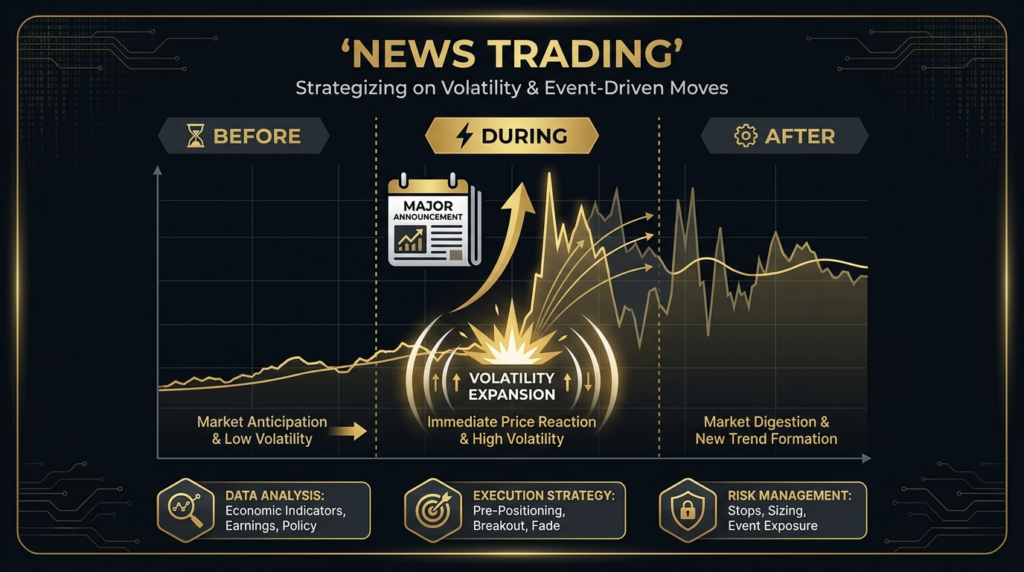
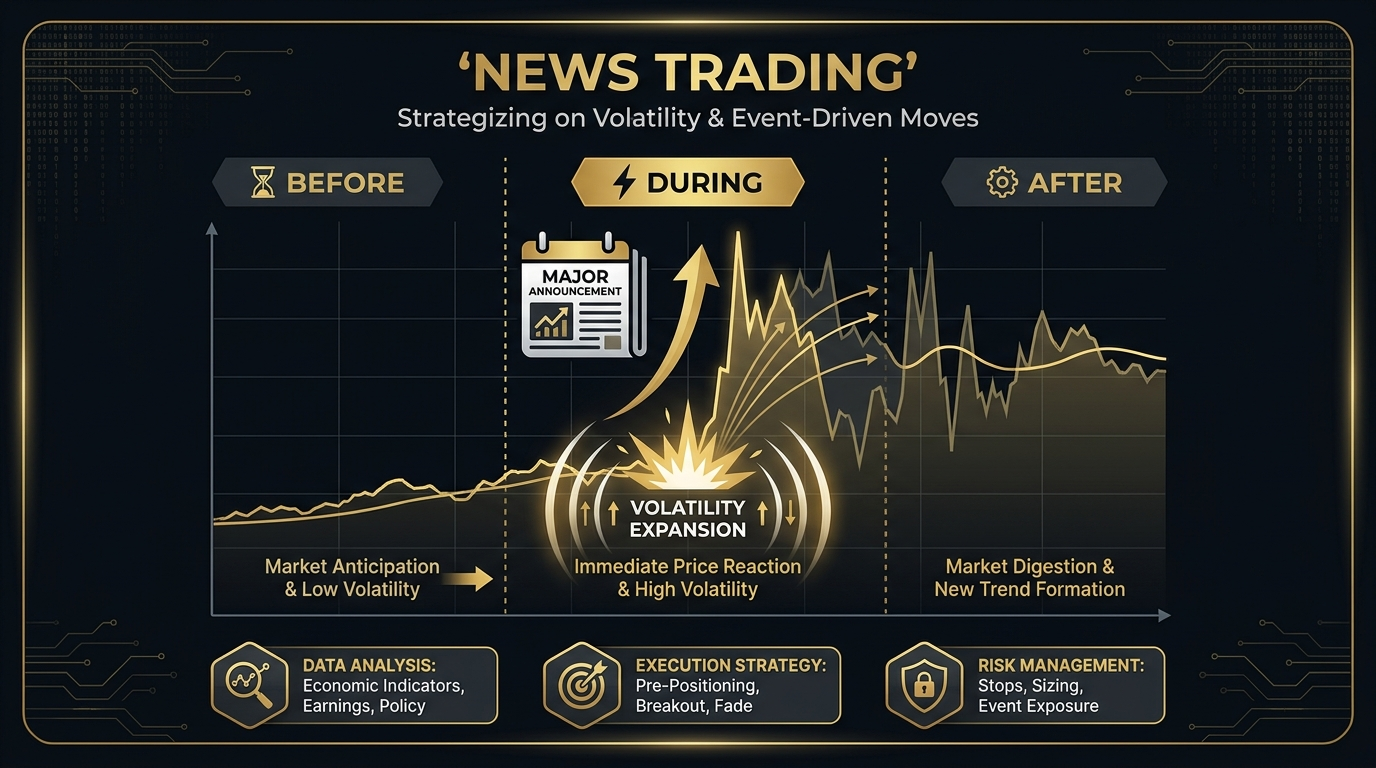
The News Trading Timeline
Pre-News Phase (Hours to Days Before)
Markets enter a holding pattern. Volatility typically contracts as traders reduce exposure ahead of uncertainty. This creates the “calm before the storm.”
Key characteristics:
Trading opportunities:
The Release Moment
When news hits, markets react instantly. Algorithmic trading systems parse headlines and execute in milliseconds, creating the initial price spike.
Characteristics:
Critical rule: Never place market orders immediately after news. Spreads widen to 10× normal or more. A market order might fill far from the quoted price.
The Initial Reaction (First 1-5 Minutes)
Human traders and slower algorithms react to the initial price move. This period often sees the most violent swings as direction gets established.
Characteristics:
The Digestion Phase (5-60 Minutes)
As the initial shock subsides, markets analyze implications. This often produces cleaner, more sustainable trends than the chaotic initial minutes.
Characteristics:
News Trading Strategies
The Straddle Strategy (Pre-News)
Enter both long and short positions before major events, capturing volatility regardless of direction.
Implementation:
Challenges:
Best for: Binary events with guaranteed large move (elections, major central bank decisions)
The Fade Strategy (Initial Spike Fade)
Trade against the initial emotional overreaction, expecting reversion as reality replaces speculation.
Setup:
Example:
Stock drops 4% on earnings miss. Forms long lower wick on 1-minute chart. Volume highest on first minute, declining after. Enter long as price reclaims 50% of the drop. Target pre-announcement level.
Risk: Sometimes the initial move is correct and keeps going. Tight stops essential.
The Breakout Strategy (Post-Digestion)
Wait for the market to choose a direction, then enter in that direction.
Setup:
Logic: The market has “voted” on news interpretation. Follow the majority.
Advantages:
The Retest Strategy
News often drives price to significant technical levels. Trading the retest of these levels offers lower-risk entries.
Setup:
Example:
Fed announcement drives EUR/USD to 1.1000 (major round number). Price initially pierces to 1.0995 then bounces. Retests 1.1000 from below, holds, and reverses. Enter long on confirmation of hold.
Economic Calendar Trading
High-Impact Events to Watch
Tier 1 (Major Market Movers):
Tier 2 (Moderate Impact):
The Calendar Approach
Weekly Planning:
Day-of Preparation:
Risk Management for News Trading
The Volatility Multiplier
News events multiply normal risk:
Adjustments:
The No-Trade Zones
Some news events are simply too unpredictable:
Avoid:
Especially Dangerous:
Position Sizing Rules
News trading requires conservative sizing:
Standard rule: Risk 0.5% maximum per news trade (half normal size)
Aggressive events: Risk 0.25% (quarter normal size)
Multiple events same day: Aggregate risk not to exceed 1%
Remember: News trades can gap beyond stops. Size for worst-case scenario.
Technical Considerations
Platform Selection
News trading demands:
Test your platform during high volatility before trading real money.
Order Types
Limit Orders:
Market Orders:
Stop Orders:
The News Feed
Speed matters. Consider:
Retail traders are at an information disadvantage. Compensate with better risk management and patience.
Psychological Challenges
FOMO (Fear of Missing Out)
News creates explosive moves that look obvious in hindsight. Traders chase these moves, entering late at terrible prices.
Solution: Pre-plan your approach. If you miss the move, you miss it. There will be other events. Chasing leads to buying highs and selling lows.
Analysis Paralysis
Complex news (economic reports with multiple components) creates confusion. Traders freeze, then act impulsively.
Solution: Focus on headline numbers initially. Details matter for swing positions, not intraday direction. The market’s reaction tells you what’s important.
Overconfidence After Wins
Successful news trades create euphoria. Traders increase size, trade lower-quality events, abandon rules.
Solution: News trading is high variance. One win doesn’t change the odds. Maintain consistent sizing and selectivity.
News Trading Best Practices
The Pre-Trade Checklist
Before every news trade:
The Post-Trade Review
News trades require specific analysis:
Conclusion
News trading offers the potential for rapid, significant gains. It also presents unique risks that can devastate unprepared accounts. Success requires speed, discipline, and acceptance that news outcomes are fundamentally unpredictable.
Trade the reaction, not the prediction. Manage risk aggressively. And remember that sitting out an event is often the smartest trade. The news will always be there tomorrow. but your capital might not be if you trade news recklessly.