
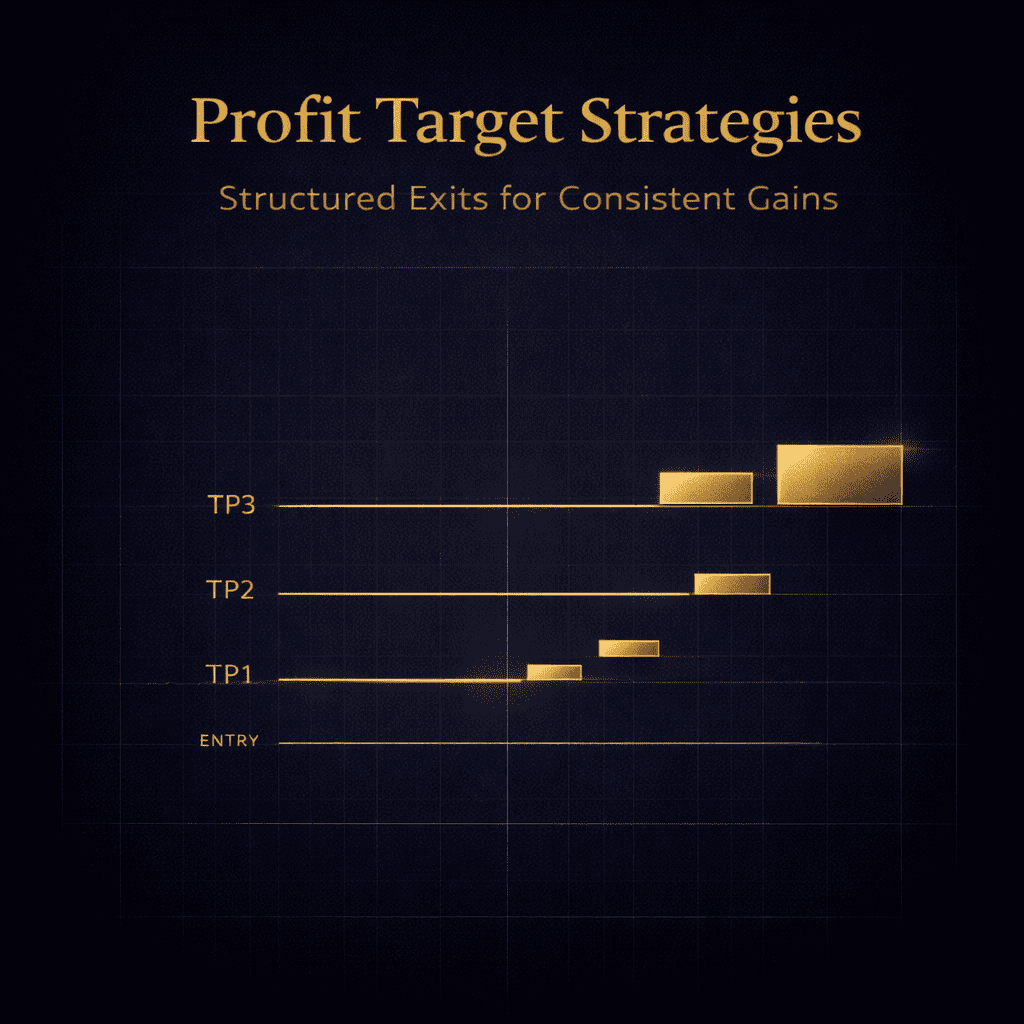
Targets: When to Take Profit
SL/TP Intelligence Series — 5/10
🔍 The Exit Problem
Everyone focuses on entries. “Where should I buy?” “What’s the perfect setup?” “Which indicator gives the best signal?”
But here’s the truth: You don’t make money entering. You make money exiting.
A great entry with a poor exit is a losing trade. A mediocre entry with a masterful exit is profitable. The exit is where profit is realized — or lost.
And yet, most traders spend 90% of their energy on entries and 10% on exits. This is backwards.
❌ The Psychology of Profit-Taking
Before discussing strategies, understand why exits are hard:
Fear of Missing Out (FOMO): Price is moving in your favor. You see bigger gains possible. So you hold. And hold. Until the move reverses and your profit evaporates.
Greed: “It’s going higher. I just know it.” The market doesn’t care what you know. It moves how it moves.
Hope: “It’ll come back. It always comes back.” Sometimes it doesn’t. Sometimes it comes back after you’ve given back all your gains.
Ego: “I called this move perfectly. I’m going to capture the whole thing.” The market humbles egos.
The professional knows: Partial profits are better than full reversals. A bird in the hand is worth two in the bush.
✅ Strategy 1: The Static Target
Concept: Set a target before entering. When price hits it, exit completely.
How to determine the target:
- Previous support/resistance levels
- Fibonacci extensions
- Measured moves (pattern projections)
- Risk-to-reward ratio requirements
Example:
- Entry: $50
- Stop: $48 (2% risk)
- Target: $54 (2:1 reward)
- Exit entirely at $54
Pros:
- Simple to execute
- No decision-making under pressure
- Defined risk-to-reward before entry
- Ideal for mean reversion strategies
Cons:
- Miss extended moves
- No flexibility for changing conditions
- Can exit just before major continuation
Best for: Beginners, mean reversion traders, strict risk managers
🧠 Strategy 2: The Tiered Exit (Partial Profits)
Concept: Scale out of positions at predetermined levels. Capture some profit early, let the rest run.
Common approaches:
50/50 Split
- Close 50% at 1:1 reward
- Close 50% at 2:1 reward (or trailing stop)
Thirds
- Close 1/3 at 1:1
- Close 1/3 at 2:1
- Let 1/3 run with trailing stop
Quartering
- Close 25% at breakeven
- Close 25% at 1:1
- Close 25% at 2:1
- Let 25% run
Example (Thirds):
- Entry: $100
- Position: 300 shares
- Stop: $98
Execution:
- Sell 100 shares at $102 (1:1)
- Sell 100 shares at $104 (2:1)
- Trail stop on remaining 100 shares
Pros:
- Guarantees some profit
- Reduces risk as trade progresses
- Allows participation in extended moves
- Psychologically easier (already won)
Cons:
- Smaller position on big winners
- More complex execution
- Requires discipline to follow plan
Best for: Trend followers, swing traders, those struggling with all-or-nothing psychology
💡 Strategy 3: The Trailing Target
Concept: Let winners run using technical levels as dynamic targets.
Implementation:
Moving Averages
- Exit when price closes below 20 EMA (longs)
- Exit when price closes above 20 EMA (shorts)
Trend Lines
- Exit when trend line breaks
- Adjust trend line as price progresses
Parabolic SAR
- Automatic trailing stop system
- Flip signals exit
Chandelier Exit
- Based on ATR
- Trails below highest high since entry
Example:
- Entry: $50
- Trail: Below 20 EMA
- As price moves to $60, 20 EMA rises to $56
- Exit when price closes below $56
Pros:
- Captures extended trends
- Adapts to market conditions
- Removes guesswork
- Mathematically objective
Cons:
- Gives back some profit on reversals
- Can exit early in volatile trends
- Requires trend to be established
Best for: Trend followers, position traders, those with patience
⚠️ Strategy 4: The Time-Based Exit
Concept: Exit based on time, not just price. If the trade hasn’t worked within X period, assume the edge is gone.
Implementation:
Swing Trading
- If trade hasn’t hit target or stop in 5 days, exit
- Edge decays over time for swing setups
Day Trading
- Exit by 3:30 PM if still open
- Avoid overnight risk
- End-of-day volatility
Event-Based
- Exit before earnings
- Exit before major announcements
- Exit before weekends (for day traders)
Example:
- Entry: Monday morning
- Expectation: Move within 3 days
- Friday close: Neither target nor stop hit
- Exit and redeploy capital
Pros:
- Prevents “hope mode”
- Frees capital for better setups
- Opportunity cost management
- Forces discipline
Cons:
- May exit just before move happens
- Requires accurate time expectations
- Can cut winners too early
Best for: Active traders, those prone to overholding, high-opportunity environments
📝 Strategy 5: The Confluence Exit
Concept: Exit when multiple factors align against your position — not just one.
Example confluence factors:
- Price hits target level
- AND momentum diverges
- AND volume decreases
- AND sector shows weakness
Why it works: Single factors can give false signals. Confluence increases probability that the move is ending.
Example:
- Long position, target $100
- Price hits $100
- RSI shows bearish divergence
- Volume lower than previous high
- Leading sector ETF breaking down
- Exit signal confirmed
Pros:
- Higher probability exits
- Filters out noise
- Aligns with confluence entry philosophy
- Professional-grade approach
Cons:
- Complex to monitor
- May exit after some reversal
- Requires multiple tools/indicators
Best for: Advanced traders, those with sophisticated analysis tools
🎯 Strategy 6: The Psychological Exit
Concept: Exit based on your psychological state, not just price.
Signs you should exit:
- You can’t sleep because of the position
- You’re checking the chart every 5 minutes
- You’ve moved your stop three times
- You’re rooting for the trade like a sports team
- You’re sizing up how you’ll spend the profits
The rule: If the trade owns you, exit. Re-enter with clearer head if setup is still valid.
Pros:
- Prevents emotional disasters
- Protects long-term psychology
- Forces self-awareness
Cons:
- Subjective
- Can create overtrading
- Requires honest self-assessment
Best for: Traders struggling with discipline, high-stress periods, oversized positions
🔧 The Hybrid Approach
Most professionals use combinations:
Example hybrid strategy:
1. Scale out 1/3 at 1:1 (guarantee profit)
2. Scale out 1/3 at technical target (capture expected move)
3. Trail stop on final 1/3 (capture extended move)
4. Time limit: 5 days (opportunity cost)
5. Psychological check: If stressed, close remaining
This combines:
- Static targets (discipline)
- Partial profits (psychology)
- Trailing stops (trend capture)
- Time limits (opportunity cost)
- Self-awareness (emotional management)
📊 Common Exit Mistakes
Mistake #1: No Target
Entering without knowing where you’ll exit. Result: Emotional decisions, random exits, inconsistent results.
Mistake #2: Moving Targets
“It’ll go higher. I’ll just move my target up.” Result: Never taking profit, giving back gains, eventual reversal.
Mistake #3: Target Too Far
Setting targets based on hope, not structure. Result: Frequent misses, frustration, system abandonment.
Mistake #4: Target Too Close
Fear-based tight targets. Result: Constant small profits that don’t cover losses, death by fees.
Mistake #5: Changing Strategy Mid-Trade
“I said I’d trail, but now I’ll take static.” Result: Worst of both worlds, no consistency.
💰 The Professional Exit Checklist
Before entering, define:
- [ ] Primary target (where does thesis complete?)
- [ ] Secondary target (if trend continues?)
- [ ] Trailing stop trigger (when does it activate?)
- [ ] Time limit (how long will I give this?)
- [ ] Partial exit levels (if using tiered approach)
- [ ] Psychological limits (when will I override?)
Write it down. Trade the plan.
🎓 The Reality Check
You’ll never capture the exact top or bottom. Chasing perfect exits leads to:
- Overtrading
- Stress
- System abandonment
- Inconsistent results
The goal: Capture enough of the move to be profitable, consistently, over time.
A strategy that captures 60% of the move every time beats a strategy that sometimes captures 100% but mostly captures reversals.
🎓 Bottom Line
Entries get you into trades. Exits determine your profitability.
Choose an exit strategy that matches:
- Your trading style (trend vs. mean reversion)
- Your psychological profile (patience vs. need for action)
- Your market environment (trending vs. ranging)
- Your risk tolerance (all-or-nothing vs. steady)
Then execute it. Without deviation. Without emotion. Trade after trade.
The exit is where the money is made.The Psychology of Letting Winners Run: Why it’s so hard
- Advanced Exit Strategies: Partial exits, scaling, and more
- The Pre-Trade Checklist: Putting it all together
Perfect exits don’t exist. Consistent exits build wealth.
Trade smart. Protect your capital.
— The Titanprotect Team
📝 Action Items
- [ ] Practice placing stops at logical invalidation points
- [ ] Track your win rate and R-multiple separately
- [ ] Calculate your expected value (EV) for each setup
Next in series: Position Sizing: The Mathematics of Survival →
Word Count: ~1533 words
Reading Time: 7 minutes
Level: Beginner-Friendly
