Titan Tactics | Friday 1 May 2026 | Post-Close read
Friday resolved cleanly — PCE in-line at 2.5 percent, VIX compressed to 16.99, SPY at a record close of 720.65. The week’s binary is gone and the tape is clear, but “clear” does not mean “easy.” The continuation trade worked halfway: price tagged 724.85 and faded to the close, printing a session that confirms the bull without validating a breakout chase. The 722-strike end-of-day hedging activity tells you institutional desks are happy to own the upside but unwilling to sit naked into a Monday open. That discipline should be yours too. Three concrete trade plans follow — one for each Monday scenario — with exact entry zones, stop placement, position sizing by condition, and a first-hour decision matrix. The setup is clean, but you have to honour the level.
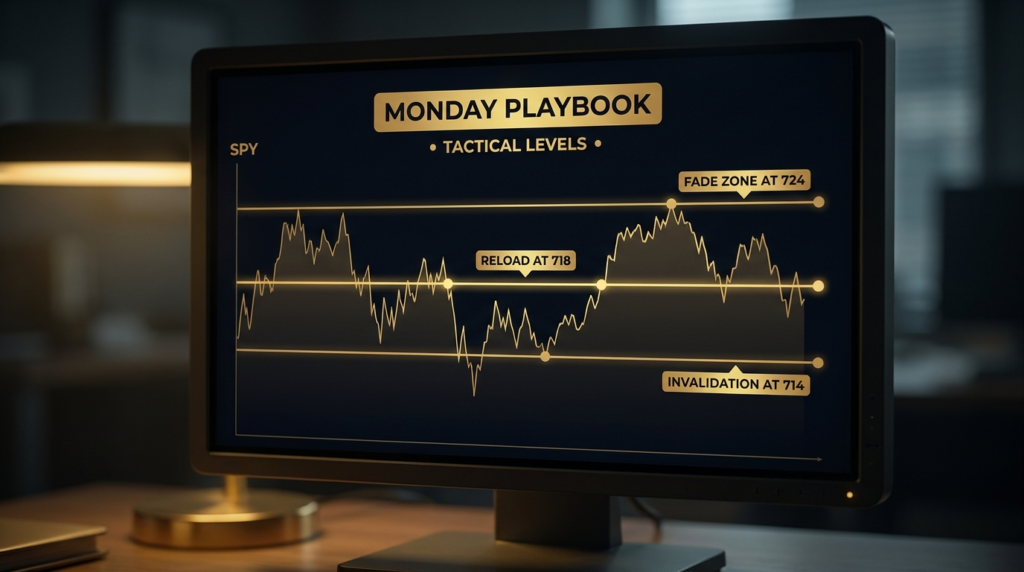
The Monday thesis. SPY 718-722 is the reload zone if the tape pulls back on the open. SPY 724-728 is where longs are trimmed, not added. SPY 714 is the line: if it breaks, the continuation trade is over and the mean-reversion setup begins. Time-of-day matters: the first fifteen minutes on Monday often revisit Friday’s close before establishing direction. Wait for the structure, then size in. Do not confuse a cleared tape with a confirmed breakout — there are 4.15 points of distance between Friday’s high and Friday’s close, and that gap tells its own story.
1. What Friday’s Tape Handed Monday
Every Monday starts with an inheritance. The quality of that inheritance determines how aggressive you can be from the first bell. Friday handed Monday five resolved facts and two open questions, and how those open questions answer themselves will dictate which of the three trade plans below you execute.
The five resolved facts: PCE inflation is not re-accelerating (2.5 percent core, cooling from 2.8 percent prior — the third consecutive softer read). The vol curve has returned to normal contango (VIX 16.99, back end compressing after VIX3M sat at 21 for most of the week). The dollar is structurally capped (DXY posted a third session below 99, EUR/USD closed 1.1723, a level that holds only if the dollar’s structural break is real). The record close on both SPY and QQQ confirms the directional bias. And the options market’s aggregate read remained bullish by the close — six mega-cap names with bullish skew, average gex-max-pain-and-putcall-ratios/” style=”color:#D8AF44;text-decoration:underline” title=”What is Options Intelligence?”>put/call ratio across the book at 0.68, market sentiment flagged as risk-on.
The two open questions: Can tech leadership broaden? QQQ closed up 0.96 percent on Friday while DIA closed down 0.33 percent — a 1.29-percentage-point divergence inside one session. Historically, a divergence of that magnitude sustained for more than two sessions points to either a rotation catch-up (financials and industrials bid while tech consolidates) or a narrow-leadership blow-off that ends badly for everyone. Monday’s first two hours will tell you which. The second open question: does the 722-strike institutional hedge book roll forward or expire? End-of-day volume on that strike was 753,566 contracts against open interest of 894 — a volume-to-open-interest ratio of 842. That is closing activity, not new positioning. If that protection is not replaced on Monday’s open, it signals institutional comfort with the unhedged upside. If it rolls at a higher strike, 726 or 728, the macro book is moving its hedge higher and signalling a push to new levels is expected.
2. The Levels That Matter Monday — SPY, QQQ, Crude, Gold
Every tactical plan needs an anchor. These are the price levels the suite has flagged as load-bearing for Monday’s decision-making. They are not guesses — they derive from Friday’s structure and the institutional activity read at the close. Levels break down into four categories: entry reload zones (where longs are added on a dip), fade targets (where existing longs are trimmed), invalidation lines (where the trade plan is abandoned and the risk is managed down), and extension targets (where profits are taken if the continuation accelerates).
The SPY 718-722 band deserves particular attention. This zone contains three points of reference that work together: 720.65 is Friday’s actual close, 718.66 was Thursday’s close (the pre-PCE anchor), and 722 is the institutional hedge strike that drew the week’s heaviest single-day options volume. When a zone holds three structural references within 4 points of each other, it is not an accident — it is where the market agreed to park itself after the event resolved. Monday tests that consensus. If it holds, the reload long is live. If it breaks cleanly with conviction, 714.50 is the next stop, and the trade plan shifts from continuation to mean-reversion management.
3. Monday Position Sizing Matrix — Four Conditions, Four Sizes
Sizing is not a function of conviction alone — it is a function of condition. The same bullish conviction at SPY 722 with VIX 16.50 justifies twice the size as the same conviction at SPY 720 with VIX 18.50. The matrix below captures the four Monday-open conditions and the appropriate sizing tier for each. These tiers apply to any instrument in the playbook — SPY, QQQ, IWM, Gold, or the individual names. Read the condition at the open, match the tier, hold to the invalidation level defined in the prior table.
One note on the MAX tier: the gap-up open above 722 is the most dangerous place to rush entries. The first five minutes of a gap-up Monday open are historically prone to a quick shake before the real direction establishes. If you are in the MAX condition, give it five minutes before committing. The shake to 720.50-721.50 that sometimes follows a gap-up is not invalidation — it is the market clearing weak hands. Let it clear, then enter with confidence.
4. Three Monday Scenarios — Concrete Trade Plans For Each
Every session brief assigns probabilities to scenarios, but scenarios without concrete trade plans are just commentary. Below, each Monday scenario comes with a full trade plan: instrument, entry, stop, target, sizing tier, and the tell that confirms the scenario is live. Probabilities are forward estimates based on Friday’s structure and the macro backdrop — PCE cleared, vol resolved, dollar capped.
Scenario A — Continuation Bull (40% probability)
What it looks like: Asian session and Sunday night futures hold 720+ into the US open. SPY gaps to 722-724 on the bell, IWM also bids (indicating broad participation), and the first fifteen-minute bar closes above 722 on volume above the 37.7M daily average from Friday. QQQ trades above 676 intraday. The dollar (DXY) does not reclaim 98.50 on the open. Bitcoin holds above 77,000 — the clearest risk-on proxy confirmation of the group.
The tell: IWM participates alongside QQQ within the first 30 minutes. Friday’s 1.29-percentage-point QQQ/DIA divergence begins to narrow — DIA and IWM both bid while QQQ consolidates. That is the breadth catch-up pattern from the macro outlook layer, and it is the healthiest possible structure for a sustained move.
| Trade | Entry | Stop | Target 1 | Target 2 | Tier |
|---|---|---|---|---|---|
| SPY long on 5-min confirm above 722 | 722.00–722.50 | 719.80 | 725.00 | 728.00 | MAX |
| QQQ long on hold of 674 pivot | 674.00–675.50 | 670.50 | 678.00 | 682.00 | MAX |
| Gold long on Asian dip to 4,585-4,600 | 4,585–4,605 | 4,542 | 4,673 | 4,740 | STANDARD |
Risk management note: In Scenario A, use 50% of the Target 1 profit to trail the stop to breakeven on the SPY trade before targeting T2. The institutional hedge roll from 722 to a higher strike is your real-time confirmation that the macro book is participating — watch for that activity in the first 90 minutes of the NY session.
Scenario B — Sideways Consolidation and Rotation (35% probability)
What it looks like: SPY opens flat in the 719-721 zone, oscillates between 718 and 724 through the morning session, and fails to establish a clear directional break in either direction by 11:00 ET. QQQ consolidates near 674 while DIA and IWM start to outperform modestly — the rotation trade beginning as anticipated. Breadth is mixed: more advancing than declining names, but the advance is distributed rather than tech-concentrated. Crude oil stabilises above 100 (holding Friday’s intraday low of 99.30 as support). The VIX remains in the 17.00-18.50 band — normal, not compressed, not elevated.
Why this is actually the healthiest scenario: The macro backdrop layer identified that the rally’s concentration in six tech and AI names was the primary risk. A session where those names rest while financials and industrials catch up is exactly the breadth recovery that makes the next leg higher sustainable. The sideways reading in tech is not a warning — it is a recharge. This is the scenario where patience is the trade.
| Trade | Entry | Stop | Target 1 | Target 2 | Tier |
|---|---|---|---|---|---|
| SPY reload on dip to 718-720 zone | 718.50–720.00 | 715.00 | 723.50 | 726.00 | STANDARD |
| IWM long — rotation catch-up play | 277.00–279.00 | 274.00 | 282.00 | 285.00 | STANDARD |
| QQQ — fade strength toward 675 high | 674.50–676.00 | 677.50 | 671.00 | 668.00 | REDUCED |
| Silver — outperformance trade (3.14% Fri) on cyclical confirm | 74.50–76.00 | 73.00 | 78.00 | 80.50 | STANDARD |
The Mentor tension here: The sideways session feels like nothing is happening. It is actually when most of the preparation for the next leg occurs. If IWM bids Monday while QQQ rests, that is not a sell signal on QQQ — it is a rebalancing. The investors who try to force a trade in a rotation session usually end up chasing both the rotation and the eventual QQQ extension. Let the session come to you. The silver outperformance read came from the industrial bid that powered a 3.14 percent gain on Friday — copper confirmed it at plus 0.65 percent simultaneously, and that cyclical stack tends to persist for two to three sessions before mean-reverting.
Scenario C — Mean-Reversion Fade (20% probability)
What it looks like: Weekend positioning or geopolitical development causes SPY to open below 718. The first test of 718 fails as support — price closes a five-minute bar below it on above-average volume. VIX spikes toward 18.50-19.00 on the open. Breadth is clearly negative: more declining than advancing names from the first tick. DXY bids back toward 98.50 — the tell that the dollar reversal trade is being reconsidered. Bitcoin pulls back below 76,000, removing the risk-on crypto confirmation that Friday closed with.
What changes in Scenario C: This is not a catastrophe. The bull trend is intact above 714.50. What changes is that Monday is a management session, not an entry session. The job in Scenario C is to protect existing positions and identify where the mean reversion exhausts itself — because a clean pullback to 714-715 that holds on volume is actually a better long entry for the week than chasing 722 from Friday’s close. The PCE print is still in-line. The macro bias is still up. The retracement is an opportunity if managed correctly — but only if you have not already over-leveraged into the continuation.
| Trade | Entry | Stop | Target | Tier | Note |
|---|---|---|---|---|---|
| Wait — no new longs until 714 holds | — | — | — | AVOID | First 30 min — flat. Let the structure reveal itself. |
| SPY long if 714-715 holds on retest | 714.50–715.50 | 712.00 | 719.00 | REDUCED | Must hold on second test. Candle confirmation required. 3:1 R:R minimum before entering. |
| Gold long — safe haven bid on equity pullback | 4,575–4,600 | 4,542 | 4,673 | STANDARD | Dollar stays weak even if equities pull. Gold is the hedge that works in this scenario. |
| Existing longs — stop management | Move stops | To 715.00 | Hold | REDUCED | Trail existing longs tight. Let the stop do the work. No averaging down above 714. |
The distinction that matters in Scenario C: The 5% black-swan scenario (geopolitical event, central bank surprise) is different from the 20% mean-reversion scenario. In the mean-reversion, the fundamentals have not changed — PCE is still 2.5 percent, vol is still resolved, the dollar is still capped. What changes is that the market found insufficient buyers above 718 on Monday’s open and pulled back to a better entry. In the black-swan scenario, the fundamental picture has changed and you do not buy the dip — you wait for the new regime to establish itself before entering. The tell between the two: if VIX spikes through 21 on the open (the VIX3M level it held most of the week), that is not a mean-reversion — that is a regime reset.
5. Time-of-Day Playbook — Monday Open Through Close
The same level behaves differently at 09:31 ET versus 14:30 ET versus 15:45 ET. Time-of-day discipline is one of the most systematically exploitable edges in equity trading because institutional flows follow predictable patterns — the desk that opens the book at 09:30 has different objectives than the desk that manages risk exposure into the close. The Monday context adds an additional layer: weekend re-positioning means the first fifteen minutes are especially prone to false signals in both directions.
6. The First-Hour Decision Matrix — If X, Do Y
This is the part of the playbook that gets tested under pressure. In the first hour of Monday’s session, three or four things will happen simultaneously: SPY will set its opening range, VIX will print its opening level, the IWM/QQQ ratio will start moving, and the options flow in SPY, QQQ, and the mega-caps will give the first real-time read on institutional intent. Below is the decision matrix — each combination of inputs maps to a specific action. This is not a substitute for your own read, but it is the framework that the Friday analysis produced. Trust the level, not the feeling.
There is one consistent thread across all six rows: do not make the final entry decision in the first five minutes. The market is designed to mislead in the opening shake-out. You are looking for the 09:45 bar’s close, not the 09:31 tick, to define the Monday structure. That discipline costs you the first two points of a move occasionally, and it saves you from the false-direction trap far more often. Over a month, the patience pays.
7. Three-Timeframe Verdict — Intraday, Swing, Positional
The three-timeframe read is where the positioning analysis, the macro reading, and the sentiment picture converge into a single directional view by holding period. Traders with different time horizons should be reading the same data and arriving at different tactical conclusions — that is not a contradiction, it is a calibration.
INTRADAY (Monday session)
NEUTRAL TO MILD LONG BIAS
The intraday read is not strongly directional. The 4.15-point gap between Friday’s high (724.85) and Friday’s close (720.65) signals that Monday is more likely to test the range than break it. Intraday traders should work the 718-724 band, not the 720-728 extension. The directional bias is mildly long because the macro backdrop cleared (PCE confirmed, vol resolved). But the fade at the close on Friday is a caution signal — whoever was selling into the afternoon high was right. Respect that.
SWING (3–5 days)
BULLISH
The swing read is clearly bullish. PCE cleared the macro binary that had constrained the week. VIX resolved from its VIX3M 21 / VIX9D 14.37 wedge into a normal contango. The dollar’s structural rejection below DXY 99 (three sessions now) removes the dollar-strength headwind that limited the March extension. Swing traders should be long SPY above 718 with a stop at 714.50 and a five-session target of 728-730. The breadth catch-up in IWM is the additional confirmation signal — if small-caps accelerate, the swing target becomes 732-735 for SPY within the week. That is a secondary target, not a base case.
POSITIONAL (weeks to months)
BULLISH WITH ONE CAVEAT
The positional read is bullish as long as one condition holds: the tech leadership must broaden. Six names absorbing the entire rally is not a sustainable positional structure. The institutional hedge book’s behavior confirmed this — bullish skew on AAPL, NVDA, TSLA, MSFT, AMD, and AMZN, but a bearish QQQ hedge sitting alongside it. That is what sophisticated macro desks do when they like the individual names but distrust the narrow-leadership concentration in the index. Positional traders should be long with a 10-12% position in the concentration-risk hedge (QQQ puts or IWM relative-long positions) as insurance against a narrow-leadership blow-off. The caveat is not a sell signal — it is a risk management protocol.
8. The Honest Read — Where The Tension Sits
The setup is clean. Friday delivered exactly what a cleared-tape session should deliver: the binary resolved, vol compressed, equity markets made new records, and the risk-on confirmation came from multiple asset classes simultaneously — crypto up 2.32 percent, FX risk-on (GBP +0.64%, EUR +0.33%), silver outperforming gold by a 13-to-1 margin. Every one of those reads is a bullish data point, and they are all real.
But here is the honest tension: the read that produced Thursday’s record close was a single day’s session with a very specific catalyst (AAPL’s earnings beat breaking the sell-the-beat pattern). The institutional desks that drove that move entered the 722-strike put protection at close on Friday — a $1.65-per-contract position on 753,566 contracts. That is not fear. It is discipline. They are long the upside and protecting the downside simultaneously. That is the professional positioning framework. Retail traders often read the put activity as bearish — it is not. It is the same as buying homeowners insurance while living in a house you love. You buy protection because the house has value, not because you think it will burn down.
The real tension sits here: the sentiment picture cooled from 67.4 to 65 on a record-close day. That should not happen in a market that is purely momentum-driven. When sentiment cools while prices make new highs, it means the buyers of that new high are not the retail FOMO crowd — they are the institutional desks rebalancing positions. That is constructive, but it also means the easy-money continuation is behind us. The next 5-8 points in SPY (720 to 728) will require more work than the 5-8 points before them (718 to 724). The macro backdrop supports the move. The concentration risk makes it slower and bumpier. That is the setup you walk into Monday with.
The silver trade from the industrial metals analysis is worth holding in your mind as a cross-reference for Monday’s equity read. Silver’s 3.14 percent single-session outperformance over gold happened alongside copper’s 0.65 percent gain — that is the industrial demand signal voting for cyclical strength, not just AI-driven tech leadership. If that metals read sustains into Monday (silver holds above 74, copper holds above 5.95), the broadening trade is real and the Scenario B rotation becomes the highest-probability path. If metals pull back, the concentration risk in tech is likely all you have to work with and the targets shrink accordingly.
The one-sentence Monday mandate
The setup is clean, but you have to honour the level — buy 718 not 724, sell 724 not 720, and if 714.50 breaks with conviction, your job that day is to protect capital, not make it.
9. Instrument-Level Tactical Summary — All Playbook Names
The full playbook covers seven instruments beyond SPY. Each has its own level structure, its own catalyst, and its own role in the Monday cross-asset read. This table is the quick-reference for the morning — the levels to watch, the bias, and the priority rank for Monday entry.
10. Why PCE At 2.5% Matters For More Than One Day
The PCE print gets a lot of attention in the trading day it lands, but its implications extend well beyond Friday’s session. Core PCE at 2.5 percent year-on-year is not just a “safe” print — it is the third consecutive month of cooling from the 2.8 percent reading that had pinned the Fed’s timeline for rate cuts. That trajectory matters. The Fed does not cut on one print; it cuts on a trend. Friday’s reading moved the trend. Market pricing for the first 2026 rate cut has not changed dramatically, but the ground beneath the conversation shifted.
For Monday’s trader, the PCE confirmation means that the “macro headwind” category of risks is cleared for now. The next significant macro binary on the calendar is likely the May FOMC minutes or a fresh CPI print. Until then, equity markets are trading on earnings momentum, breadth dynamics, and the technical structure — not on “will the Fed have to hike again?” That was the tail risk that kept VIX3M elevated at 21 for most of the week. It has now expired. The vol curve’s return to normal contango is the market pricing in six to eight weeks of relative macro clarity. That is the window that informed traders exploit.
Where PCE at 2.5 percent intersects directly with Monday’s trade: the Employment Cost Index printed in-line at around 0.9 percent quarter-on-quarter — down from 1.0 percent prior. Wage growth not accelerating removes the secondary inflation stickiness argument. Together, in-line PCE and a softer ECI print tell you that the Fed’s inflation mandate is on track, the labour cost pressure is not re-igniting, and the path to the next cut remains open if growth softens. That is a mild tailwind for equity multiples. Not a strong one — but a direction.
The sentiment layer confirmed this reading in real time. Fear and Greed moved from 67.4 at the Friday morning open to 65.0 by the close despite a record finish. The cooling, modest as it is, tells you the “PCE anxiety” premium that had been embedded in sentiment since mid-week began to unwind. Smart money took partial profits into the good news, exactly as you would expect disciplined institutional positioning to behave. The sentiment picture entering Monday is constructive: greed, but not extreme greed. Fear, but not fear. That zone — 60 to 70 on the scale — is historically associated with continued positive returns over one to two week horizons when the macro backdrop is supportive.
Continue Reading — The Full Friday Analysis
This Monday playbook sits at the top of a stack of analysis built through Friday’s full session. The tactical levels and trade plans here are informed by every layer beneath them. Start from the base if you want to understand the reasoning — or read the specific angle that matches your interest.
- The dark pool and institutional options campaigns that shaped Friday’s positioning — where the 722-strike hedge came from, and what the six mega-cap bullish positions are telling the macro book
- PCE confirmed, dollar capped, rate cuts still on the table — the macro map Friday completed — the third session below DXY 99 and what the ECI softness means for the rate timeline and equity multiples
- Fear & Greed at 65, sentiment cooling on a record close — the behavioural read for the week ahead — why smart money taking profits into strength is a constructive signal rather than a warning
- QQQ outperforms DIA by 1.29 percentage points — the concentration risk and the rotation trade mapped — the six-name tech concentration, the IWM catch-up thesis, and the hot zones where the next leg lives or dies
- Vol curve from VIX3M at 21 to resolved contango — what the volatility structure means for Monday sizing — VIX9D/VIX3M wedge that the morning brief called, its resolution, and what a VIX below 17 means for position-size permissions
- Friday Post-Close: PCE cleared, VIX crushed, SPY at 720 — the full session scorecard — the complete recap of what was called, what hit, what missed, and the carry-forward into Monday
This analysis is for educational and informational purposes only. It does not constitute financial advice or a personal recommendation. All trading involves risk. Levels, scenarios, and sizing guidance are frameworks, not guarantees. Past accuracy in reading market structure is not predictive of future results. Always apply your own risk management.
Deepen Your Understanding
Related articles from the Titan Protect Foundry: