Hot Zones: Weekend Edition
Tactical Radar | Published for the week ahead | Friday 17 April 2026
Russell 2000 (IWM) up 2.13%. Silver up 3.98%. Crude oil down 9.41%. Those three numbers tell you everything about where money moved this week. Capital rotated out of energy, into small caps and precious metals, while mega-cap tech gained steadily but without leading.
This is a rotation market, and the sector heat map below reveals exactly where the temperature is rising, where it is cooling, and what that means for the week ahead. As you’ll find in our Setup Radar brief, IWM was flagged as priority 3 and gold as priority 5 for Monday. The sector breakdown here explains why.
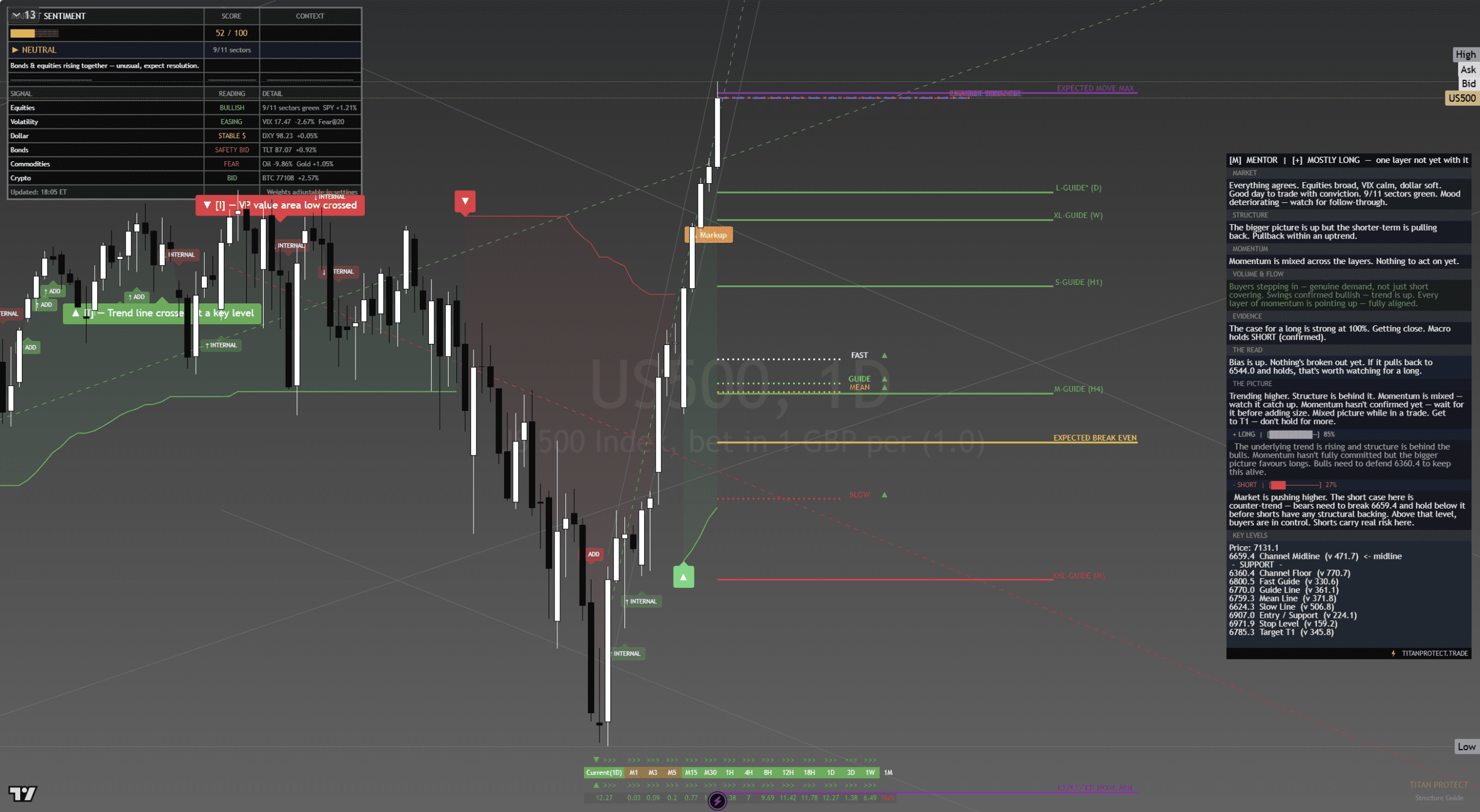
Sector Heat Map — 11 GICS + Semiconductors
| Sector | ETF | Heat | Weekly Flow | Rotation Theme | Tactical Note |
|---|---|---|---|---|---|
| Technology | XLK | HOT | Inflows sustained | Mega-cap concentration | Institutional accumulation in NVIDIA, Apple, Microsoft drives the heat. Breadth within tech is narrower than the ETF suggests |
| Financials | XLF | WARM | Moderate inflows | Yield curve steepening | Rate path at around 55% hold probability favours bank margins. Credit flow confirms institutional appetite |
| Healthcare | XLV | WARM | Steady | Defensive with growth | Defensive sector holding its own in a risk-on week. Portfolio ballast, not leadership |
| Energy | XLE | COLD | Heavy outflows | Demand destruction | Crude down 9.41% on the week. Speculative positioning is heavily short. The sector cannot rally until crude stabilises. Avoid until $86+ |
| Industrials | XLI | WARM | Moderate inflows | Domestic growth | Russell leadership at +2.13% pulls industrials higher. Manufacturing data supports |
| Materials | XLB | WARM | Moderate inflows | Commodity bid ex-crude | Gold +1.48%, Silver +3.98%, Copper +0.63%. Materials benefit from the metals bid and weak dollar |
| Utilities | XLU | COOL | Flat to mild outflows | Defensive rotation out | Money leaving defensive sectors as sentiment reaches the upper third. Classic risk-on behaviour |
| Real Estate | XLRE | COOL | Flat | Rate-sensitive laggard | Around 55% hold probability means no near-term rate cut catalyst. Real estate waits for the next rate signal |
| Consumer Staples | XLP | COOL | Mild outflows | Risk-off unwind | When greed dominates, staples lose flows to cyclicals. This is mechanical, not fundamental |
| Consumer Disc. | XLY | HOT | Strong inflows | Consumer confidence play | Tesla and Amazon institutional activity anchors discretionary heat |
| Comms Services | XLC | WARM | Moderate inflows | META-driven | Meta Platforms’ targeted accumulation provides sector lift. Alphabet adds to the base |
| Semiconductors | SMH | HOT | Very strong inflows | AI infrastructure | The hottest subsector by accumulated flow. NVIDIA anchors with AMD elevated. Semi leadership continued into Friday |
Global Index Heat Check
| Index | Region | Sector Rotation Read |
|---|---|---|
| FTSE 100 | UK | Commodity-heavy composition benefits from gold/metals bid. Energy drag partially offsets |
| DAX 40 | Germany | Industrial and auto exposure aligns with the cyclical WARM theme. Export sensitivity to euro matters |
| Euro Stoxx 50 | Eurozone | Broad benchmark reflects the European cyclical vs defensive split mirroring US rotation |
| CAC 40 | France | Luxury and industrial tilt follows the consumer discretionary HOT classification |
| Nikkei 225 | Japan | Tech and industrial mix benefits from semiconductor heat. Yen direction is the swing factor |
| Hang Seng | Hong Kong | Tech-heavy index benefits from the semiconductor and consumer discretionary heat themes |
| ASX 200 | Australia | Materials WARM classification directly supports mining-heavy ASX composition |
| Nifty 50 | India | Financial and industrial weight aligns with the WARM cyclical rotation underway |
| China A50 | China | Financial and consumer sector weight benefits from the risk-on, weak-dollar backdrop |
Rotation Theme Analysis
Growth is winning this week but not by the margin you would expect. Nasdaq 100 gained 1.50% against the Russell’s 2.13%. In a typical growth-led rally, Nasdaq leads by 50–100 basis points. The fact that the Russell is outperforming reverses that relationship.
This is a value and small-cap catch-up move. In late-cycle expansion environments, growth stocks reach valuation limits while value and small caps benefit from economic momentum that the larger names already priced in. The 2.13% Russell move is the market pricing in domestic growth acceleration that mega-caps cannot capture.
Cyclicals are dominating. Industrials, materials, and consumer discretionary are all WARM to HOT. Defensives — utilities, staples, real estate — are COOL. When sentiment pushes into the upper third, money mechanically flows from defensive to cyclical sectors.
The one exception is healthcare (XLV), which holds WARM status despite being traditionally defensive. Healthcare has a dual personality — it acts as growth in biotech-heavy periods and as defensive during broad sell-offs. Its current warmth suggests the market views it as growth, not safety.
Energy is the cold spot on the map, and it is cold for a reason. Crude oil’s 9.41% weekly decline is the largest single-week move in the commodity complex. Speculative positioning is heavily short and carries snap-back risk.
For sector allocation: energy (XLE) is an avoid until crude stabilises above $86. But the contrarian opportunity is real. If crude bounces from the 82–84 zone, energy becomes a catch-up trade with 10–15% potential over 2–4 weeks. That is an advanced-level play with clear invalidation.
Russell Leadership as a Breadth Signal
The Russell 2000’s (IWM) 2.13% weekly gain deserves its own section because of what it implies about market health. When small caps lead, it typically means one of three things:
2. Short squeeze or rebalancing — mechanical flows from index reconstitution or short covering. Typically fades within 2–3 sessions.
3. Late-cycle rotation — value and domestic exposure outperforming as growth reaches limits. Persistent but eventually transitions to defensive.
Current evidence supports a mix of 1 and 3. Breadth at 71% above the 50-day is expanding, but 52.3% above the 200-day shows the structural recovery is incomplete. Institutional block flow in IWM confirms this is not a pure short squeeze.
The tell for Monday: if IWM opens with volume above Friday’s average and breadth ticks above 73–74%, the broadening is real. If Russell gives back gains while Nasdaq 100 reasserts, the rotation was a Friday rebalancing event.
Multi-Strategy Breakdown
Risk Assessment
Factors:
- Sector rotation is orderly, not chaotic — this reduces risk because money is moving in a predictable pattern
- Institutional flow aligns with sector heat — no contradictions between what institutions are buying and what sectors are leading
- Energy is the only sector with deteriorating breadth — that makes the risk concentrated, not systemic
- Russell leadership with incomplete 200-day breadth recovery adds fragility to the broadening thesis
- Broad cross-asset bullish alignment supports the rotation continuing
Scenario Analysis
| Scenario | Probability | Description | Sector Action |
|---|---|---|---|
| Rotation deepens | 40% | Russell continues leading. Breadth expands above 73%. Cyclicals strengthen | Overweight XLI, XLF, IWM. Maintain SMH |
| Tech reasserts | 30% | Nasdaq 100 reclaims leadership. Growth over value resumes | Overweight XLK, SMH. Reduce cyclical exposure |
| Consolidation | 20% | All sectors flatten. Market digests weekly gains before next catalyst | STANDARD sizing across the board. No sector bets |
| Energy reversal | 10% | Crude bounces. XLE rotates from COLD to WARM rapidly | Add XLE on crude confirmation above $86 |
Experience Level Guide
Hedging Recommendations
- Cyclical overweight: Hedge with XLU or XLP exposure at 10–15% of cyclical allocation as a reversal buffer
- Tech concentration: A small volatility call position offsets the narrow breadth risk in tech-heavy portfolios
- Energy avoid: No hedge needed — staying out is the hedge
- Full rotation exposure: IWM put at 270 strike provides a floor beneath the Russell leadership thesis
Market Timing Verdicts
| Timeframe | Verdict | Rationale |
|---|---|---|
| Short term (1–3 days) | Cyclicals favoured | Russell momentum and institutional flow support continuation into Monday |
| Medium term (1–3 weeks) | Rotation monitored | Breadth expansion above 55% on the 200-day is the confirmation threshold |
| Long term (1–3 months) | Late-cycle sector selection | Growth narrows, value and quality outperform. Sector picking beats index buying |
Further Reading
- As you’ll find in our Positioning Pressure brief, institutional flow data directly informs the heat classifications above
- As you’ll find in our Macro Pulse brief, the late-cycle expansion regime explains why Russell leads and the growth-vs-value dynamic is shifting
- As you’ll find in our Sentiment Shift brief, sentiment at the 67th percentile explains the defensive-to-cyclical flow mechanically
- As you’ll find in our Setup Radar brief, IWM at priority 3 and gold at priority 5 are direct applications of the sector rotation flagged here
Related Intelligence
As you’ll find in our Sector Flow brief, where institutional money flow reveals which sectors are attracting real capital.
For the full breakdown, see our Positioning Pressure brief — where COT and short volume data shows the institutional conviction behind these zones.
What We Called vs What Happened
Starting this week, every Hot Zones brief will include a track record section where we hold ourselves accountable. Our calls from the prior week will be listed alongside the actual market outcome, so you can see exactly how the analysis played out. Expect this section to grow each week with a running accuracy record.
This week’s calls are now on record. Check back in our next edition to see how they resolved.
This is analysis, not financial advice. Always manage your risk.
The energy sector rotation thesis reverses sharply if the Hormuz closure holds through Monday. The Strait of Hormuz recorded zero oil tanker transits on Saturday — the first complete shutdown in recorded history — after a US Navy strike on an Iranian cargo vessel and collapsed negotiations. XLE could gap up violently as supply fears override the demand-driven weakness from Friday. The “growth in, energy out” rotation may flip overnight.
Deepen Your Understanding
Related articles from the Titan Protect Foundry: