Sentiment Shift | Friday 1 May 2026 | Post-Close read
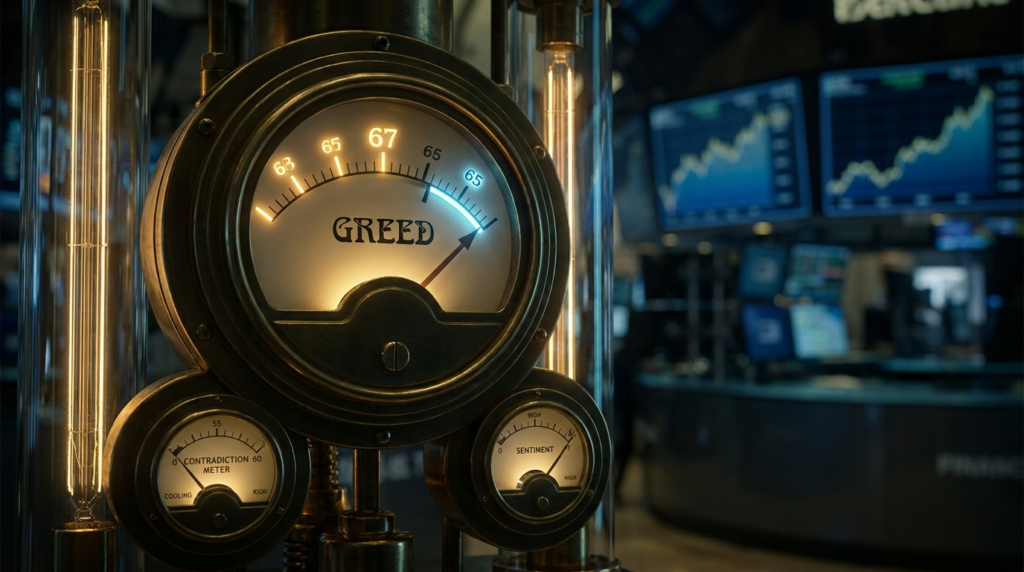
The S&P 500 posted a record close and the Fear & Greed Index fell. That combination — record price, cooling sentiment — is one of the most constructive setups a bull market can produce, and it is exactly what Friday delivered. The index dropped from 67.4 at the morning read to 65 by the close, a 2.4-point retreat on a day that should have stretched it further. Bitcoin confirmed the broader risk-on picture at plus 2.32 percent, and the options skew across mega-cap technology ran six names bullish against a single bearish signal on QQQ — a counter-positioning trade that speaks to tactical concentration-risk hedging rather than genuine distribution. The crowd is split at exactly the right moment: enough optimism to sustain the move, enough caution to prevent the overextension that kills rallies. Monday inherits that tension, and how it resolves will determine whether the week’s record is a launchpad or a local high.
The core behavioural read for Friday 1 May 2026
Fear & Greed at 65 on a record close is not stretched greed — it is disciplined money taking partial profits into strength. The 2.4-point cool-down happened while SPY advanced 0.28 percent and QQQ advanced 0.96 percent. That directional decoupling between sentiment and price is characteristic of institutional distribution at the margin, not retail capitulation or panic-buying. Bitcoin at plus 2.32 percent and silver at plus 3.14 percent confirm the risk-on regime is intact. The QQQ bearish options print — at a volume-to-open-interest ratio of 2,126 against six bullish mega-cap skews — is the day’s most interesting single trade: positioned against the session’s strongest performer, it reads as tactical concentration-risk insurance rather than a directional bet. Monday’s setup is constructive with a caveat: the crowd that is missing is the one that makes moves sustainable.
1. The Number That Matters Most — Greed Cooled On A Record
The Fear & Greed Index measures crowd psychology across seven inputs — stock price momentum, stock price breadth, options gex-max-pain-and-putcall-ratios/” style=”color:#D8AF44;text-decoration:underline” title=”What is Options Intelligence?”>put/call ratios, market volatility, junk bond demand, safe-haven flows, and stock price strength. On a day when the S&P 500 closed at a record high and the Nasdaq added nearly one percent, you would expect that composite to push higher. It did not. It fell from 67.4 in the morning to 65 by the close.
That move tells you something specific. The price action was real — SPY 720.65, QQQ 674.15, both prints that would have pushed the index toward 69 or 70 in a pure momentum environment. The fact that it cooled says the internals underneath the headline were not as clean. Breadth was the tell: QQQ outperformed DIA by 1.29 percentage points in a single session, the largest tech-versus-Dow divergence of the week. When the market is running on six names rather than 500, the sentiment composite picks that up even when the index does not.
The constructive interpretation: at 65, sentiment is elevated enough to confirm the rally is real but not so stretched that mean-reversion pressure is imminent. The danger zone for a momentum-driven pullback historically begins around 75 to 80. Friday’s reading gives the market 10 points of sentiment headroom before it enters territory that consistently precedes corrections. The bear case interpretation: momentum breadth is deteriorating even as the headline number holds above fear. Both readings are valid. That tension is what makes Monday interesting.
2. What Actually Cooled The Reading — The Internals Behind The Headline
When sentiment cools on a record close, the culprit is almost always internals. Two components stand out on Friday as the most likely drivers of the 2.4-point retreat.
Breadth divergence. QQQ added 0.96 percent. DIA fell 0.33 percent. That 1.29 percentage point spread in a single session concentrated the day’s gains into the narrowest possible slice of the market. The S&P 500 breadth component of the Fear & Greed composite measures the number of stocks advancing versus declining across the broader universe — not just the index. When the Dow lags by a third of a percent on a record tech day, that breadth differential registers as a negative input to the composite even as the headline number moves higher. Friday’s price was record. Friday’s breadth was not.
Junk bond demand and safe-haven flows. Crude oil fell 2.45 percent on Friday — a sharp one-day move that carries dual implications. On its own it says supply pressure or demand concern. In the context of a risk-on day where equities closed at records, it reads more specifically as sector rotation: energy money moving toward tech. But the crude decline also introduces a mild risk-aversion signal into credit markets, particularly high-yield energy issuers, which can soften the junk bond demand component of the composite without triggering outright credit stress. Friday’s session had both of those crosscurrents running simultaneously.
The net result of those inputs is a composite that holds in greed territory but fails to extend — exactly the behaviour of a market where real money is participating selectively. The PCE brief mapped the vol-curve binary. The record close brief mapped the price action. The sentiment read adds the third layer: the crowd that could have blown this composite to 70 or 75 on a record day chose not to. That is the most important behavioural signal of the session.
3. Disciplined Money vs Panic Buying — How To Tell The Difference
There are two ways sentiment can be at 65 after a record close. The first: sentiment started the session at 55, the record close dragged it up to 65, and retail momentum buyers are just getting started. That is the pattern that ends badly — sentiment chasing price, not leading it. The second: sentiment started the session at 67.4, the record close was not enough to hold that level, and real money took partial profits into the strength. That is the pattern Friday produced.
Panic buyers push sentiment up with price. Disciplined money pulls sentiment down while price advances. Friday was the second pattern. The morning brief’s Fear & Greed read of 67.4 was already elevated — the pre-PCE position was confident, not cautious. Then the PCE cleared in-line, the regime binary resolved, and the smart response was to reduce exposure at the confirmation rather than pile in. That is what the 2.4-point drop represents: a subset of the institutional book taking the gift and stepping back.
Why this is constructive for Monday
Sentiment cooling on a record close means there is dry powder on the sidelines that has not yet chased this move. Every institutional desk that took Friday’s partial profit is a potential buyer on any Monday dip. Markets that correct on sentiment exhaustion have no natural buyer. Markets that cool because disciplined money took profits have a very clear buyer: the same disciplined money, waiting for the right entry. The 65 reading going into the weekend is the constructive signal — not because 65 is bullish in isolation, but because the direction it arrived from (down from 67.4 on a record day) tells you what kind of capital is in control of this tape.
4. Bitcoin’s 2.32 Percent — The Cleanest Risk-On Signal Of The Session
Bitcoin’s 2.32 percent advance to $78,074.91 on a PCE print day carries more informational weight than its size suggests. Digital assets are the most liquid, most globally accessible risk-on proxy available to institutional and retail capital simultaneously. When institutional risk appetite is genuine — not just a response to a short squeeze or a positioning squeeze — crypto tends to confirm it. When the risk-on signal is thin or manufactured, crypto does not follow.
Friday’s Bitcoin move confirmed the risk-on read across three distinct investor bases: US institutional money rotating into tech and AI (confirmed by QQQ at plus 0.96 percent); international money following dollar weakness and EUR/USD strength to plus 0.33 percent; and the broad speculative community represented by the crypto market. All three moved in the same direction on the same day. That is not a coincidence — it is a co-movement signal that says the regime is real.
Ethereum followed at plus 1.54 percent — slightly softer than Bitcoin, which is typical in a risk-on rather than crypto-specific rally. When Ethereum underperforms Bitcoin in a rising environment, it says the move is about macro risk appetite rather than crypto-native catalysts. That is the more durable signal. Macro-driven crypto moves tend to sustain for sessions. Crypto-native moves tend to reverse when the catalyst fades.
Silver’s 3.14 percent advance deserves a separate read. Silver outperforming gold by 2.9 percentage points in a single session (silver plus 3.14, gold plus 0.24) is the metals market voting for industrial demand rather than defensive flight. That is the cyclical bid showing up in commodity space — the same market structure that historically pairs with Russell 2000 outperformance over Nasdaq for several sessions following. Friday’s IWM modestly outperformed at plus 0.47 percent. Whether that extends to genuine small-cap leadership or fades back to tech concentration is Monday’s first question to answer.
5. Six Bullish Skews, One Bearish QQQ — Reading The Options Crowd
The options market sent a composite signal on Friday that splits the crowd in a specific and readable way. Six individual mega-cap technology names — Apple, Nvidia, Tesla, Microsoft, AMD, and Amazon — showed net bullish options positioning across their skew reads. The aggregate put/call ratio across the full snapshot came in at 0.679, which the overall market assessment classified as bullish. But running against that consensus was a single bearish signal: the Nasdaq 100 ETF itself.
The QQQ bearish print was not a small signal. The top unusual activity on QQQ was a put at the 675 strike with 293,398 volume against 138 open interest — a volume-to-open-interest ratio of 2,126. That is an extreme reading. A ratio above 100 is unusual. A ratio above 1,000 is significant. A ratio above 2,000 says someone initiated a substantial new position with extreme urgency into Friday’s close, buying puts on QQQ at the precise moment QQQ was delivering the session’s strongest return at plus 0.96 percent.
The pattern across the six bullish names is internally consistent. Four of the six show their top flow as put-buying against a background of bullish skew — that is textbook collar construction, where you hold the stock or call-side long and buy downside protection as the position grows in value. You do that when you are bullish on the name but want to protect paper gains. It is not bearish behavior — it is what disciplined money does when positions are working.
6. The QQQ Put — Why The Day’s Lone Bearish Signal Is Actually Constructive
Here is the tension that makes Friday’s behavioural picture genuinely interesting. The session’s best-performing equity index ETF was QQQ at plus 0.96 percent. The session’s most extreme unusual options signal by volume-to-open-interest ratio was a bearish put on QQQ at a ratio of 2,126. Someone bought protection on the strongest performer of the day, at the most urgent pace relative to existing open interest, as the session closed at a record.
This is not a signal of distribution. It is a signal of concentration-risk management. The logic: if you are running a technology-heavy book and QQQ delivers plus 0.96 percent on a single session while DIA falls 0.33 percent, your portfolio concentration has just increased meaningfully. The risk management response is not to sell the position — that triggers transaction costs, tax events, and momentum losses. The response is to buy index-level downside protection that caps the loss if the narrow leadership reverses, while keeping the underlying position intact. That is what a 675 put with a ratio above 2,000 looks like.
The QQQ put — three possible interpretations
Most likely (around 65%): Tactical concentration-risk hedge against a long QQQ / mega-cap tech book that has grown too large relative to mandate limits after three sessions of outperformance. Insurance, not direction.
Possible (around 25%): Structural hedge by a macro fund positioning for tech leadership to hand off to financials and industrials — the rotation trade. Not a crash bet, a relative-value position expecting QQQ to lag while IWM or DIA catches up.
Least likely (around 10%): Directional bear positioning on a genuine view that QQQ reverses sharply from the record close. Would require a specific catalyst — which Monday’s light calendar does not provide.
The post-close brief established that the macro hedge book is not rebuilding in scale — the SPY put at the 722 strike with a volume-to-open-interest ratio of 843 was closing-day end-of-week hedging, not new strategic directional positioning. The QQQ put is a different instrument at a different strike with a different ratio — but the same structural interpretation applies. End-of-week, record-close, increased concentration: the hedge is the rational response. It is the market working correctly, not the market breaking down.
7. What The Analyst Community Was Saying Into The Close
The tone from market-watchers and flow-tracking commentary into Friday’s close split along a predictable axis: those focused on the options structure and gamma positioning were constructive; those focused on macro and earnings cycle risk were more measured.
The constructive camp was anchored by the gamma structure read. The SPX options positioning entering the weekend sits in a strong positive gamma, call-dominated setup with GEX and dealer exposure both surging and heavy concentration between the 7,250 and 7,280 level — a tight near-term magnet for price. In a positive gamma regime, dealer hedging activity acts as a stabilising force: as price moves away from the magnet in either direction, dealers buy weakness and sell strength, dampening volatility and creating a self-reinforcing range. The options structure is set up to support prices near record highs through the early sessions of next week unless a catalyst disrupts the gamma balance. The broad commentary from this camp: flows are supportive and market structure favors stability near highs.
The rotation camp was focused on the cross-asset divergence. The last five days of sector performance showed energy names and commodity-linked stocks doing well alongside technology — a pairing that would have been unusual a month ago. The commentary from this corner was not bearish on equities; it was redirecting attention toward the names that had lagged through the tech-led April rally. The CTA (commodity trading advisor / systematic) positioning read showed equities remain elevated, commodities particularly in energy still supported, while rates stay net short and the dollar is more neutral. That combination was read as a regime in transition — not breaking down, but repositioning.
The macro-risk camp introduced the note that household savings have fallen to 3.6 percent — the lowest since October 2022 — and that two consecutive months of decline have brought total savings compression to 0.9 percentage points. For Friday’s record close, that reading is a medium-term amber rather than an immediate red: savings compression historically leads consumption softening by two to four quarters. Near-term, spending remains elevated. The concern is not Q2. It is Q3 and Q4 if the rate environment does not ease. The PCE cleared in-line at 2.5 percent. The path toward rate cuts is intact. But the consumer cushion is thinner than the equity market appears to be pricing.
The CapEx and AI camp remained the loudest voice. The scale of capital being deployed in 2026 — with projected CapEx across the major technology platforms running into the hundreds of billions — was framed as a structural demand floor for tech hardware, semiconductors, and data infrastructure that no single quarter of softening consumer sentiment can override. Amazon at $200 billion of projected annual CapEx expanding AWS infrastructure, Microsoft at $190 billion — these commitments do not reverse on a monthly PCE print. The commentary from this camp into the close: AI spend is driving everything, and the market is only beginning to price the scale of what is coming.
The synthesis: all three camps ended the week with the same direction — long equities, long tech — but with different hedging overlays and different views on the durability of the move. That is the definition of a market that has room to run. When everyone agrees on direction but disagrees on magnitude and hedging, you get the kind of controlled optimism that Friday’s Fear & Greed reading captured.
8. The Tension You Need To Hold Going Into Monday
The sentiment read says this tape is healthier than it looks because greed cooled on a record. That is the constructive case, and it is real. But here is what you have to hold in the other hand at the same time: the five-day sector momentum is showing energy and commodities running alongside tech, and that is not a normal combination. When two very different economic regimes — an AI-driven tech bull and a commodity super-cycle — are both rallying simultaneously, one of them is usually wrong. Either tech is right about a deflationary AI productivity boom that keeps rates contained, or commodities are right about an inflationary re-industrialisation that forces rates back up. Both cannot win indefinitely.
Friday’s crude oil falling 2.45 percent on the same day tech closed at records is the regime picking a winner for one session. The market voted: AI beats oil. That is not a permanent result. The next vote comes when Strait shipping lanes, OPEC supply decisions, or geopolitical developments shift the crude supply picture. When crude starts moving higher again from the 100 dollar level — a key level the post-close brief mapped as Monday’s watch — the inflation narrative reactivates, and the rate-cut path that is funding the tech-AI multiple contracts. That is not Monday’s problem. It is the problem to have in your peripheral vision while you trade Monday’s record-close setup. The sentiment read is constructive. The structural tension is real. Hold both.
9. Sentiment Across Three Timeframes
10. The Macro Flag Friday Buried — Personal Savings At 3.6 Percent
The PCE print at 2.5 percent was the headline binary. Buried inside the same report was a number that got less attention but carries more medium-term weight: the US personal savings rate fell to 3.6 percent in March, the lowest reading since October 2022. This is the second consecutive monthly decline, bringing the total compression over two months to 0.9 percentage points.
Savings compression funds consumption in the short run. It is one reason the economy has remained resilient despite higher-for-longer rates — consumers are running down savings to maintain spending patterns. That is not inherently bearish for equities in Q2. But it establishes a consumption clock. At 3.6 percent, the savings rate is far enough above the post-COVID lows (which bottomed near 2 percent) to have some runway remaining. But the direction is clear, and the pace — 0.9 percentage points in two months — is not gradual. If the savings rate continues to fall at this pace through Q3, the consumption-driven corporate earnings resilience that the current equity multiple assumes starts to face a genuine headwind.
This is not the trade for Monday. But it is the macro context that qualifies the bullish sentiment read at every timeframe beyond the immediate. The record close is real. The greed cooling is constructive. The savings compression is the flag underneath the flag — worth knowing, not worth trading in isolation.
11. Three Monday Scenarios — The Sentiment Angle On Each
Every scenario below inherits the same starting point: Fear & Greed at 65 (greed but not extreme), average options put/call at 0.679 (net bullish), positive gamma regime with SPX concentration 7,250–7,280, VIX at 16.99, and a record SPY close at 720.65. The sentiment question in each scenario is whether Monday’s price action confirms or rejects the behavioural read from Friday’s close.
Scenario 1 — Extension (40% probability)
Price trigger: SPY opens above 722, holds on the first 30-minute candle, QQQ breaks 676. Asian and European flows follow Friday’s direction. DXY holds below 99.
Sentiment read: Fear & Greed moves from 65 toward 68–70 as the weekend dry powder deploys. The 2.4-point cool-down on Friday was exactly the reset needed to allow fresh buyers in without running into exhausted sentiment overhead. In this scenario, the constructive read plays out as designed.
Options confirmation: QQQ calls replace the Friday-close puts as the dominant flow. The 675 put buyer is under water immediately. The six bullish mega-cap skews extend further into their respective ranges.
Position sizing: MAX. Opening above 722 on volume with VIX holding below 17 is the confirmation of the post-close brief’s continuation setup. Full book, tighter stops on longs.
Scenario 2 — Rotation Consolidation (35% probability)
Price trigger: SPY opens 718–722, QQQ consolidates 670–674, DIA bids toward 497–500. IWM leads on the open — the breadth catch-up trade activates.
Sentiment read: Fear & Greed holds in the 63–66 range. No extension, no deterioration. The Friday-close sentiment level proves to be the equilibrium point for a tape that is rotating internally. This is actually the healthiest scenario for the medium-term bull: breadth expanding, leadership diversifying, concentration risk declining.
Options confirmation: The QQQ put buyer is partly vindicated on a relative basis — QQQ lags DIA and IWM — but SPY itself does not break down. The hedge is working as a relative position, not an outright short.
Position sizing: STANDARD. The rally is real but concentrated; trade the rotation toward DIA and IWM rather than chasing QQQ strength. The IWM/QQQ ratio at the open is the tell — if IWM bids relative to QQQ, lean into the rotation.
Scenario 3 — Mean Reversion Fade (25% probability)
Price trigger: SPY opens below 718, VIX moves above 18, crude oil bounces toward $104–$105 over the weekend (geopolitical catalyst or OPEC signal), risk-off pressure from Asia.
Sentiment read: Fear & Greed would drop toward 58–62 at the Monday open — back into neutral from greed. The partial profit-taking that the 65 reading implied on Friday accelerates. The QQQ put buyer is significantly in the money. The six bullish mega-cap skews come under pressure.
What causes it: The most likely catalyst is crude oil. At $102.50, it is sitting on a key level. The post-close brief flagged $100 as the support to watch. If crude bounces rather than breaks — driven by Middle East tension, shipping lane developments, or an OPEC supply signal — the inflation narrative reactivates and the rate-cut path that is funding the tech multiple gets repriced.
Position sizing: REDUCED. SPY below 718 with VIX above 18 is the early reversal signal. Halve the book and wait for the first hour to establish structure before adding exposure in either direction. The sentiment at 65 is supportive but not immune to a macro catalyst that resets the inflation read.
12. Position Sizing — The Sentiment Lens Applied
The sizing logic at every tier starts from the sentiment read rather than the price move. A 65 Fear & Greed score on a record close gives you MAX permission only if the price confirms the constructive interpretation on the open — specifically, holding above 722 rather than immediately giving it back. If the open is above 722 but immediately rejects toward 720, the MAX signal is retracted and you move to STANDARD until the tape proves it is not a gap-and-trap.
13. The April Context That Sets The Monday Baseline
Friday’s record close did not happen in isolation. The Nasdaq rallied 15.3 percent in April and the S&P 500 added 10.4 percent — the best monthly gains for both since 2020 and the third-best month for US markets over the last 15 years. Friday’s close is the exclamation mark at the end of April’s sentence. That context matters for Monday’s setup in a specific way: month-end rebalancing flows, which mechanically sell winners and buy laggards at the close of the month, already ran through Thursday and Friday. The rebalancing is done. Monday opens to a clean, non-rebalanced flow environment.
A 15.3 percent Nasdaq month without a month-end rebalancing fade means the index enters May at the high end of its April range with fresh institutional mandates. The funds that underperformed April now need to either chase the move or wait for a pullback that gives them a lower entry. That dynamic — the underperformers facing the choice between chasing and waiting — is structurally supportive of Monday’s tape. It also means the first meaningful dip in May will attract aggressive buying from the desks that missed April.
Continue Reading
The sentiment read above is one layer of Friday’s picture. The full picture is built across the day’s coverage — each piece extends a different angle of the same argument.
The PCE binary, VIX crush, and record close
How the session actually played out — three calls confirmed, two partial, and why the easy continuation trade has already been priced in.
The vol-curve wedge and PCE setup
How Friday was set up from the pre-market — the VIX9D 14.37 versus VIX3M 21 wedge, the 30-40% sizing rule before 13:30 GMT, and why PCE was the only binary that mattered.
The NY session levels and continuation call
SPY above 722 entering New York, the 726–728 stretch target, and the STANDARD size call into a post-PCE tape. Why the target missed by 1.15 to 3.15 points.
This is analysis, not financial advice. All figures sourced from public market data as of the Friday 1 May 2026 close. Sentiment readings, options data, and cross-asset levels are educational reads of publicly available information and do not constitute personal investment recommendations. Past performance is not predictive of future results. Manage your risk.
Deepen Your Understanding
Related articles from the Titan Protect Foundry: