Wednesday’s hot zones analysis identified the semiconductor cluster as the dominant flow destination — $11.6 billion concentrated across four names. That call was correct and the sector closed with XLK at the 99th percentile of its 22-day range, up 4.83% over five sessions. Today the question is different. When geopolitical risk spikes overnight and crude re-bids above $95, which sectors absorb fresh money and which ones bleed?
The short answer: defence and aerospace draw institutional attention, gold miners follow the gold structural bid, and energy is still searching for a multi-session base rather than attracting clean directional capital. The longer answer requires understanding what changed between Wednesday and Thursday — and it is not just the Gulf news.
Inheritance from Post 04: The setup radar confirmed Gold delivered at 3.8:1. Crude was avoid — it bounced 6.4% intraday without structure. IWM -1.63% confirmed small-cap breadth cracking. The hot zone rotation analysis begins from that baseline: what flows toward quality in a hedged-long regime when geopolitics adds noise?
XLK: The Wednesday Winner Now Cooling
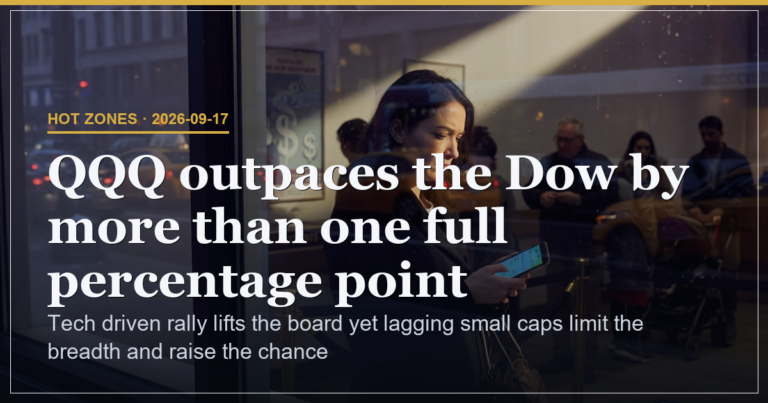
Technology absorbed the truce rally on Wednesday. XLK gained in both session price and percentile position, now sitting at the 99th percentile of its 22-day range ($145.61–$170.03) with a five-day change of +4.83% and a ten-day gain of +5.68%. That is extended. The question for Thursday is not whether technology is the right sector — it clearly is within the current AI infrastructure cycle — but whether you chase it at the 99th percentile or wait for the 92nd–95th range to re-emerge as a pullback entry.
NDX is at 28,563 after a -0.12% overnight session. The high on Wednesday was 28,825 — the pullback is modest. Any dip in NDX toward 28,300–28,400 would represent a natural retest of the breakout and a better entry for technology longs. Chasing XLK at 99th percentile with a 55% risk score environment is not disciplined. Wait or reduce size significantly.
The Defence Rotation: Gulf Escalation Triggers Budget Repricing
Geopolitical risk creates a secondary rotation that does not require you to hold a view on crude direction. When a military exchange occurs in a major oil transit region, defence procurement timelines are repriced within days at the government level. Markets move faster than procurement. Aerospace and defence names within XLI begin attracting capital before the budget headlines land.
XLI sits at the 94th percentile of its 22-day range ($169.94–$176.87) — elevated but not extended in the way XLK is. The five-day change is +0.6% and the ten-day change is +0.86%. That modest trailing performance against a high percentile position tells you that XLI has been gradually accumulating rather than spiking. Gradual accumulation at elevated percentiles in a geopolitical risk environment is a better entry profile than a sharp spike into a new high.
The defence rotation thesis holds as long as Gulf tensions persist beyond a single headline. A truce that collapsed once is less likely to hold on the second attempt — markets are aware of this. Any pullback in XLI to the 91st–92nd percentile, approximately $173.50–$174.20, provides the risk-controlled entry that the current environment demands.
| Sector ETF | 22d Percentile | 5d Change | 10d Change | Gulf Risk Reading | Bias |
|---|---|---|---|---|---|
| XLK | 99th | +4.83% | +5.68% | Neutral to Gulf risk | Wait for dip — extended |
| XLI | 94th | +0.60% | +0.86% | Defence tailwind emerging | Accumulate on dips |
| XLE | 84th | -4.93% | -1.44% | Gulf bounce unstructured | Wait for base |
| XLF | 39th | -0.71% | -0.50% | Yield sticky = rate ceiling | Avoid — caught between scenarios |
| XLP | 87th | -0.23% | +1.99% | Defensive bid muted | Dead money in risk-on week |
| XLU | 77th | -3.07% | -2.32% | Energy cost headwind | Avoid — trending lower |
| XLRE | 99th | +0.18% | +2.09% | Yield sticky headwind | Extended — do not chase |
Gold Miners: The Leveraged Expression of the Gold Bid
Gold at $4,730 with a structural bid creates a secondary opportunity in gold mining equities that many participants overlook because they are focused on the commodity directly. The economics are straightforward: miners have relatively fixed costs and their profit margins expand non-linearly as the gold price rises above their cost curves. When gold adds $30 in a single session from a base of $4,699, a miner whose all-in sustaining cost is $1,200 per ounce sees margin expansion that dwarfs the percentage move in the commodity itself.
Wheaton Precious Metals (WPM) reported after the Wednesday close. With gold at a structural high and their streaming model insulating them from direct cost exposure, any earnings beat represents a hot zone for fresh interest. The silver leverage thesis — silver +1.49% to $80.89 on Wednesday — adds a further dimension since WPM’s streaming portfolio includes significant silver exposure. One earnings catalyst that validates the precious metals bid in a geopolitical risk session is the kind of confluence that concentrates flow.
The broader gold miner theme requires discipline on the same basis as any sector play: entry on structure, not on emotion. Chasing a miner that has already gapped up 8% on Wednesday’s gold move is not a setup — it is a continuation bet without a defined stop. The better approach is to identify miners that have not yet fully reflected the gold move and wait for the alignment of commodity price, sector flow, and technical entry.
Energy: Why the Bounce Does Not Create a Trade
Wednesday’s hot zones were explicit: XLE was a structural unwind at -4.12%, not a dip-buy. The Gulf news overnight has created a narrative reason to re-examine that call — crude bounced from $94.86 to $98.64 intraday before settling at $95.12. That is a $3.78 swing on headlines alone.
Here is the problem with the energy trade right now. The market spent several sessions pricing in the truce — lower crude, lower energy equities, rotation out of XLE. That unwind was orderly because it was structural. The reversal on Gulf news is disorderly because it is reactive. You cannot trade a reversal in a structurally unwinding sector on the basis of a geopolitical headline that could resolve, escalate, or stall within 48 hours. The institutional flows in XLE do not show the accumulation pattern you saw in semiconductors on Wednesday. XLE at the 84th percentile of its 22-day range with a -4.93% five-day performance is a sector still looking for direction, not one that has found its footing.
If you want energy exposure in a Gulf escalation scenario, the cleaner expression is through defence and aerospace (the second-order beneficiary of geopolitical risk budgets) rather than through direct crude or XLE exposure, where your risk is a de-escalation headline that could cut 6% in a session.
Small Cap Divergence: IWM as a Breadth Warning
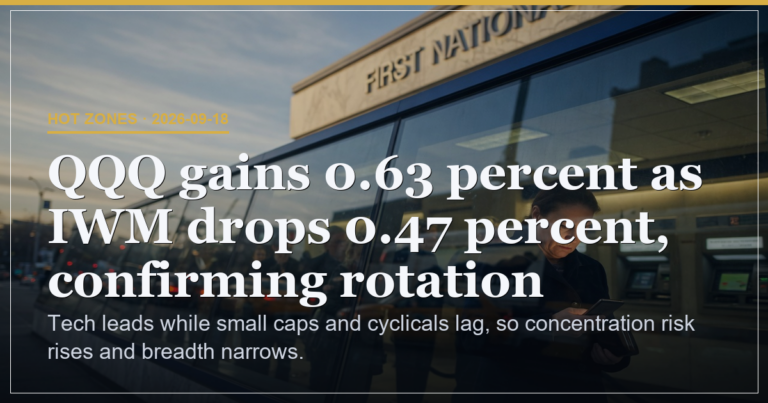
IWM’s -1.63% session on Wednesday (-1.58% as flagged in positioning data) is the most important breadth signal of the week so far. When the Russell 2000 underperforms SPX by more than one percentage point on a session that takes SPX to an all-time high, it means the advance is being driven by a narrow group of large-cap names and the broader market is not participating.
Wednesday’s hot zones identified that the semiconductor cluster absorbed over $11 billion in Dark Pool Flow?”>dark pool flow. That concentration confirms the narrow advance thesis. Institutional capital is not distributing broadly across the market — it is concentrating into specific AI infrastructure names and index-level hedges. For small-cap longs, this is an unfavourable environment. IWM at 2,839 needs to reclaim 2,886 (Wednesday’s open) before small-cap exposure becomes viable again.
Dark pool note: The institutional flow picture from Wednesday concentrated into SPY, semiconductors, and mega-cap tech. There is no equivalent dark pool accumulation visible in XLE, XLU, or IWM-correlated small caps. When dark pool activity concentrates into specific names while broader instruments show institutional hedge books (P/C OI ratio 2.71 on SPY today expiry, P/C 2.38 total), the message is clear: large money is buying quality and hedging the index simultaneously. That is not a rotation into defensives, energy, or small caps.
The Financials Dilemma: XLF at the 39th Percentile
XLF is at the 39th percentile of its 22-day range — sitting in the middle of recent trading conditions with a -0.71% five-day performance. Banks need two things to perform: a steepening yield curve (higher long rates relative to short rates) and credit conditions that support lending growth. Neither is clearly present today.
The 10-year yield at approximately 4.35% is sticky but not rising. The Gulf risk narrative could push yields higher via an inflation premium if crude sustains above $100 Brent — but the same scenario tightens credit conditions by increasing uncertainty. Financials are caught between a scenario where oil inflation pushes yields higher (rate expansion positive for net interest margins) and a scenario where Gulf disruption creates credit uncertainty (negative for loan book quality). The 39th percentile positioning is correct — the market has not made up its mind, and neither should you. XLF is an avoid until NFP resolves the rate path ambiguity.
Variance Summary: What the Numbers Are Saying
Three sector ETFs are in the top 94th percentile or above: XLK (99th), XLI (94th), and XLRE (99th). Two of these — XLK and XLRE — are either extended (XLK) or in a rate-sensitive sector heading into an NFP with sticky yields (XLRE). XLI’s 94th percentile alongside modest trailing performance is the healthier setup of the three. XLE at the 84th percentile with a -4.93% five-day trend is a declining sector bouncing on noise, not rebuilding on structure. XLF at the 39th percentile with -0.71% five-day is caught in neutral.
The VIX contango spread of 3.27 points sits at the 62nd percentile of its 22-day range — a ten-day change of +1.89 points. Forward fear is building relative to spot calm. The SPX IV rank is 23.2% (cheap on historical basis) while NDX IV rank is 56.5%. That divergence in implied volatility between the broader index and technology-heavy index reflects specific Nasdaq uncertainty in the options market. It is a warning for concentrated technology exposure, not a reason to exit — but it does favour a diversified approach.
Hot zones for Thursday, in order of conviction: Gold and precious metals momentum (highest), defence and aerospace within XLI on pullbacks (high), technology continuation on NDX dips to 28,300–28,400 (medium — valuation constraint), GBP/USD continuation (medium — construction miss overlay). Cold zones: energy, utilities, financials, small caps. That ranking has not materially changed from Wednesday except that Gulf risk has elevated the case for defence and precious metals while doing nothing to rehabilitate the energy trade.
This analysis is for informational purposes only and does not constitute financial advice. All trading carries risk. Past performance is not indicative of future results.
Deepen Your Understanding
Related articles from the Titan Protect Foundry: