Trader Mindset Series
What Is a Stop Loss?
Understanding the only tool that keeps you in the game long enough to be right.
The Cost of Being Wrong
Every trade you place is a bet on incomplete information. You do not know where price goes next. Nobody does. What separates traders who last from those who blow up is not their win rate or their ability to predict direction. It is their relationship with being wrong.
A stop loss is simply a pre-defined exit point. If price reaches that level, the trade is closed and the loss is taken. That is it. It sounds mechanical, but the psychology underneath it is anything but simple. The stop is not where you hope the trade will not go. It is where you acknowledge the trade is finished.
Think about it this way. Every time you sit down at the market, you are buying an option on a directional move. The stop is the premium you are willing to pay. Professional traders do not agonise over losing that premium. They size it correctly in advance, accept it as the cost of doing business, and move to the next trade.
Why Every Trade Needs One
Markets can and do move against positions for longer than feels rational. The 2020 March sell-off saw the S&P 500 drop over 35% in 33 days. The August 2015 flash crash took out over 1,000 points in the Dow in minutes at the open. In both cases, traders holding without defined stops faced decisions they were not prepared to make under pressure.
Without a stop loss, you are not managing risk. You are hoping. Hope is not a strategy.
There is also a capital preservation argument. If you lose 50% of your account, you need a 100% return just to get back to flat. Keeping losses small is not just about any individual trade. It is about protecting your ability to take the next fifty trades.
Types of Stop Loss
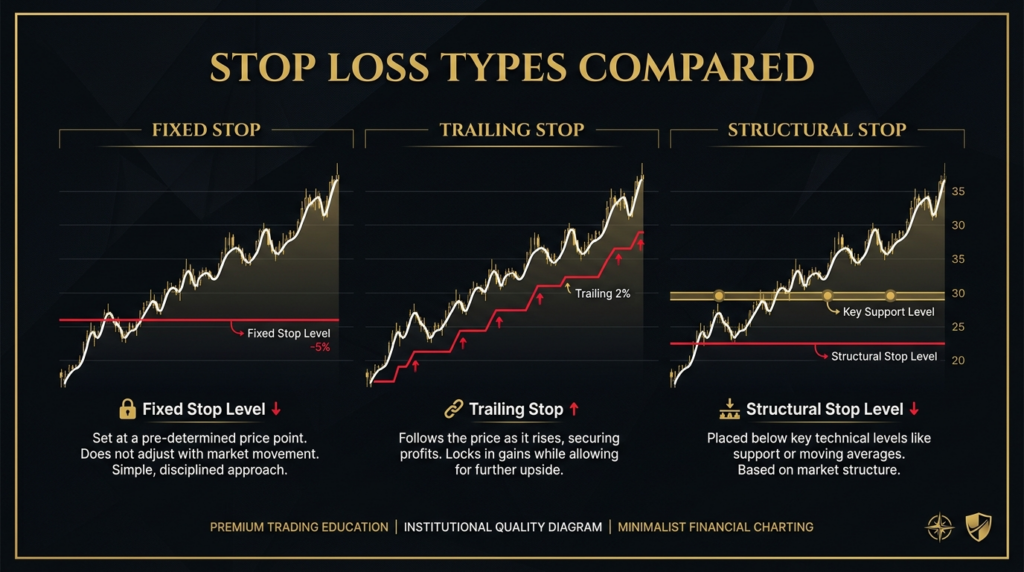
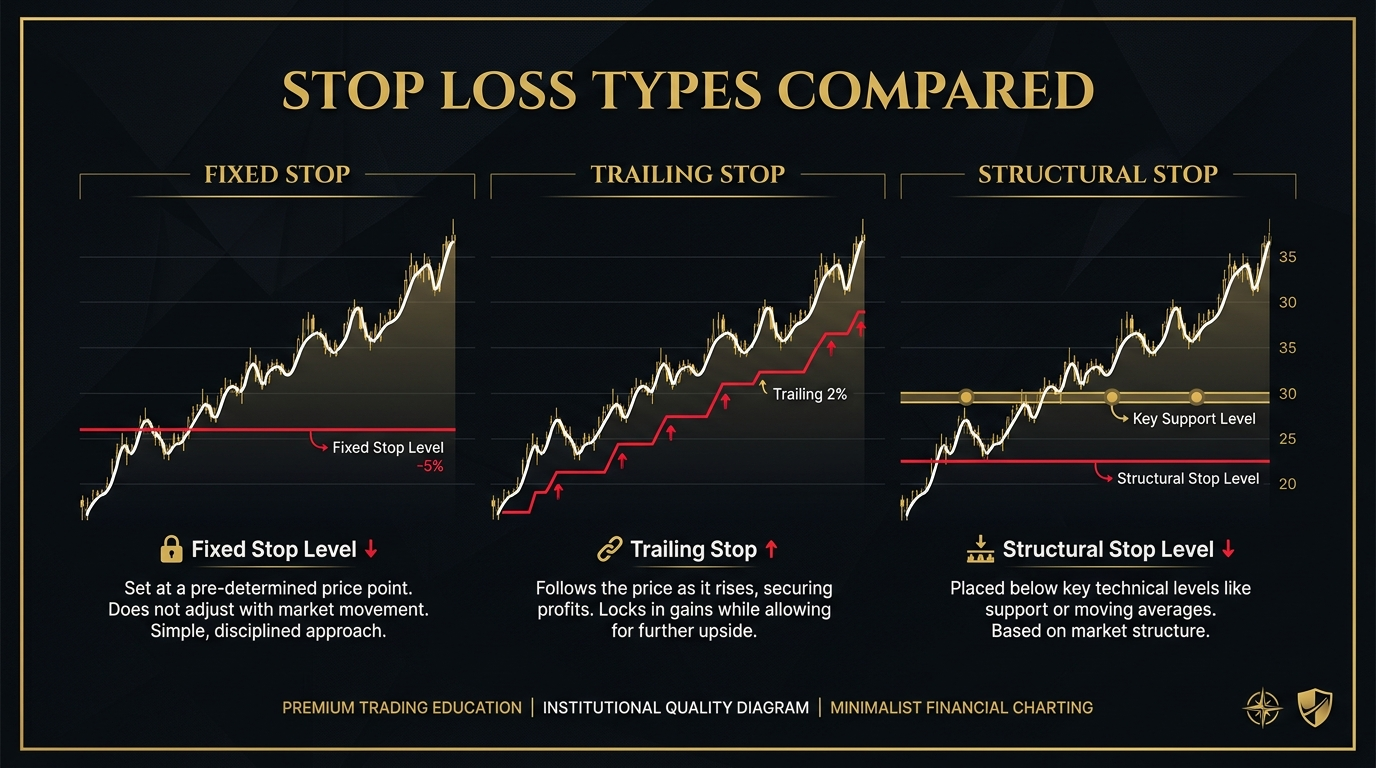
Not all stops are created equal. The three main types serve different purposes, and choosing the wrong one can hurt you even when your direction is correct.
| Stop Type | How It Works | Best Used For | Main Risk |
|---|---|---|---|
| Fixed / Hard Stop | Set at a specific price before entry. Does not move. | Scalps, intraday setups with clear invalidation levels | Can be too mechanical around key levels where price spikes |
| Structural Stop | Placed below/above a meaningful price structure (swing low, support zone, prior day high). | Swing trades, position trades where context matters | Wider than fixed stops, so requires appropriate sizing |
| Trailing Stop | Moves in the direction of the trade as price extends. Locks in profit as the move progresses. | Trend trades, capturing extended moves without exiting prematurely | Normal pullbacks can trigger the stop before the trend resumes |
The Most Common Stop Loss Mistakes
Stops that are too tight are the number one account killer for newer traders. A stop placed just below the entry on a 5-minute chart will be taken out by normal market noise before the setup even has a chance to play out. If every setup you take gets stopped at a small loss before moving in your direction, the stop is the problem, not the setup.
Stops that are too wide destroy your risk profile. A 200-pip stop on a currency pair trade means you are either taking minimal position size, or you are risking far too much capital on a single idea. Neither is a good situation.
Moving stops against the trade is how small losses become account-ending losses. If price is approaching your stop and you move it further away because you still believe in the trade, you have abandoned your risk framework. That is the moment the trade has control of you, rather than the other way around.
Using arbitrary percentages instead of structure. Setting a stop at “1% below entry” regardless of what the chart says is not a strategy. A 1% move might be nothing, or it might be beyond the most meaningful structural level nearby. Your stop should reflect where the trade idea is invalidated, not a percentage you feel comfortable with.
How to Set a Stop Based on Structure
This is the right way to think about stops. Before you even think about entry, ask: “Where is the trade wrong?” If you are buying a breakout of a prior day high on the FTSE 100, the trade is wrong if price falls back below that level and holds. Put the stop there, with a small buffer for noise.
If you are fading a spike into resistance on the Nasdaq, the trade is wrong if price pushes through that resistance and holds above it. Your stop sits just above that level.
The structural stop approach forces you to think about the trade’s logic before you place it. That discipline alone separates it from the arbitrary approach.
Once you know where the stop is, work out the position size from that. The stop defines the risk. The position size is the variable you adjust to keep that risk within your account rules. Never reverse this process.
The Mental Framework
Professional traders do not fight their stops. They place them, and then the stop has their full permission to be hit. The moment you set a stop and start hoping price does not reach it, you are already in trouble. The mental shift is accepting that the stop amount is spent before you enter the trade. It is the price of participation.
When the stop hits, the correct response is to close the trade, record the loss in your journal, and evaluate whether you followed your process. The outcome of a single trade tells you almost nothing. Your process over fifty trades tells you everything.
Action Items
- On your next three trades, identify the structural level that invalidates the setup before you touch the entry button.
- Calculate your position size from the stop distance, not the other way around.
- Review your last ten losing trades. Were any stopped out by normal noise before the trade worked? Adjust stop placement, not the stop concept.
- Write in your journal: “This stop is the cost of this trade.” Say it before every entry until it becomes automatic.
Continue Learning
Next in Series
Understanding Risk-to-Reward →
Trader Mindset Series
How to Build a Trading Routine →
