Sector Flow | Wednesday 6 May 2026
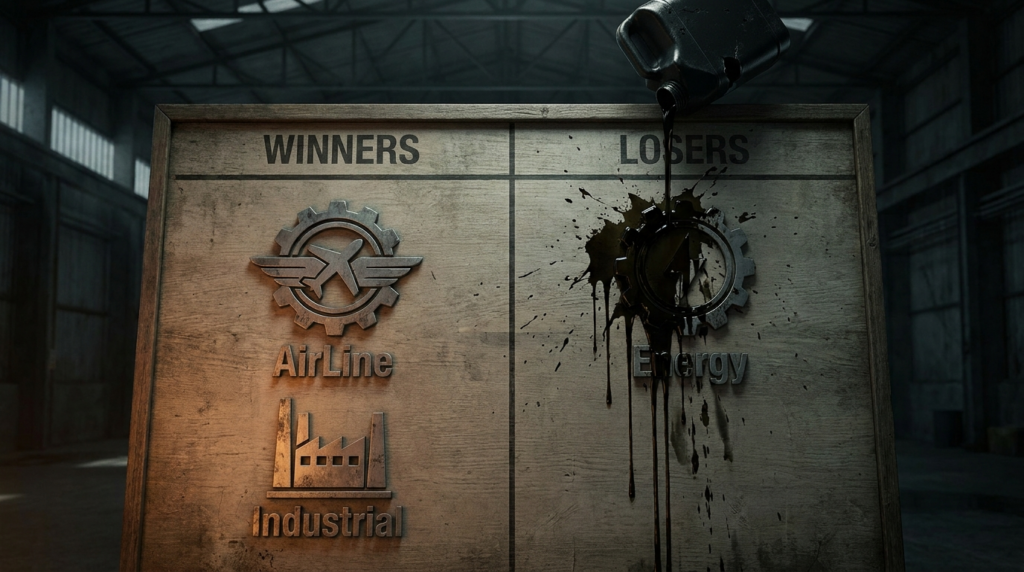
Crude collapsed from $102 to $89 overnight. That is not a dip. That is a macro map redraw. Every sector just got a new input. Here is who benefits, who gets punished, and what AMD’s after-hours print means for the growth side of this rotation.
The Starting Point
Tuesday’s squeeze confirmed the regime. VIX broke below 17.5 and held at 16.45. Fear and Greed printed 67.3 (Greed territory). AM positioning showed institutional conviction on the long side. The squeeze was not a fluke; it was a positioning flush followed by a directional commitment.
Then Hormuz de-escalation news arrived and crude shed $12.63 in a single session. That one move changes the cost structure for every sector that uses energy as an input, every consumer facing higher fuel bills, and every fund that was overweight energy as an inflation hedge.
11-Sector Snapshot
Direction and conviction reflect the Hormuz repricing combined with Tuesday’s sentiment and volatility readings.
| Sector | Direction | Conviction | Key Driver |
|---|---|---|---|
| Technology / Semis | BULLISH | High | AMD +15% AH, record options sweeps, NDX +1.31% |
| Materials | BULLISH | High | Gold +3.86%, silver +6.99%, copper +4.44% |
| Industrials / Transports | BULLISH | Medium-High | Fuel cost collapse, airlines direct beneficiary |
| Consumer Discretionary | BULLISH | Medium-High | Lower pump prices, real spending power, Russell +1.75% |
| Financials | NEUTRAL | Medium | FOMC Minutes is the binary; rate path unclear |
| Healthcare | NEUTRAL | Low-Medium | Defensive, no oil linkage; rotation away from safety |
| Consumer Staples | NEUTRAL | Low-Medium | Input cost relief, but no VIX bid to drive defensives |
| Real Estate | NEUTRAL | Low | Rate path ambiguity; REITs stalled |
| Utilities | BEARISH | Medium | VIX 16.45, no safety rotation; capital leaving defensives |
| Communication Services | BULLISH | Medium | Tech growth spillover, ad spend linked to consumer confidence |
| Energy | BEARISH | High | Crude -12.35%, Brent -10.53%, XLE under direct pressure |
The Rotation Thesis
From Energy to Growth
When crude was at $102, energy was a de facto inflation hedge. Funds with inflation mandates overweighted XLE, drillers, and pipelines. That trade just broke. Crude at $89 means the inflation premium is unwinding, and that capital needs somewhere new to go. The path of least resistance is growth: technology, semis, consumer names that benefit from lower input costs.
NDX led on Tuesday at +1.31%, outpacing the SPX at +0.81%. That differential matters. When Nasdaq outperforms broad market during a regime confirmation squeeze, the message from the market is consistent: money is moving toward earnings growth, not commodity inflation plays.
From Defensives to Cyclicals
VIX at 16.45 with VIX9D at 14.64 tells you that near-term fear has been repriced out. The contango structure is healthy. In that environment, defensives become a drag. Utilities and staples were bought when VIX was above 25; at 16 the cost of holding safety becomes real. The rotation out is not panic selling, it is portfolio optimisation.
Russell 2000 at +1.75% is the loudest voice in this argument. Small caps do not lead unless economic optimism is genuine. They are rate-sensitive and growth-sensitive in equal measure. The fact that Russell outpaced the Dow (+0.73%) on Tuesday tells you this is not purely a large-cap defensive squeeze. There is a broadening underway.
What AMD’s +15% After-Hours Means for Semis
Semis were already the hottest sector going into Tuesday’s close. AMD’s after-hours move to +15% is a confirmation, not a surprise. The options market was already pricing in a significant move; record sweep activity in SMH and AMD calls preceded the print.
The key question for Wednesday is what happens to the gap. AMD is expected to open well above Tuesday’s close. The tactical read from the framework is gap-pullback long at 396 to 400. That is the zone where fast-money gap buyers get shaken, and where the real conviction enters.
For broader semis, an AMD beat does three things. First, it confirms AI-related data centre demand is intact. Second, it validates the semiconductor supply chain recovery narrative. Third, it gives fund managers with underweight semi positions a reason to add before quarter-end rebalancing forces their hand.
Crucially, semis are a growth sector, not an energy sector. In a world where crude just collapsed and the growth-versus-inflation trade is shifting, semis sit on exactly the right side of that rotation.
Energy: Assessing the Damage
WTI at $89.64. Brent at $98.30. Both down over 10% in a single session. To put that in context, the prior close was $102.27 on WTI. In one night, the Hormuz premium that built up over weeks evaporated.
XLE is the immediate casualty. The ETF tracks integrated oil majors and equipment companies, all of which priced in $100+ crude as a base case. At $89, earnings estimates for Q2 need downward revision. The market will not wait for analysts to catch up; the repricing happens at the open.
Drillers and offshore services get hit hardest. Their project economics depend on sustained prices above $85 to $90. At $89 that margin is thin. Any further downside in crude puts exploration investment plans at risk, and the market knows it.
Tactical note on the energy bounce
Crude at $89 is approaching a natural level where short-covering could trigger a technical bounce to $91 to $92.50. That bounce is a sell opportunity, not a re-entry. The macro setup is clear: Hormuz de-escalation removes the supply premium, and lower demand growth from a still-slowing global economy means the structural bid for oil has weakened. Bounce-sell, do not chase the long.
Who Benefits from $89 Crude
Airlines
Jet fuel is roughly 25-30% of an airline’s operating cost. A $13 collapse in crude is a significant margin event. The travel demand backdrop is solid. Airline stocks often lag the crude move by one session; Wednesday is the catch-up window.
Road Freight / Logistics
Diesel is the variable cost that kills trucking margins. Lower crude flows through to diesel within days. Any freight-heavy industrial or logistics name sees immediate cost relief and, more importantly, an earnings revision catalyst.
Consumer Discretionary
Lower fuel costs act as a tax cut for consumers. It is not immediate but the expectations channel matters: when petrol prices drop, consumer confidence indices tend to follow within 2-3 weeks. Russell +1.75% is already pricing some of this in.
Chemicals / Petrochemicals
Feedstock costs collapse with crude. Speciality chemicals, plastics, fertilisers: all see input cost relief. The earnings impact takes a quarter to show up, but the narrative shift happens immediately.
Materials: The Gold Story Is Not the Same as the Oil Story
Gold at $4,731.50, up 3.86%. Silver up 6.99%. Copper up 4.44%. These moves happened on the same day that crude collapsed. That tells you something important: this is not a simple commodity bull run. Gold and oil are diverging, and they are diverging for different reasons.
Oil fell because geopolitical risk premium was removed. Gold rose because a weaker dollar (DXY hovering near 97.0 support) provides a persistent tailwind, and because institutional demand for the metals complex is genuinely accelerating. Record GLDM prints confirm this is not retail speculation.
Copper is the most interesting divergence. It is up 4.44% but has no Hormuz story. The framework flags this as either a dollar-weakness effect or a genuine industrial demand signal. At this stage it is probably both, and either way it is constructive for materials-heavy industrials.
The materials trade into Wednesday: gold pullback to 4,690 to 4,710 is the framework entry zone. Silver has outrun gold on a percentage basis; the mean-reversion risk on silver is higher. Copper is worth watching through the lens of the FOMC Minutes, since any hawkish surprise would hit the dollar and extend the metals bid.
The FOMC Gate Across All Sectors
Everything above is conditional on one thing: FOMC Minutes do not break the narrative. The minutes were drafted when oil was above $100. The committee’s language around inflation was shaped by that environment. If traders read the text and interpret it as hawkish, the rate path expectations shift and financials, rate-sensitive tech, and small caps all get hit.
The constructive read is that $89 crude removes the inflation concern entirely and the market treats the FOMC text as stale. That is the higher-probability scenario given the VIX structure and current sentiment positioning, but it is not guaranteed.
Sizing accordingly: the framework approach is 50% pre-FOMC on levels that have been tested, scaling to full size after the minutes confirm. Full allocation before the minutes is a position risk management failure, not a bold trade.
Where the Flow Is Going
In: Semis (AMD-led, record institutional sweeps), materials (gold/silver/copper all confirming), industrials and consumer names that benefit from sub-$90 crude, communication services riding the growth tape.
Out: Energy (XLE direct hit, drillers more vulnerable), utilities and defensives (VIX 16.45 means the safety bid is gone).
Gated: Financials, real estate, rate-sensitive growth until FOMC Minutes confirm the market’s interpretation of the old inflation language.
This content is for informational and educational purposes only. Nothing here constitutes financial advice or a recommendation to buy or sell any instrument. All trading involves risk. Past analysis does not guarantee future results. Always manage your own risk.
Continue with Titan Protect
Continue with the daily framework.
Daily Pre-Asia, Pre-London, Pre-NY and Post-Close briefs across twenty-plus instruments. Indicator suite, Shield dashboard, Foundry library and live community. Today’s case study shows the read on the tape.
Core
£59/mo
Indicator suite plus daily framework reads.
Edge Popular
£109/mo
Core plus Shield dashboard and member-only briefs.
Elite
£179/mo
Edge plus weekly 1:1 call and early access to new tools.
Save 15% on annual billing
Want to see the framework in action? Free Explorer tier — no card required.
Join the live community: Discord channel · Shield dashboard
Education, not financial advice. Trade your own analysis.
Deepen Your Understanding
Related articles from the Titan Protect Foundry: