Institutional Flow: Weekend Edition
Macro Structure | Published for the week ahead | Friday 17 April 2026
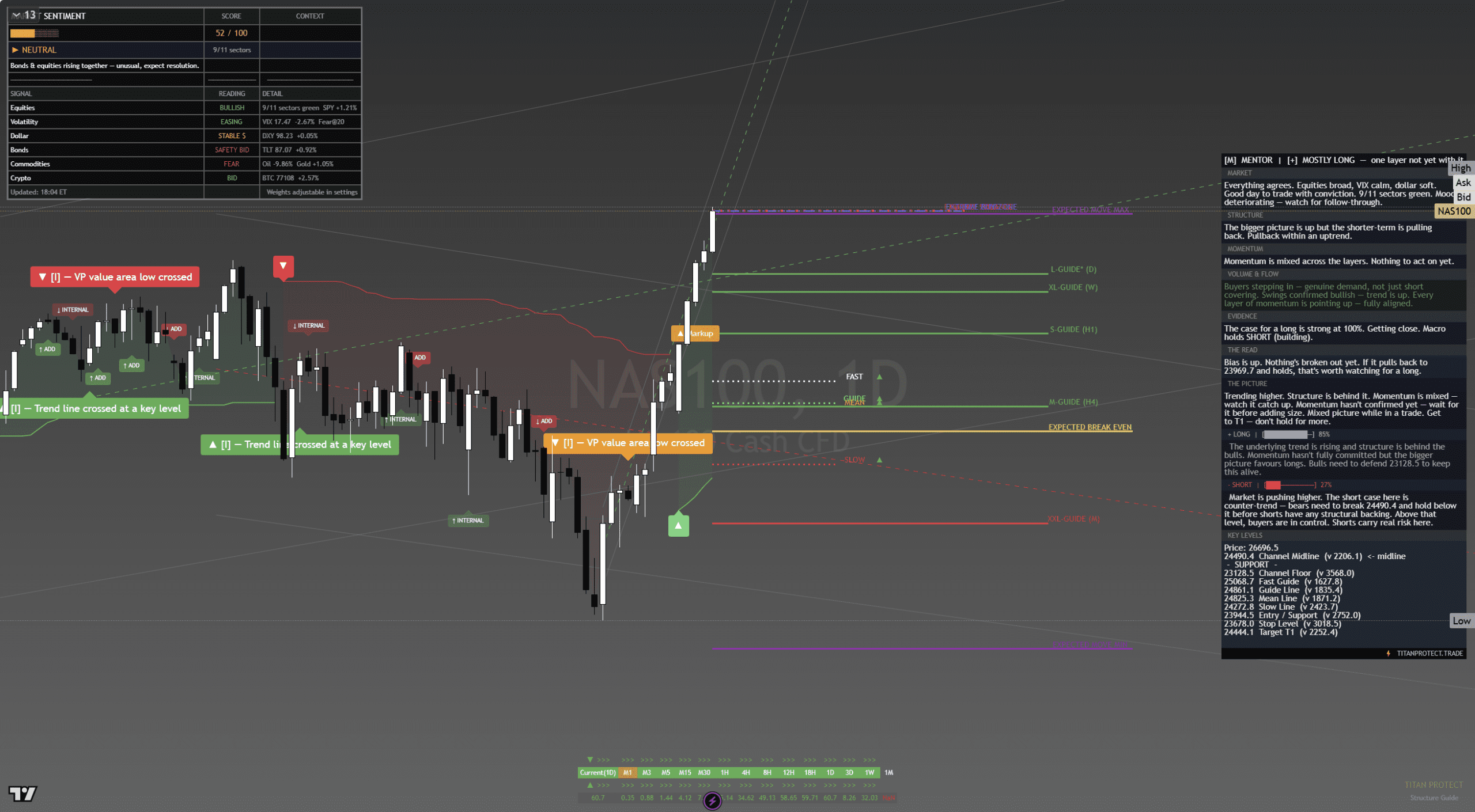
Institutional activity printed $27.6 billion across the top ten names on Friday. That number means nothing on its own. What matters is how it was printed — the size per order, the count per name, and the classification of each flow type.
When you break those elements apart, you see a market where institutions are accumulating equities with algorithmic precision, building credit positions through block execution, and concentrating capital in a handful of names that are already leading. As you’ll find in our Positioning Pressure brief, the positioning table was introduced there. This post goes deeper — order classification, per-symbol commentary, credit flow analysis, and what it all means for Monday.
Institutional Flow — Top 10 by Total Value
| # | Instrument | Total Value | Classification | Flow Type | Monday Implication |
|---|---|---|---|---|---|
| 1 | S&P 500 (SPY) | $9.42B | Block execution | Institutional rebalancing | Pension, sovereign wealth, index flows. Structural, not speculative. Expect continuation |
| 2 | NVIDIA (NVDA) | $3.13B | Algorithmic accumulation | Sustained directional | Consistent execution throughout the session. Someone is building a position quietly. Follow-through likely |
| 3 | Apple (AAPL) | $2.72B | Core rebalancing | Index-level activity | Large average size suggests ETF creation/redemption or model portfolio rebalancing. Steady, not urgent |
| 4 | Tesla (TSLA) | $2.13B | High-frequency hedging | Options-linked delta | Highest activity count. Small average size = automated delta hedging from options desks. Volatility play, not direction |
| 5 | Russell 2000 (IWM) | $2.11B | Block execution | Small-cap rotation | Confirms +2.13% Russell leadership. Institutional block sizes = deliberate allocation, not retail momentum |
| 6 | LQD (Inv. Grade) | $1.72B | Block execution | Credit positioning | Institutions building duration exposure. Implies rate stability expectation |
| 7 | HYG (High Yield) | $1.57B | Block execution | High-yield demand | Junk bond buying = credit risk appetite expanding. Combined with LQD, this is full-spectrum credit allocation |
| 8 | Meta Platforms (META) | $1.61B | Targeted accumulation | Deliberate positioning | Fewer orders but larger average. Someone chose Meta specifically, not as part of a basket trade |
| 9 | Amazon (AMZN) | $1.52B | Steady accumulation | Tech rotation | Consistent flow across the session. Building, not trading around events |
| 10 | Microsoft (MSFT) | $1.45B | Broad base building | Portfolio construction | Moderate size, steady cadence. Model portfolio allocation — the kind of flow that persists for weeks |
Global Index Context
| Index | Region | Institutional Flow Read |
|---|---|---|
| FTSE 100 | UK | SPY block execution often spills into FTSE via global allocation desks. Commodity miners benefit from metals accumulation |
| DAX 40 | Germany | European institutional flow tends to follow US institutional patterns with a 1-session lag |
| Euro Stoxx 50 | Eurozone | Credit flow (LQD + HYG) signals confidence that extends to European credit markets |
| CAC 40 | France | Luxury and tech accumulation themes translate to LVMH and SAP-heavy CAC composition |
| Nikkei 225 | Japan | Semiconductor accumulation (NVIDIA, AMD) has direct read-across to Japanese chip equipment names |
| Hang Seng | Hong Kong | Tech accumulation theme benefits Hang Seng Tech index. Institutional risk appetite is supportive |
| ASX 200 | Australia | IWM block execution signals broader risk appetite that typically flows through to ASX financials and miners |
| Nifty 50 | India | Global institutional risk-on positioning tends to increase EM allocation. Credit confidence supports |
| China A50 | China | Full-spectrum credit buying and tech accumulation create a supportive global backdrop for mainland equities |
Order Classification System
Not all institutional flow is equal. The classification above is derived from three variables: average order size, activity count relative to session length, and consistency of timing. Here is how to read each type:
Credit Flow Analysis
$3.29B in combined credit flow is significant. When institutions buy both investment-grade and high-yield simultaneously, it signals confidence that the credit cycle is not turning. No one buys junk bonds if they expect defaults to rise. This credit signal confirms that the risk environment is supportive for equities heading into Monday.
Cross-Day Comparison
Thursday’s session showed lower activity across the board. Friday’s numbers increased substantially:
The cross-day comparison tells you that Friday was not a wind-down. It was an intensification. Institutions increased their activity going into the weekend, which historically suggests they expect Monday to continue the trend rather than reverse it. When desks are concerned about a gap down, they reduce Friday activity, not increase it.
What This Means for Monday
Multi-Strategy Breakdown
Risk Assessment
Factors:
- Institutional flow intensification from Thursday to Friday reduces risk — institutions are leaning in, not pulling back
- Block execution at elevated SPY levels provides structural support beneath the market
- Credit flow confirms no near-term stress, which reduces the probability of a sharp equity reversal
- Concentration in tech names creates narrow leadership risk — if one key name stumbles, the flow picture changes
- Tesla hedging activity could unwind in either direction, adding localised volatility risk
- IMF Monday is the external variable that institutional flow cannot predict
Scenario Analysis
| Scenario | Probability | Description | Implication |
|---|---|---|---|
| Accumulation continues | 45% | Monday opens with institutional activity matching or exceeding Friday | Full confirmation. MAX sizing on priority names |
| Block holds, algos pause | 25% | SPY block execution continues but individual name accumulation slows | SPY outperforms individual names. Shift to index-level exposure |
| Distribution emerges | 20% | Flow shifts from accumulation to distribution in tech names | Warning. REDUCE individual name exposure. Hold SPY |
| Credit reversal | 10% | LQD and HYG flow reverses. Credit stress signals appear | Risk-off. Exit equity longs. Raise cash. This is the tail event |
Experience Level Guide
Hedging Recommendations
- Tech concentration risk: A small tech ETF put or QQQ put hedges the narrow leadership concern without reducing upside participation
- Credit insurance: If LQD or HYG flow reverses on Monday, exit equity longs immediately — do not wait for confirmation
- Tesla hedging activity: If short Tesla volatility, Monday could see an unwind that creates a directional move. Size accordingly
- Full book: Volatility calls at 20 strike provide broad portfolio insurance at current cheap contango levels
Market Timing Verdicts
| Timeframe | Verdict | Rationale |
|---|---|---|
| Short term (1–3 days) | Bullish, institution-backed | Institutional flow intensification into the weekend supports Monday continuation |
| Medium term (1–3 weeks) | Bullish with concentration risk | Algorithmic accumulation in tech has multi-week characteristics but narrow breadth is a structural concern |
| Long term (1–3 months) | Selective | Block execution sets floors but does not predict direction. Follow the accumulation names, not the index |
Further Reading
- As you’ll find in our Positioning Pressure brief, the positioning table was introduced there — this post adds classification, cross-day comparison, and per-symbol commentary
- As you’ll find in our Macro Pulse brief, credit flow confirms the macro regime of stable rates and expanding risk appetite
- As you’ll find in our Hot Zones brief, sector heat classifications are the equity translation of the tech-concentrated institutional flow
- As you’ll find in our Global Grid brief, multi-asset alignment provides the macro backdrop for interpreting institutional flow as risk-on confirmation
- As you’ll find in our Option Watch brief, Tesla’s options-driven activity connects directly to the delta-hedging described here
Related Intelligence
As you’ll find in our Positioning Pressure brief, where COT and short volume data provides the broader positioning backdrop.
For the full breakdown, see our Option Watch brief — where options activity reveals the hedging strategies behind these flows.
What We Called vs What Happened
Starting this week, every Institutional Flow brief will include a track record section where we hold ourselves accountable. Our calls from the prior week will be listed alongside the actual market outcome, so you can see exactly how the analysis played out. Expect this section to grow each week with a running accuracy record.
This week’s calls are now on record. Check back in our next edition to see how they resolved.
This is analysis, not financial advice. Always manage your risk.
The $325M in index longs paired with $760M in crude shorts, placed simultaneously at 8:24 AM ET Friday, now demands a different interpretation. The Strait of Hormuz recorded zero oil tanker transits on Saturday — the first complete closure in history — after a US Navy strike on an Iranian vessel and collapsed negotiations. Institutional commentary flagged the timing and size as unusual. Someone positioned ahead of a weekend where the geopolitical landscape changed completely. Monday’s dark pool prints will reveal whether institutions are hedging or doubling down.
Deepen Your Understanding
Related articles from the Titan Protect Foundry: