The Session in One Line
S&P 500 closed at 7,041.28 (+0.26%), the Dow at 48,578.72 (+0.24%), and Nasdaq led at 24,102.70 (+0.36%). Quiet headline numbers. Boring, even. But underneath those gentle green closes, two data points detonated that will reshape positioning for the rest of the week.
The Crude Shock
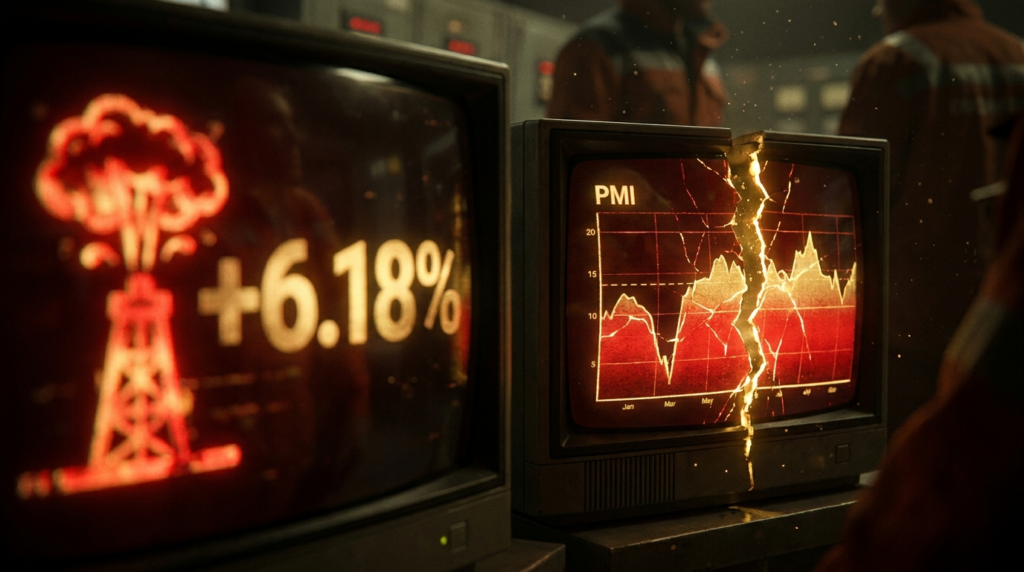
WTI crude surged $5.42 to $93.19, a +6.18% single-session move. That is not a drift. That is a supply shock repricing in real time. A move of this magnitude forces immediate recalculation across every sector with fuel exposure. Cruise lines dropped 5-6% on the session. Airlines, logistics, and anything with a fuel line item just saw their forward margins compress in a single afternoon.
Meanwhile, the energy complex itself becomes a magnet for momentum capital. When crude moves +6% in a session, the options market lights up, positioning shifts, and the second-order effects ripple through bonds, currencies, and inflation expectations for days afterward. The 10-year yield rose to 4.309% (+0.63%) on the session. That is not a coincidence. Bonds are pricing in the inflationary impulse from energy before the economists have updated their models.
The Factory Floor Contradiction
Here is where it gets genuinely unusual. The Philly Fed Manufacturing Index printed 26.7 against a consensus of 17.0. That is a +9.7 beat above expectations, the kind of upside surprise that screams expansion. Regional manufacturing surveys do not overshoot by 57% unless something structural is happening in the order pipeline.
And then, in the same session, Industrial Production came in at -0.5% versus a +0.5% forecast. A full 1.0 percentage point miss to the downside, from positive expectations to outright contraction.
How do you square a manufacturing survey saying “boom” with actual factory output saying “decline”? One measures sentiment and forward orders. The other measures what physically came off the production lines last month. The divergence tells you that manufacturers are bullish on their pipeline but have not yet translated that optimism into output. Supply chain constraints, labour adjustments, or simply a lag between orders and production. Whatever the cause, this gap will not persist. One of these numbers is wrong, and the market will spend the next two weeks deciding which one.
What the Rest of the Board Confirms
ES futures settled at 7,078.25 and NQ at 26,464.25, both above the cash close. That overnight bid tells you the after-hours crowd is not spooked by today’s data split. They are leaning into the growth narrative, at least for now.
The VIX faded to 20.45, down 0.44% from yesterday’s 20.59. Volatility continues to compress, which supports risk-on positioning, but the pace of the decline is slowing. The easy VIX compression is behind us.
Gold pulled back to $4,810.90 (-$12.70, -0.26%) after a multi-day markup phase. Silver dropped harder at -1.15% to $78.46. Copper held better at $6.04 (-0.14%). The metals complex is taking a breath, not reversing. The dollar at DXY 98.17 remains bearish across all timeframes, and that structural weakness continues to underpin hard assets even through a single-session pullback.
The jobs picture remains solid: Initial Claims at 207K beat the 216K forecast, and Continuing Claims at 1,818K undercut the 1,840K expectation. The labour market is not cracking. That matters because it removes the recession catalyst that would justify a more defensive posture.
Conviction Weighting
Two themes deserve your attention above everything else this week. First, crude at $93.19 and what that means for sector rotation. Energy costs just repriced violently, and the second-order effects on airlines, transport, and consumer discretionary have not fully filtered through yet. Second, the Philly Fed vs Industrial Production divergence will be tested by next week’s data: Retail Sales on April 21st, PMI Flash on April 23rd, and Michigan Sentiment on April 24th. Those three prints will arbitrate between the optimistic survey and the pessimistic output number.
Until that data arrives, the market will trade the tension. Position accordingly.
This is analysis, not financial advice. Always manage your risk.
Deepen Your Understanding
Related articles from the Titan Protect Foundry: