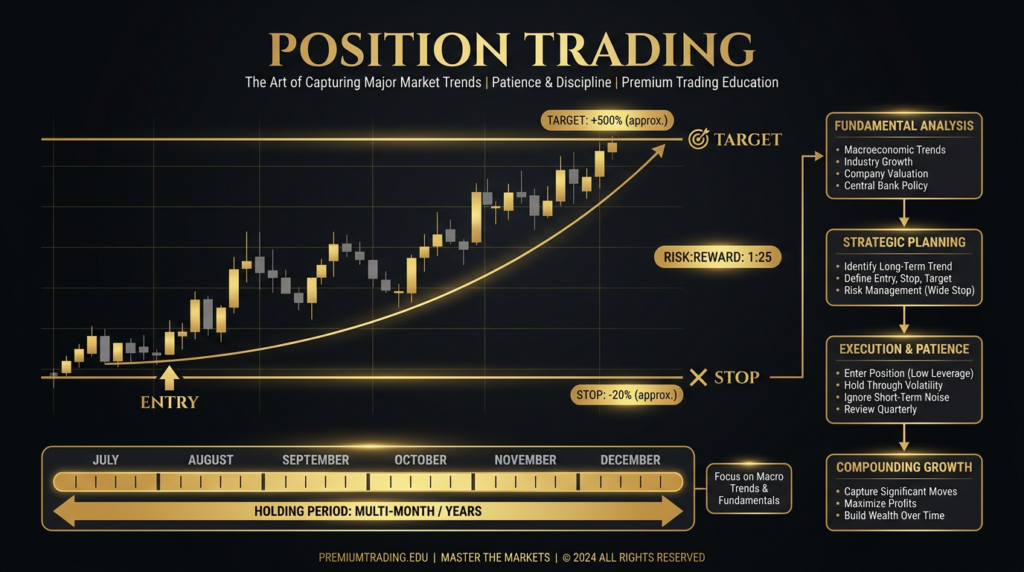
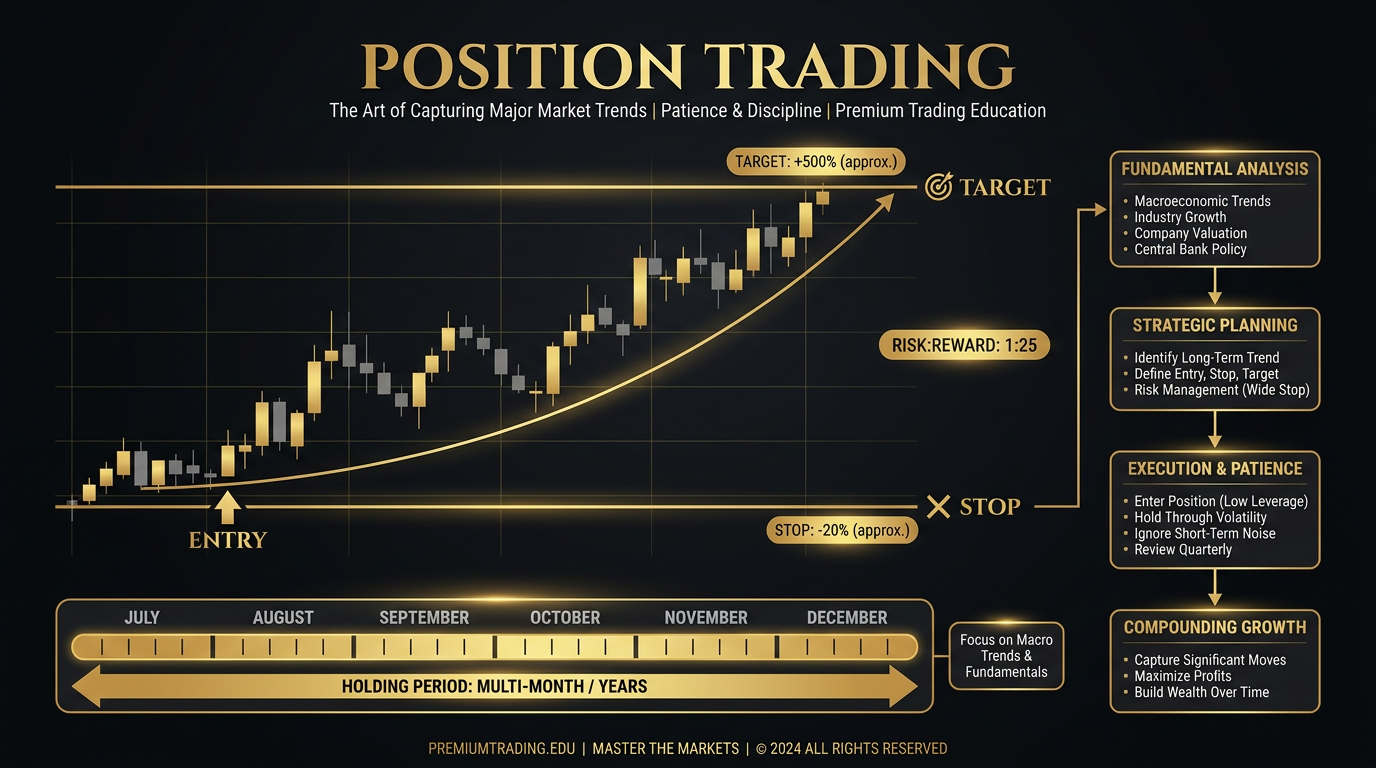
Position Trading: Capturing Major Market Moves
While day traders chase intraday fluctuations and scalpers profit from micro-movements, position traders operate on a different timeline entirely. They hold trades for weeks, months, or even years, capturing the massive trends that smaller timeframe traders miss entirely. This article reveals how position trading works, who it’s for, and how to implement this patient, profitable approach.
What Is Position Trading?
Position trading is the longest-term active trading style. Trades typically last from several weeks to several months, with some extending beyond a year. Unlike investing, which focuses on fundamental value, position trading uses technical analysis to identify and ride major trends. Unlike shorter-term styles, position traders accept that meaningful moves require time to develop.
The philosophy is simple: identify the dominant trend, enter at advantageous prices, and hold until that trend shows signs of exhaustion. Daily price fluctuations become noise. Weekly charts replace one-minute bars. The position trader’s edge comes not from perfect timing but from capturing the majority of major moves while avoiding the churn that consumes shorter-term traders.
Position Trading vs. Other Styles
Scalping: Seconds to minutes, dozens of trades daily, small targets
Day Trading: Hours, no overnight positions, intraday patterns
Swing Trading: Days to weeks, capturing swing highs and lows
Position Trading: Weeks to months, major trend capture
Investing: Years to decades, fundamental value focus
Position trading sits between active trading and investing, combining technical entry precision with long-term holding patience.
Why Position Trading Works
The Trend Persistence Principle
Markets trend on longer timeframes much more reliably than shorter ones. A daily trend might continue for months, while a 5-minute trend rarely lasts an hour. By operating on weekly and monthly charts, position traders align with the strongest, most persistent market forces.
Institutional money. pension funds, mutual funds, central banks. moves slowly. Their buying and selling create trends that persist because they can’t exit positions quickly. Position traders ride these institutional flows rather than fighting them.
The Cost Advantage
Trading costs destroy shorter-term strategies:
Day trader (10 trades/day):
Position trader (2 trades/month):
Lower transaction costs mean position traders keep more of their profits. A strategy profitable for position traders might be unworkable for day traders purely due to cost structure.
The Lifestyle Benefit
Position trading doesn’t require screen watching. Once a position is established with proper stop losses, daily monitoring is optional. This suits traders with full-time jobs, families, or other commitments. A 30-minute weekend analysis session often suffices for the entire week.
Position Trading Timeframes and Tools
Primary Analysis: Weekly and Monthly Charts
Position traders live on higher timeframes where noise diminishes and signal strengthens:
Monthly Charts:
Weekly Charts:
Daily Charts:
Essential Indicators
Position trading favors clean, simple tools:
Trend Identification:
Momentum Assessment:
Entry Timing:
Avoid clutter. Position trading decisions should be visible from across the room on a weekly chart.
Position Trading Strategies
The Trend Continuation Approach
The most reliable position trading strategy: identify an established trend, wait for a pullback, enter when the trend resumes.
Setup Criteria:
Entry: Weekly close above the reversal pattern high
Stop Loss: Below the pullback low (typically 3-5% below entry)
Target: Next major resistance level or trailing stop when 20-week MA breaks
Example:
Stock in 6-month uptrend pulls back to 20-week MA. Forms hammer candle with volume spike. Entry on break above hammer high. Stop below hammer low. Hold until close below 20-week MA or major resistance reached.
The Monthly Breakout Strategy
Major moves often begin when price breaks from multi-month consolidation.
Setup Criteria:
Entry: Monthly close outside consolidation range
Stop Loss: Inside the consolidation range (below breakout level for longs)
Target: Measured move (consolidation height projected from breakout point)
Example:
Forex pair ranging between 1.1000-1.1200 for 4 months. Breaks above 1.1200 on high volume. Entry at 1.1220. Stop at 1.1150. Target 1.1400 (200-pip range + 1.1200 breakout).
The Major Reversal Strategy
Less frequent but highly profitable: catching the turn of major trends.
Setup Criteria:
Entry: Break of key weekly support or neckline
Stop Loss: Above the reversal pattern high
Target: Prior major support/resistance level or measured move
Warning: Reversal trading is lower probability than continuation. Reduce position size and require stronger confirmation.
Risk Management for Position Traders
Wider Stops, Smaller Positions
Position trading requires accepting larger stop distances. A weekly trend might have 8-15% natural volatility. Compensate with smaller position sizes:
Example Calculation:
Compare to day trading where 0.5% stops might allow 20% position sizes. Position traders trade smaller relative sizes but capture larger absolute moves.
The Trailing Stop Approach
Since position trades last months, static stops often exit too early. Use trailing stops that protect profits while allowing trend continuation:
Weekly Close Below 20-Week MA:
ATR-Based Trailing Stop:
Parabolic SAR (Monthly):
Portfolio Heat Management
Position traders hold fewer positions longer, but concentration risk matters:
Position Trading Psychology
Embracing Boredom
Position trading involves long periods of inactivity. After entry, weeks may pass with minimal portfolio change. This boredom causes two errors:
Solution: Accept that doing nothing is a position. The best trades often feel boring. If you need action, trade a small separate account with discretionary funds.
Surviving Drawdowns
Position trades experience significant open drawdowns. A 15% stop distance means 10% temporary losses are normal. This feels catastrophic to traders accustomed to tight day trading stops.
Reframe: You’re not losing money. you’re renting the position. The stop loss is your maximum rent. The potential reward justifies this cost.
Reality check: Look at any major trend on a weekly chart. Notice how many 10-15% corrections occurred during the trend. Capturing the full move required tolerating these pullbacks.
The Patience Premium
Position trading profits come disproportionately from the final 20% of trends. Exiting early captures most of the risk but little of the reward. The patience to hold through normal corrections separates good position traders from great ones.
Rule: Set your stop loss and target at entry. Don’t move stops closer. Let the trade work or stop out. Interference usually reduces profitability.
Building a Position Trading Plan
Market Selection
Not all markets suit position trading:
Ideal:
Avoid:
The Weekly Routine
Position trading requires minimal time but specific timing:
Weekend Analysis (1-2 hours):
Mid-Week Check (15 minutes, optional):
Monthly Review (1 hour):
Position Sizing Rules
Standard position sizing adapted for wider stops:
When Position Trading Goes Wrong
Early Stops
Entering on weekly timeframe but using daily stop distances. This creates constant whipsaws. If you analyze weekly, accept weekly volatility.
Overstaying
Ignoring exit signals because “it’s a position trade.” Position trades become bad trades like any other. Honor your stop losses regardless of timeframe.
Under-Diversification
Concentrating in 2-3 positions “because I’m holding long-term.” Longer holding periods increase the chance of adverse events. Diversify adequately.
Ignoring Correlation
Holding 5 long stock positions during market crash. Position trading doesn’t eliminate systematic risk. Consider hedging or cash positions during major uncertainty.
Is Position Trading Right for You?
Position trading suits traders who:
Position trading challenges traders who:
Conclusion
Position trading offers a path to significant profits without the intensity of shorter-term styles. By aligning with major trends, accepting wider stops, and embracing patience, position traders capture moves that dwarf typical day trading gains.
The approach requires a different mindset. one that values doing less but doing it better. In a world obsessed with speed and constant activity, position trading reminds us that sometimes the fastest path to profit is simply to wait.
If you can handle boredom, tolerate drawdowns, and trust your analysis over days and weeks, position trading might be your optimal path. The major trends are there, waiting for patient traders willing to ride them.