Titan Playbook Series
Titan Playbook 01: Trading Styles
Ten approaches. One market. The style that fits your life determines whether you survive long enough to get good.
Why Style Selection Matters More Than Strategy
Most traders spend months looking for the perfect entry signal. They read every indicator guide, backtest every pattern, watch hours of chart walkthroughs. Then they wonder why nothing works when they try it live. The answer is almost never the strategy. It is the mismatch between how they trade and how they live.
A surgeon who finishes at 19:00 cannot scalp the London open. A parent with two children under five cannot watch a 15-minute chart all morning. A person with a short temper and low drawdown tolerance will blow up a trend-following account before the first trade even closes. The market does not care about your preferences. It will expose every structural mismatch between your style and your circumstances.
This series covers the ten core trading styles in use by serious market participants. Not theoretical frameworks from a textbook. Approaches that institutional desks, proprietary trading firms, and experienced independent traders actually use. Understanding each one gives you a map. The rest of this Playbook series helps you read it.
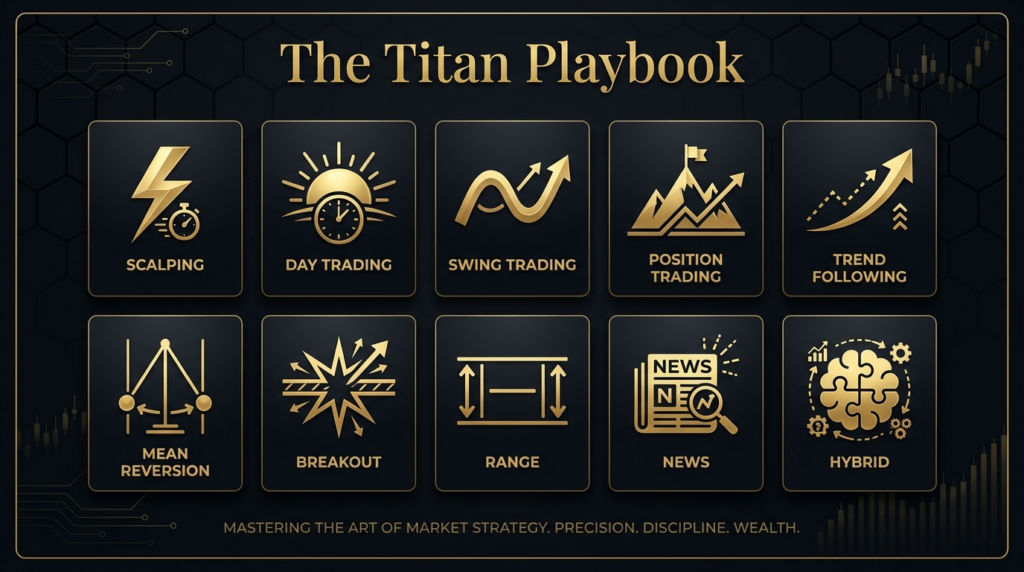
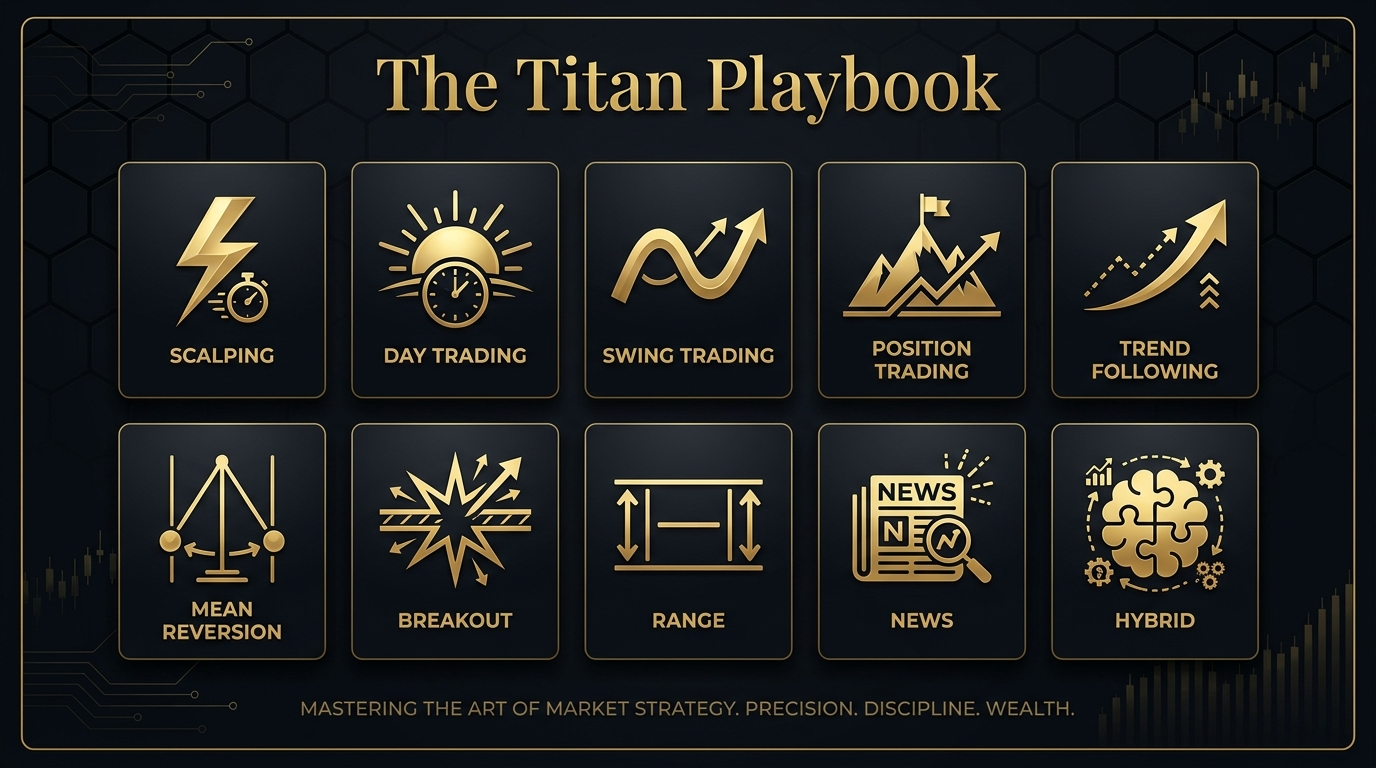
The Ten Styles at a Glance
Every style sits on a spectrum of time, complexity, and psychological demand. Some styles run parallel to a day job. Others require full presence at a screen. Some are suited to volatile, trending conditions. Others work only in specific range-bound environments. Knowing where each style sits helps you eliminate the ones that will never work for your situation before you waste months finding out the hard way.
| Style | Typical Timeframe | Holds | Risk Profile | Best For |
|---|---|---|---|---|
| Scalping | 1m – 5m | Seconds to minutes | Very high frequency, tight risk | Full-time, fast execution setups |
| Day Trading | 5m – 30m | Minutes to hours, flat by close | Moderate to high, no overnight | Session-focused traders, no overnight risk |
| Swing Trading | 1h – 4h | 1 to 10 days | Moderate, overnight exposure | Traders with limited screen time |
| Trend Following | Daily – Weekly | Weeks to months | Low frequency, wide stops | Patient, systematic traders |
| Mean Reversion | 15m – Daily | Hours to days | Moderate, range-dependent | Fade traders, range-bound markets |
| Breakout Trading | 15m – 4h | Hours to days | Moderate to high, momentum-driven | Volatility expansion traders |
| Position Trading | Weekly – Monthly | Months | Low frequency, macro-driven | Investors with long time horizons |
| News Trading | 1m – 5m | Seconds to minutes | Very high, event-driven spikes | Experienced traders only, fast infrastructure |
| Algorithmic Trading | Any | Automated | Depends on system design | Quantitative, systematic operators |
| Arbitrage | Tick – 1m | Milliseconds to seconds | Very low per trade, capital-intensive | Institutional desks, not retail |
One Size Does Not Fit All
The table above shows immediately why there is no universal answer to the question of which style is best. A scalper and a position trader are playing entirely different games. Their instruments of choice differ. Their risk-per-trade sizing differs. The psychological demands are worlds apart. What they share is the need for a defined edge, the discipline to execute it consistently, and the risk management framework to protect capital when that edge does not fire.
Retail trading education has a habit of selling styles as universally accessible. The reality is that scalping requires institutional-grade execution infrastructure, tight spreads, and the mental bandwidth to make hundreds of micro-decisions each day without fatigue degrading quality. Trend following requires the psychological ability to sit through 20%, 30%, even 40% drawdowns on individual positions without abandoning the system. Most people cannot do either of those things without years of conditioning.
The styles covered in the first six Playbook articles represent the most practical approaches for independent traders with finite capital and real-world constraints. They are not ranked by prestige or complexity. They are ordered by the time demands they place on your day, starting with scalping at the most intensive end and moving toward approaches that work alongside a full schedule.
How to Use This Series
Each article in the Titan Playbook series covers one style in depth. The mechanics, the instruments it suits, the session timing that gives the best conditions, the psychological profile required, and the common failure points that end accounts.
Read each one in order. Even if you already know which style fits you best, understanding why other approaches fail in specific conditions will sharpen your own judgment. The scalper who understands trend following does not try to scalp into major structural moves. The swing trader who understands mean reversion does not overstay welcome in extended ranges.
Markets cycle. Conditions that favour one style suppress another. A trader who understands the full landscape can at minimum recognise when conditions are not suited to their primary approach, even if they do not trade every style. That awareness alone is worth more than most people realise.
Choosing Your Primary Style
Before you read further, answer three questions honestly.
First: how many hours per day can you genuinely commit to watching the market? Not “I can probably find time.” Genuinely, reliably, without sacrificing sleep or creating pressure in other areas of your life. If the answer is less than two hours, scalping and active day trading are not your primary style.
Second: what is your emotional response to a trade going against you by 10%? If the answer involves anxiety, an urge to move the stop, or difficulty focusing on anything else, trend following and position trading will cause serious psychological distress before they have time to work.
Third: what is your starting capital? Strategies with very tight stops and small targets need enough capital to size trades properly without a single loss representing a significant percentage of the account. Insufficient capital forces position sizing that makes normal drawdowns feel catastrophic.
Your answers to these three questions eliminate most of the ten styles immediately. That is not a limitation. It is a framework. Work within it before you try to expand beyond it.
Action Items
- Audit your available daily screen time honestly. Assign a realistic number of hours.
- Review the comparison table and eliminate any style that does not fit your time availability.
- Of the styles remaining, identify which risk profile matches your current capital and emotional tolerance.
- Read Playbook articles 02 through 06 in order, paying attention to the failure modes sections.
- Commit to one primary style for a minimum of three months before evaluating whether it suits you.
Continue Learning
- Titan Playbook 02: Scalping
- Titan Playbook 03: Day Trading
- Titan Playbook 04: Swing Trading
- Titan Playbook 05: Trend Following
- Titan Playbook 06: Mean Reversion
- What Is a Stop Loss?
- Risk/Reward Ratio Explained