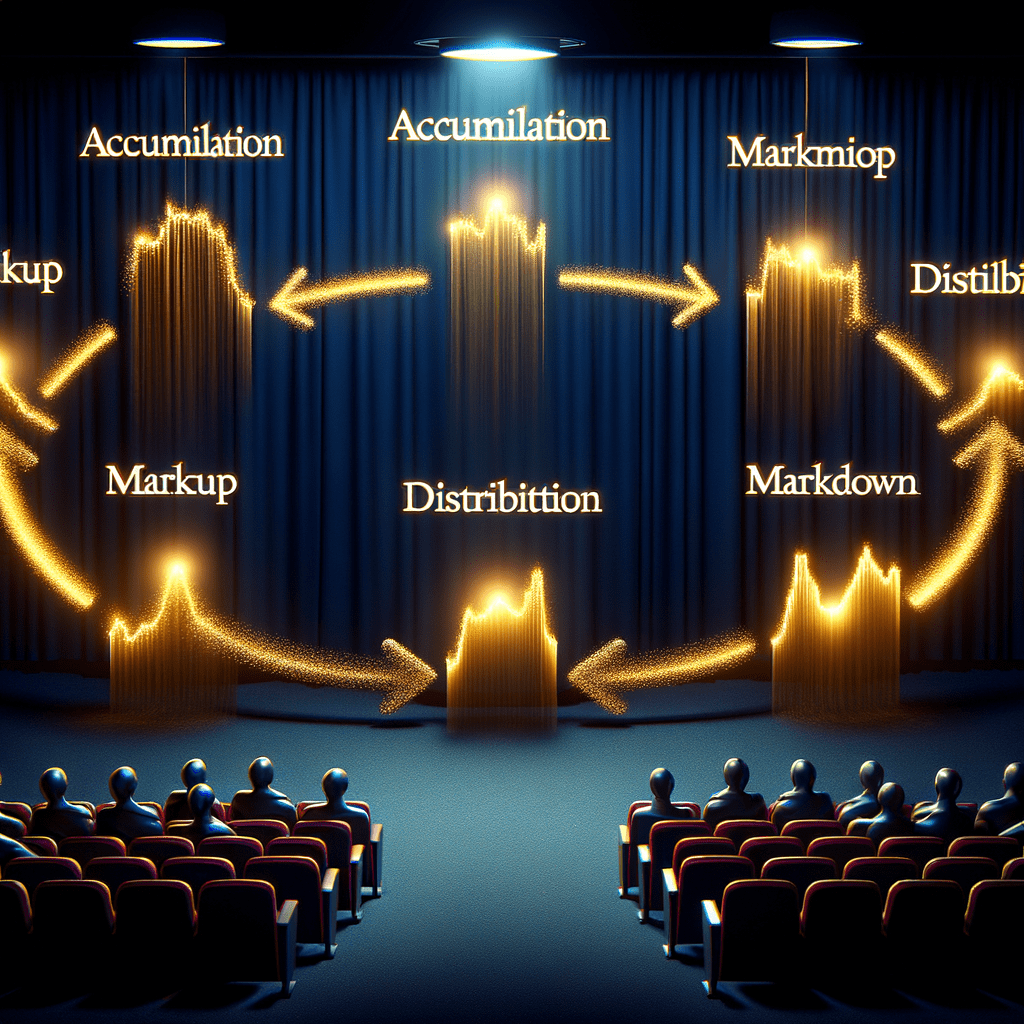
# 🔄 Understanding Market Cycles ## 🎯 The Rhythm of Markets Markets don’t move in straight lines. They cycle through phases of accumulation, markup, distribution, and decline. Understanding these patterns separates professionals from amateurs. This article reveals the framework for recognizing where we are in the cycle and what comes next. — ## 📊 The Four Market Phases Wyckoff methodology defines market structure: **Phase 1: Accumulation** – Smart money quietly builds positions – Range-bound price action – Volume dries up – Weak hands exit – Base building for next move **Phase 2: Markup** – Breakout from accumulation – Trend establishment – Increasing participation – Momentum accelerates – Public begins buying **Phase 3: Distribution** – Smart money distributes to public – Topping formation – Volume remains high – Range-bound churn – Weak hands accumulate **Phase 4: Markdown** – Breakdown from distribution – Trend reversal – Panic selling emerges – Volume spikes – Cycle prepares to repeat — ## 🔍 Identifying Accumulation The basing phase builds wealth for patient traders: **Visual Characteristics** – Trading range development – Lower highs stop forming – Higher lows develop – Volume contraction – Support tests hold **Volume Profile** – Selling exhaustion – Institutional absorption – Quiet accumulation – Shakeouts shake weak hands **Time Requirements** – Bases take time to build – Longer base = stronger move – Patience rewards participants – Early entry risks stop-outs — ## 📈 Riding the Markup Trend phase generates portfolio returns: **Early Markup** – Breakout from base – Initial volume surge – Trend followers enter – Pullbacks are shallow **Mid Markup** – Established trend – Increasing participation – Pullbacks to moving averages – Volume on rallies **Late Markup** – Parabolic acceleration – Public participation peaks – Warning signs emerge – Distribution preparation — ## ⚠️ Recognizing Distribution Tops fool most participants: **Volume Dynamics** – High volume, little progress – Selling into strength – Churning action – Institutional exit **Price Action** – Failed breakouts – Lower highs within range – Support tests weaken – Range contraction then expansion **Time Factor** – Tops take longer than bottoms – Distribution is subtle – Warning signs dismissed – Optimism remains high — ## 📉 Surviving the Markdown Bear phases destroy unprepared portfolios: **Early Markdown** – Support breakdown – Volume expansion – Trend followers flip short – Recession fears emerge **Mid Markdown** – Established downtrend – Rally attempts fail – Fear replaces greed – Capitulation approaches **Late Markdown** – Despair and panic – Volume climaxes – Capitulation selling – Accumulation begins — ## 🎯 Sector Rotation Within Cycles Different sectors lead different phases: | Cycle Phase | Leading Sectors | Lagging Sectors | |————-|—————–|—————–| | Early Accumulation | Financials, Technology | Defensives | | Markup | Growth, Cyclicals | Utilities | | Late Markup | Speculative names | Quality | | Distribution | Defensives, Staples | Growth | | Markdown | Utilities, Bonds | Cyclicals | | Capitulation | Cash, Gold | Everything | Rotation provides cycle timing clues. — ## 💡 Cycle Timing Tools Objective measures for cycle identification: **Moving Averages** – Price above rising MAs = markup – Price below falling MAs = markdown – Compression = transition **Advance-Decline Lines** – Breadth confirms phase – Divergence warns of transition – New highs/lows tracking **Volume Analysis** – Institutional footprint – Phase confirmation – Exhaustion signals **Sentiment Extremes** – Euphoria at tops – Despair at bottoms – Cycle inflection points — ## ⏱️ Cycle Duration Timeframes vary considerably: **Short-Term Cycles** – Days to weeks – Trading opportunities – Noise for investors **Intermediate Cycles** – Weeks to months – Swing trading focus – Most actionable **Long-Term Cycles** – Months to years – Investment decisions – Secular trend importance **Secular Cycles** – Multi-decade – Generational shifts – Asset allocation driver — ## 📚 Learn With Titan | 🎯 Core Concept | 🧠 Mental Model | ⚡ Action Step | |—————-|—————-|—————-| | Phases are predictable | Markets cycle consistently | Identify current phase | | Accumulation rewards patience | Bases build future gains | Buy in consolidation | | Distribution punishes greed | Tops form slowly | Sell into strength | | Markdown requires defense | Down trends persist | Preserve capital | | Cycles nest | Multiple timeframes | Align with primary trend | — ## 🔮 Key Takeaways – Markets cycle through four predictable phases – Accumulation and distribution take time – Markup and markdown move faster – Sector rotation confirms cycle position – Multiple timeframes create context Cycles don’t predict timing perfectly, but they provide essential context. Knowing whether we’re in accumulation, markup, distribution, or markdown changes every trading decision. The phase determines probability. Trade with the phase, not against it. — *Next: Understand the most powerful force in markets—central banks →*